Reading Classic RuneQuest: How To Create an Adventurer
I was distracted for a while with things like finding a new job and releasing some Call of Cthulhu adventures, but I’m now back to reading RuneQuest 2nd edition! We are finally out of the Introduction chapter (and some digressions about it), yay! Let’s enter the game proper! The next chapter is about character creation, so let’s get rolling.
Characteristics and Abbreviations
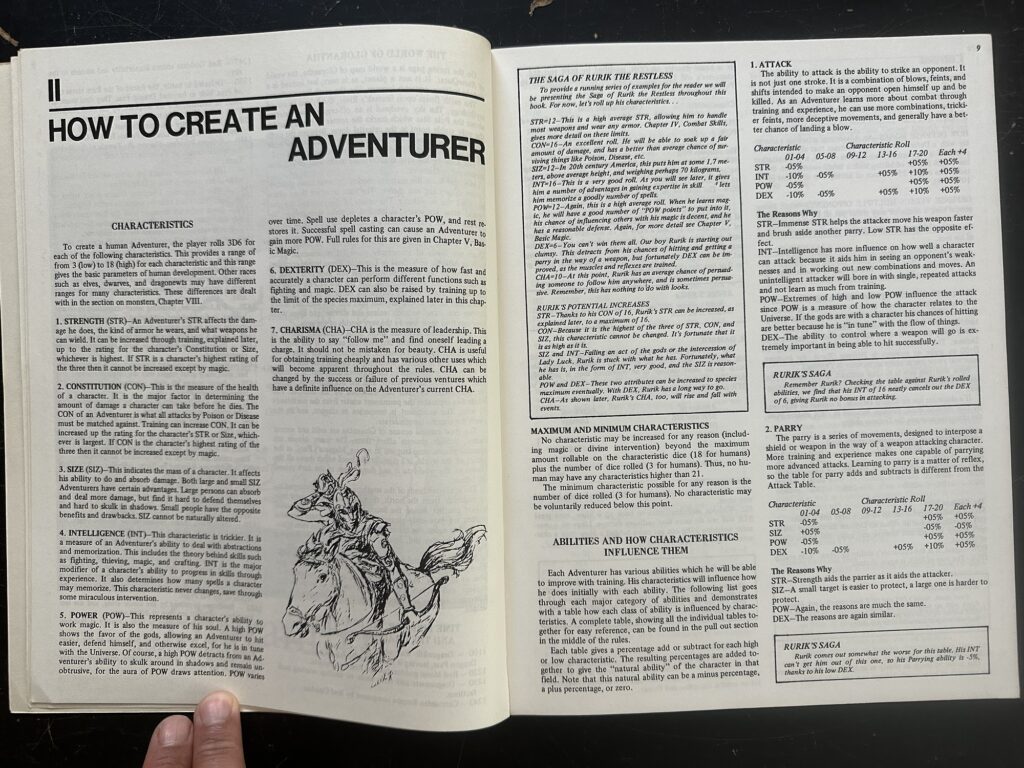
The chapter starts with the familiar list of “characteristics”, which in the case of RuneQuest and BRP are sort of following D&D’s lead. There are six basic characteristics in D&D’s 1977 Basic Set, and RuneQuest has five of them in common with it: Strength, Constitution, Intelligence, Dexterity, and Charisma. RuneQuest replaces Wisdom for Power, and adds Size, but they’re all still on a 3D6 (3-18) scale.
RuneQuest uses standard abbreviations for these characteristics, reducing them to three upper case letters: STR, CON, INT, etc. I naively thought that this came from D&D, but it turns out that it’s not the case. The “Character Record” sheet associated with the 1977 “Holmes” boxed set spells out the characteristics in full:
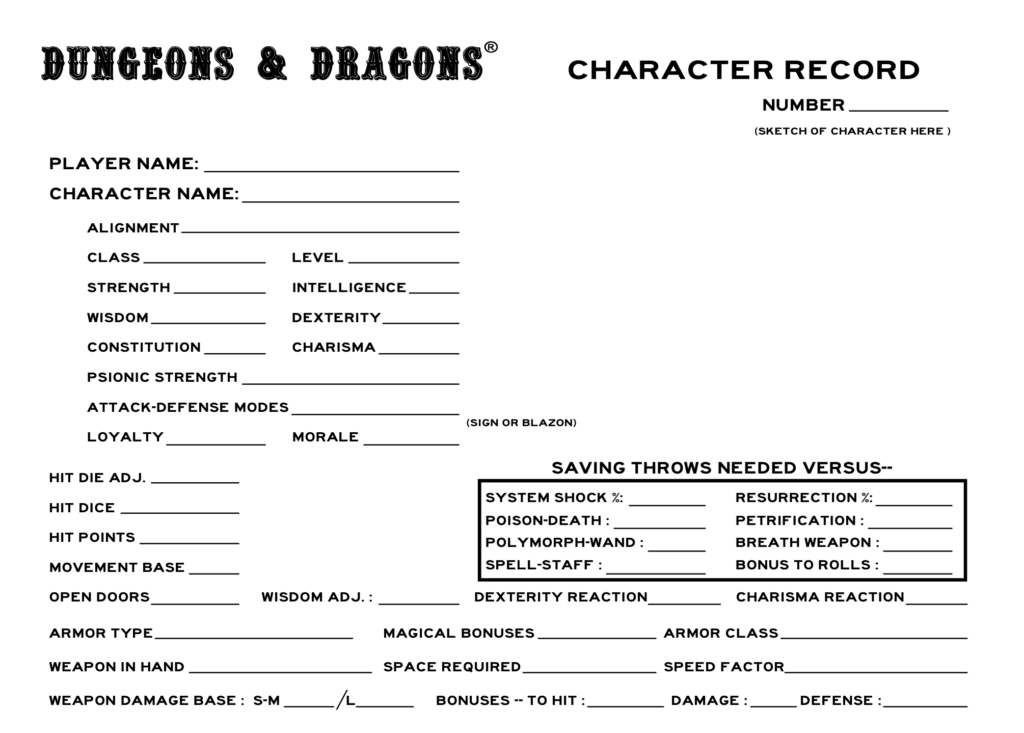
Many of D&D’s rules and character sheets over the past few decades have featured uppercase abbreviations similar to what we find in RuneQuest since 1978. It shows up in some other games, too, such as some versions of Traveller. So did it actually start with RuneQuest?
I looked at several games from the late 1970s to figure it out: Empire of the Petal Throne, Bunnies & Burrows, Metamorphosis Alpha, Traveller, Gamma World… they all used the full characteristic names, even though many used abbreviations for other attributes like Hit Points (HP), Armour Class (AC), and so on.
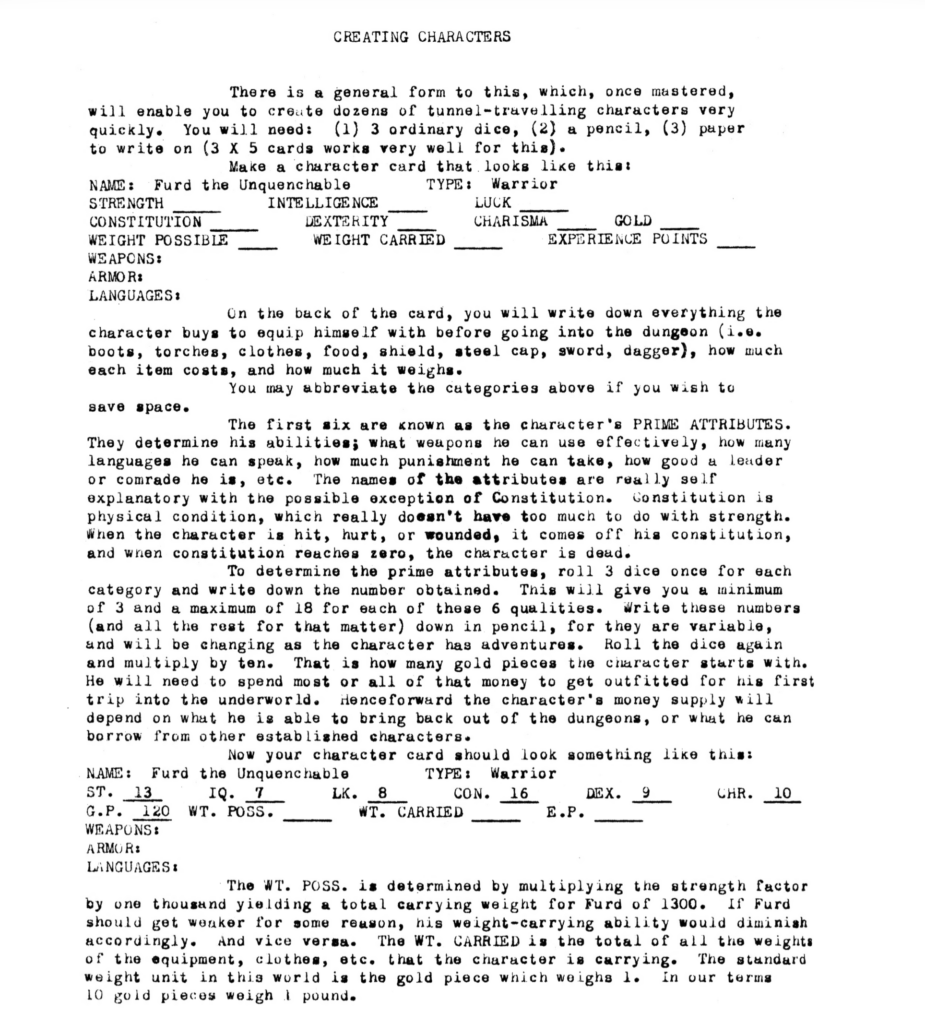
As far as I can tell, Tunnels & Trolls (1975) was the first to use abbreviated characteristics, but not in a consistent, three-letter way. The rulebook first shows a “character card” with fully spelled-out characteristics, and then mentions that you can abbreviate it all to make it faster to write. Later on that page, a second character card is shown, with “ST.” instead if strength, “IQ.” instead of intelligence, “CON” instead of constitution, and so on. So, arguably, T&T is the first game to “officially” abbreviate characteristics, but we don’t have the familiar, consistent three-letter system yet. Besides, “IQ” isn’t even an abbreviation of “Intelligence”!
It’s possible that Chivalry & Sorcery (1977) is the one who “pioneered” this now sort-of-de-facto convention, just a year before RuneQuest. But I’m not 100% sure because I’m going from the unofficial “Red Book” re-edition of the original C&S. In the character creation chapter, we find standard abbreviations next to each characteristic (although charisma is CHR and not CHA).
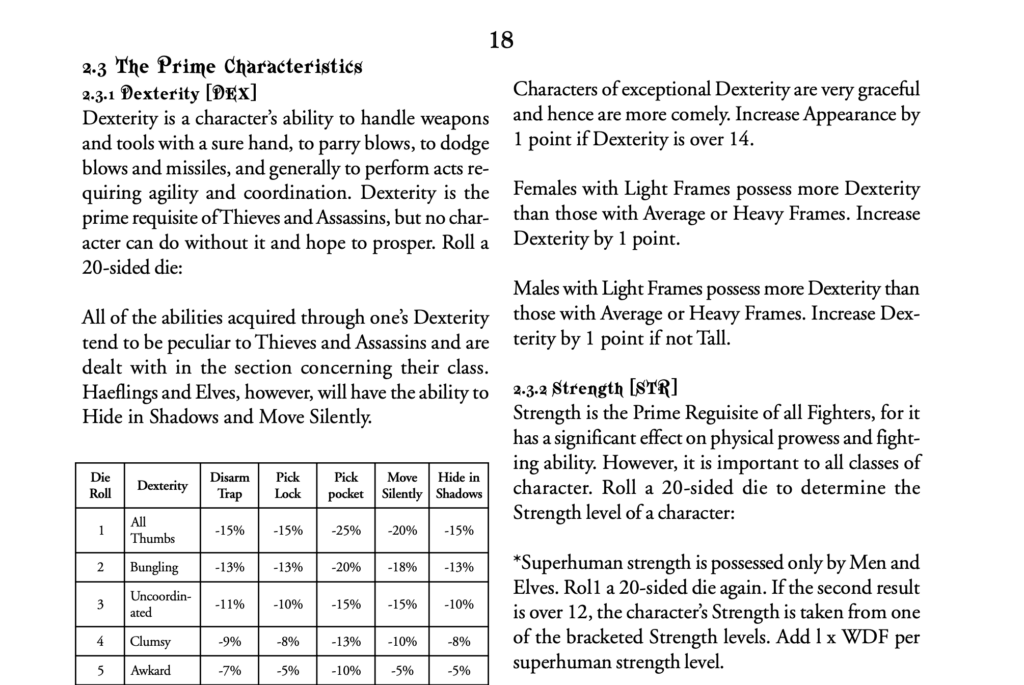
While the Red Book isn’t supposed to change much of the content compared to the original 1977 book, it does advertise a few “minor additions” (and of course a bigger font size, since the original C&S had infamously small print!) So could these abbreviations have been added later? I have a scan of the second edition of C&S and it does not feature these abbreviations, except for STR, specifically, which shows up in a couple examples… which, by the way, is weird since you have to guess what this refers to. Either way, the absence of standard abbreviations from the second edition makes me lean towards the idea that the first edition didn’t have them either, and that the Red Book added them.
So until someone can check a proper, original first edition book of C&S, I’m going to tentatively and gloriously announce that RuneQuest was the first game to use standardized three-letter upper case abbreviations for characteristics. Is this an incredibly niche and inconsequential detail to even think about? It sure is! Am I now obsessed with figuring out who did it first? You can bet your ass I am! Do you have an original C&S rulebook? Please do me a favour and go check, please! And of course, if you know of another game who did it before 1978, please correct me, that’s what the Internet is for, after all.
Those Fiddly Modifiers
Next, we compute some ability modifiers and attributes from the main characteristics. The ability modifiers are: Attack modifier, Parry modifier, Defense modifier, Perception modifier, Stealth modifier, Manipulation modifier, and Knowledge modifier. The attributes are: Hit Points and Damage Bonus.
The ability modifiers are better known nowadays as “skill category modifiers”, since they are bonuses or penalties to all the skills under the associated category. These modifiers are as fiddly in the latest RuneQuest Glorantha (RQG) edition as they were in the 2nd edition: you get +/-05% here and there for having a high or low score in some characteristics related to the skill group. For instance, high DEX gives a bonus to stealth skills, but high SIZ gives a penalty, because you’re bigger and therefore harder to hide. This is the kind of tables that crunch-lovers and bean-counters will enjoy, but I personally find this overly complicated and stupid… although not as stupid as RQG keeping this stuff around almost 40 years later. Oh well.
Interestingly, these couple pages of modifier tables also spend the time to explain to you why these bonuses exist. For instance, about STR, INT, POW, and DEX all giving bonuses to attack, it says:
STR: Immense STR helps the attacker move his weapon faster and brush aside another parry. Low STR has the opposite
effect.
INT: Intelligence has more influence on how well a character can attack because it aids him in seeing an opponent’s weaknesses and in working out new combinations and moves. An unintelligent attacker will bore in with single, repeated attacks and not learn as much from training.
POW: Extremes of high and low POW influence the attack since POW is a measure of how the character relates to the Universe. If the gods are with a character his chances of hitting are better because he is “in tune” with the flow of things.
DEX: The ability to control where a weapon will go is extremely important in being able to hit successfully.
This sort of behind-the-scenes explanation about why a mechanic works the way it does isn’t very common in TTRPGs, and isn’t even really encountered again in the rest of the RuneQuest rulebook. But it’s notable! I wonder if we can draw a line between this and, say, the sidebars in 13th Age: Glorantha where Jonathan and Rob also give some behind-the-scenes explanations about their choices.
The Combat Modifiers
As mentioned before, today’s RQG kept the skill category modifiers pretty much verbatim. But what happened to the Attack, Parry, and Defense modifiers?
Well, it turns out that the Attack modifier table is exactly the same as the Manipulation modifier table, so if you consider weapon skills to be manipulation skills, you can remove one table. That’s what RuneQuest 3rd edition did, and RQG, which is basically 60% 2nd edition and 30% 3rd edition, also went with that. Yay, one less table!
The Parry modifier table is different, and RuneQuest 3rd edition introduced the “Agility” skill category for it. But while RQG kept that skill category, it wisely dropped the idea of the parry score being different from the attack score. Yay again! As far as I can tell, in RuneQuest 2nd edition, you had to write your weapon skills without the category modifier, and then had to add one of three modifiers based on the situation every time you rolled. This is just crazy-pants bullshit if you ask me, but I guess 80’s kids had more time to waste by not having smartphones… Edit: Brian Duguid tells me that RQ2 also had separate attack and parry skills, so I’m wrong here! I should have read ahead… or taken a closer look at the character sheet in this chapter, which does indeed let you write you attack, special, critical, and parry scores!
The Defense modifier is more interesting. It basically acted as a sort of “passive dodge”. The text in this chapter tells us that you subtract the Defense modifier from the attacker’s attack ability. If they have 40% to hit, and you have a Defense modifier of 10%, then they must roll under 30%.
In the Stafford House Campaign book, which collects articles by Greg Stafford from various gaming fanzines between 1978 and 1981, there is a mention of this. The Wild Hunt #38 has Greg replying to someone referred to as John, who apparently wrote something about weapons and combat abilities (we only get Greg’s answers, sadly, and not the articles he responds to). Greg refers to it as the “Great RQ Weapons Debate”, which I’d love to know more about, but anyway, Greg follows by saying:
I do, however, like your Defense Factor concept. I almost go crazy anyway trying to run a half dozen monsters and having to subtract the Defense from the attacks. And how many times have I heard both “Did you subtract my 15% Defense?” and “Did my Defense Bonus help?” Making it a separate roll is an excellent solution and I plan to adopt it immediately.
Players are especially likely to ask about their Defense modifier because the rulebook explains that you get a chance to gain experience in it when the gamemaster fails to hit you just because of it. That is, if the previously mentioned unnamed attacker with an effective 30% score to hit was to roll, say, a 37, that would be a success for their unmodified attack skill of 40%, but they only missed because of your 10% Defense modifier. When that happens, you roll a D100 under you INT to gain +05% in your Defense modifier… the text even says:
Note that this rule is in total contrast to the usual experience increasing rules shown in Chapter IV. It is the only exception.
Whyyyy, Steve? Whyyyy, Greg? If you have just one rule that is an exception to an already perfectly working rule that applies to the rest of the game, maybe you…. rework your stuff so that there’s no exception anymore? Ugggh. I guess Greg regretted this pretty quickly, since I think his reply in The Wild Hunt was written in 1979.
I assume that what John proposed, and that Greg said he would adopt, is to roll the Defense modifier as a separate roll. That is: the attacker simply rolls under 40%, and you roll under 10%. That is of course also kinda stupid, since you might also parry the attack and then you end up rolling twice to defend… but I suppose this is how the Dodge skill was born, introducing the choice between parrying and dodging. The Dodge skill actually didn’t exist in RuneQuest 2nd edition, but it it did appear in 3rd edition, while the Defense modifier disappeared. Once again, RQG went with the 3rd edition on this.
Increasing Characteristics
The rules for increasing characteristics in RuneQuest are weirdly complicated and possibly problematic. A lot of these issues carried over all the way to the latest edition, by the way.
You can only increase STR, CON, and DEX, and then only up to the highest of other two, which is fine, I guess. But somehow you can’t increase SIZ, which to me should not only be possible (both gladiators and sumo wrestlers, for instance, purposefully did it) but it could (or should?) also be tied to increases to STR and CON, in my opinion.
The worst, however, is that you can’t increase INT or CHA. This feels like some sort of dated gene-centric view on intelligence and attractiveness. The reality, to me, is that both INT and CHA represent concepts that are provably trainable. INT includes memory and general knowledge, while CHA includes physical grace, body language, and voice control, for instance. Thinking that you’re either born intelligent and charismatic, or you’re not, is…. ewww. I’ll let you figure out the racist tropes hiding in there, too, by the way.
Now, before you plan on correcting me about CHA, yes there are a few paragraphs about increasing it, but it’s annoyingly fiddly stuff: increases in Oratory skill can give up to 4 points of CHA, for instance. Okay, sure, but then why don’t increases in, say, Climb or Jump not also benefit STR or DEX? Other factors may play a role with CHA, such as “leading an expedition”, but you then roll under your CHA with a percentile die to gain a point, while STR/CON/DEX just automatically get a point if you spend the time and money for training. Why? When you also consider that POW increases are completely different and described in the chapter on magic, you realize there are so many different mechanism for increasing attributes, it’s quite a mess. And still, RuneQuest was hailed as an eminently logical and consistent system… I shudder at the idea of reading D&D’s 1977 rules…
Subsequent versions of RuneQuest tried to prevent characters with too-small INT or SIZ by making you roll 2D6+6 for them, since you’re pretty much stuck with that score forever. But RuneQuest 2nd edition doesn’t have that: you roll 3D6 for all characteristics, no exceptions! I can barely imagine how fun/annoying it is to have someone roleplay an INT 4 character in the group… Edit: Brian Duguid once again mentions that “alternative methods” of character creation are found in the appendices. This includes using 2D6+6 for some stats! I’ll get there when I get there! 😄
This section has a different thing of note: the beginning of some Gloranthan world-building through rules text. For instance, we learn that criminal and theatrical guilds exist in Glorantha, because those are the ones that provide DEX training. Guilds tend to have a somewhat “medieval” feel to them, but they actually did exist in some form in Ancient Rome so I guess it’s OK.
The Character Sheet
The last section in the chapter, “Money and Equipment”, is pretty unremarkable except for the fact that you roll your character’s background, and that can really change how much money and equipment you get! But anyway, let’s look at the character sheet:
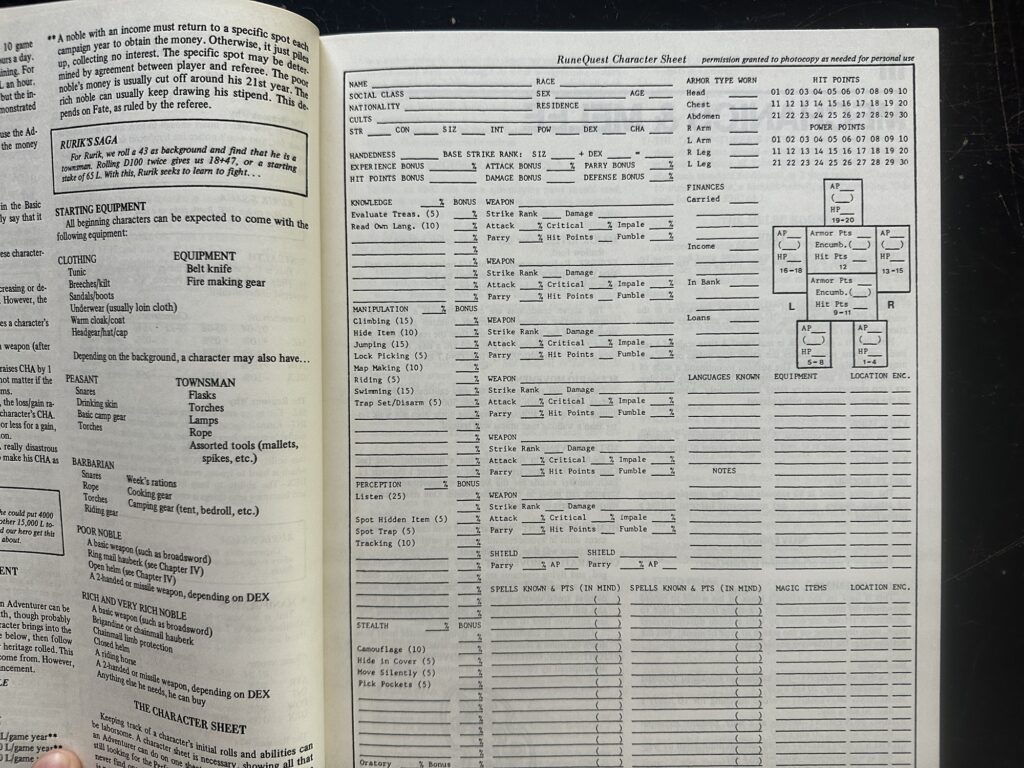
This was probably the most complicated character sheet of the time? Except maybe for Chivalry & Sorcery, which was probably about as complicated?
There is a second character sheet included in the back of the book. It’s organized and formatted differently, for non-humanoid characters who therefore have a free-form list of hit-locations, as opposed to a little graphical “paperdoll” in the top-right corner:
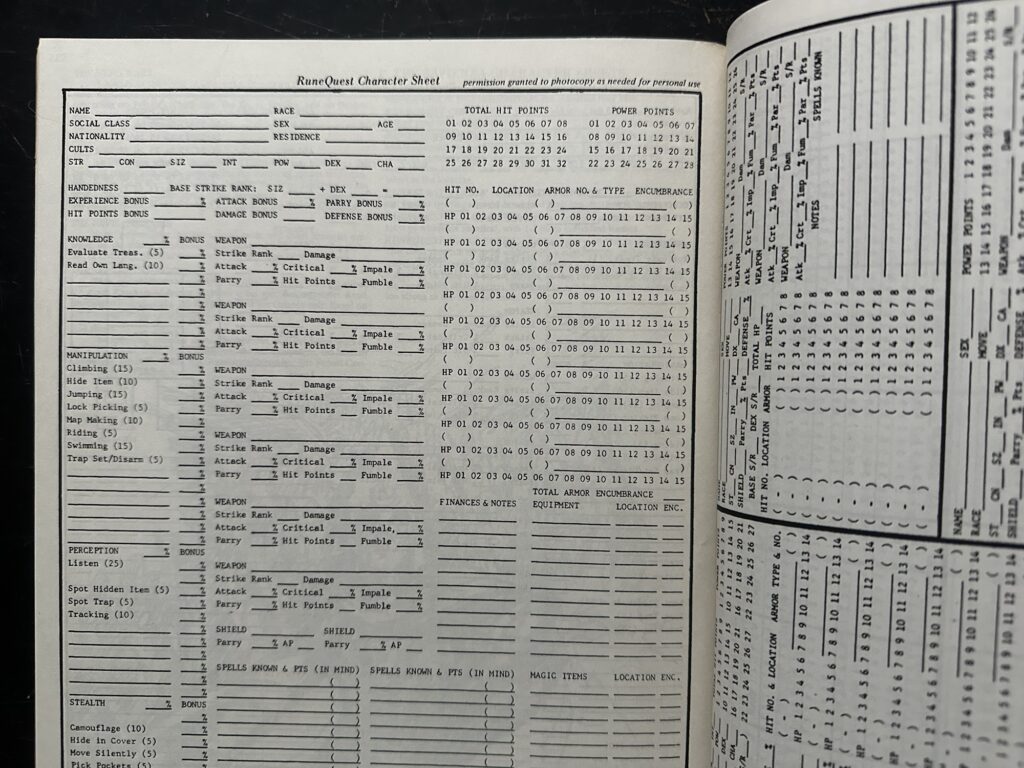
The text gets very apologetic:
The authors are still looking for the Perfect Character Sheet, and will probably never find one. The sample sheet shown on pages 13 and 113 is not perfect, but it is good for a beginning character.
It’s interesting to see that (1) people were apparently never happy with character sheets at that time, and (2) while checking other late-1970s games, I realized that many did not come with a character sheet! I guess people just wrote their character’s stats on a blank piece of paper? The past really is a foreign country, as they say…
Rurik’s Saga
The last notable bit in this overall chapter is, of course, the beginning of “Rurik’s Saga”. Rurik the Restless is an “example” character featured in text boxes throughout the text. In this case, we are told what Rurik’s player rolled for his characteristics, background, money, and so on. Later in the book, Rurik is used for examples of combat rounds, magic, and more.
This is of course brilliant because not only does this give us an example of character creation and gameplay to follow, it also lets the authors write little vignettes of what adventuring in Glorantha looks like. This tradition of “So-and-so’s Saga” has been preserved across all editions of RuneQuest. It even carried over to other BRP games. For example, Call of Cthulhu also features an example character inside text boxes… although unlike RuneQuest, that character, Harvey Walters, has been the same from the first edition to the latest!
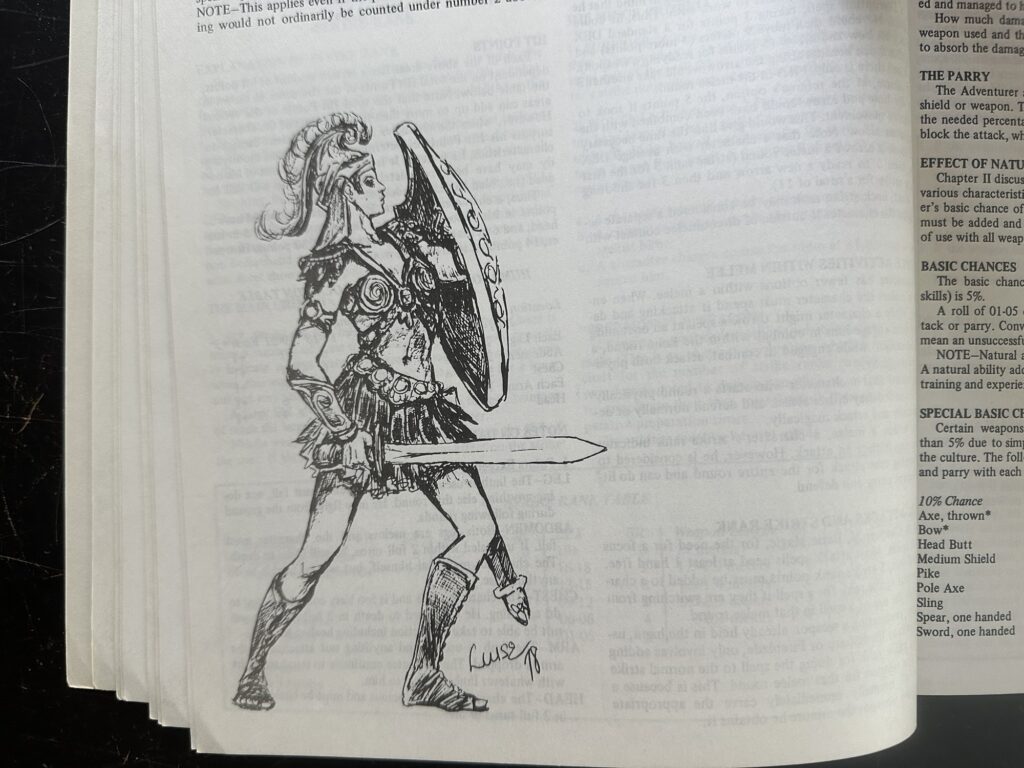
That said, I have to confess that I think the authors messed up with Rurik. When you look at the first dozen pages of the rulebook, you see various drawings from Luise Perrin who feature the same female warrior as on the cover… so in my opinion, they should have used her as the example character!
And that’s pretty much what RQG did. The example character, Vasana, features on the cover and in many illustrations inside the rulebook, and even in several other supplements. I’ve got my problems with RQG, but the art is definitely not one of them!
Glawyn, RuneQuest Edition
Remember Glawyn, my character from the BRP booklet? Let’s roll him again but this time with the RuneQuest rules!
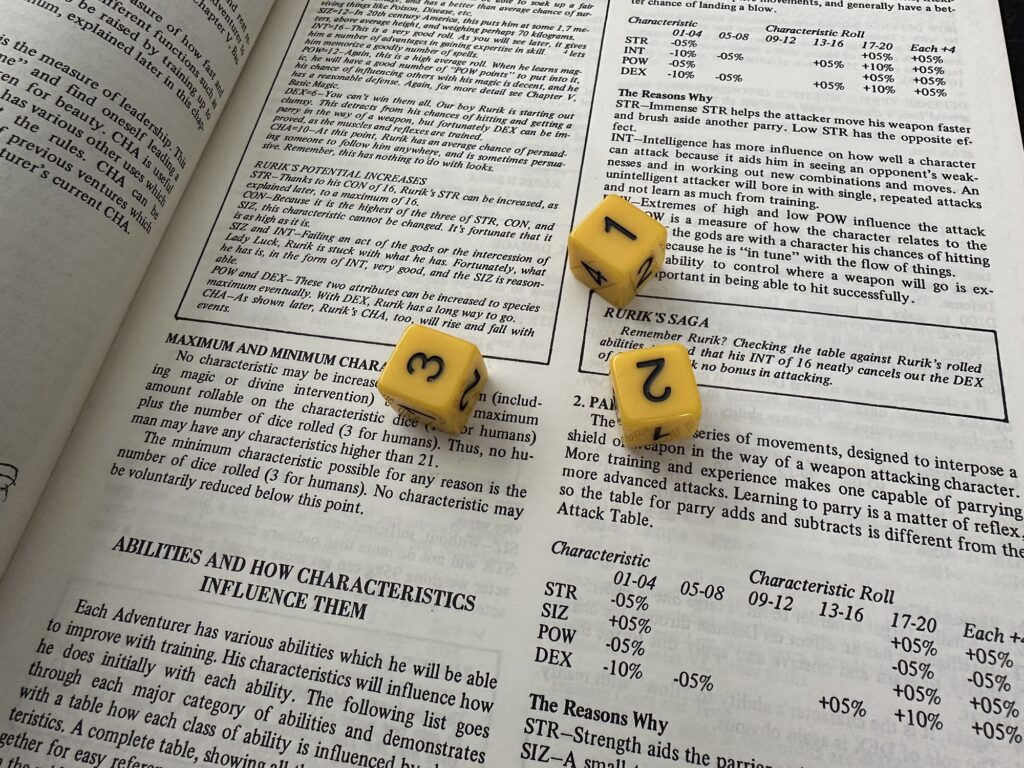
For Glawyn’s characteristics, I of course rolled 3D6 seven times in a row, in order. No cheating, no switching scores, no nothing. I got STR 9, CON 12, SIZ 6 (below what you could ever get in later editions!), INT 14, POW 9, DEX 8 (ouch), and CHA 10. Glawyn isn’t looking so great…
Parry modifier is –5%, Perception modifier is +5%, Stealth modifier is +5%, and Knowledge modifier is +5%. Glawyn’s got 11 Hit Points and he barely gets 0 damage bonus (one point less and he had a negative one!)
Funnily enough for his size, Glawyn is a Barbarian, with 81 L in loot on him! How did he get his hands on that? I guess we’ll figure this out once we have fleshed out his character sheet!

Once again, I ended up writing three times as much stuff as I originally thought… let’s see how long I can keep ranting. Is any of this interesting to anybody but me? Oh well, I’m having fun. Next time we even get into the game mechanics! I might have to split that into two articles…
Happy gaming!