Reading Classic RuneQuest: The First Glorantha Map
In the last article of the “Reading Classic RuneQuest” series, I looked at the Introduction chapter of the RuneQuest 2nd edition rulebook and noted that I would have things to say about the map of Glorantha we see here… as many of you know, I love maps, and this is one of the three classic and famous maps in this book! It deserves its own article!
The Best Introductory Map to Glorantha
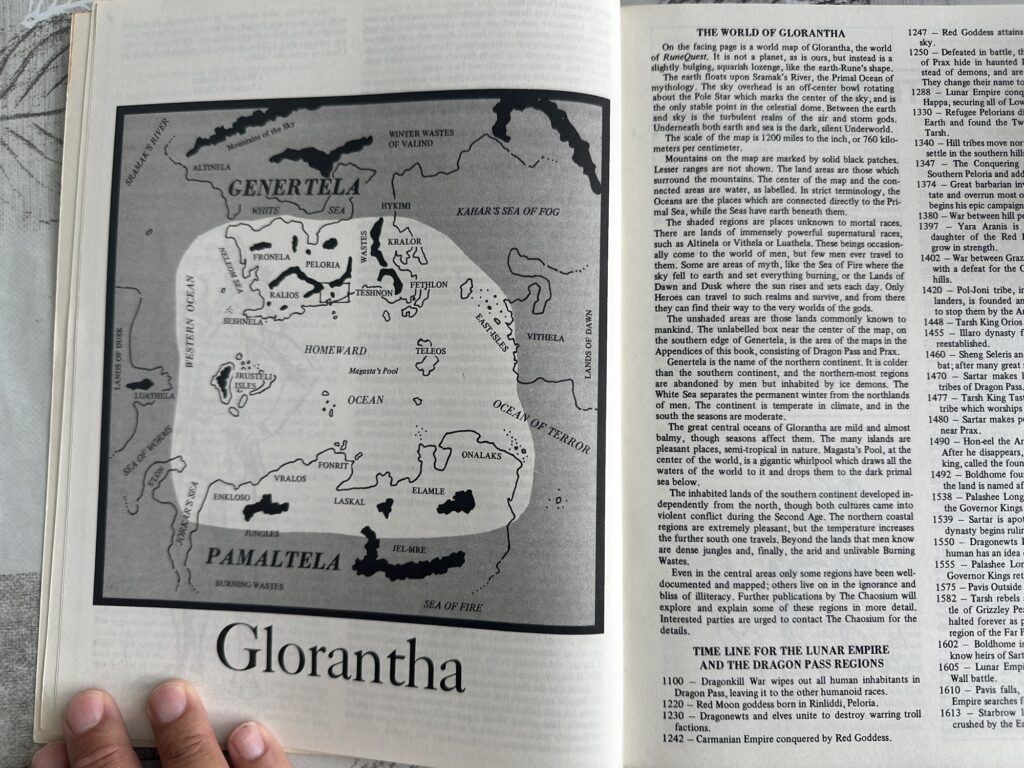
Okay so here I’m going to argue that this is the best introductory map to Glorantha that was ever produced.
Here is what makes this map work:
- There is a main region for play (Dragon Pass and Prax), and it is identified with the little square found in the bottom middle part of the north continent. It not very well identified but it is identified. We get maps for that specific area later in the book, but this helps us understand how our game’s location relates to the rest of the fantasy world.
- The various other main regions of Glorantha are clearly labelled. If we want to move our game elsewhere, we have a name and a vague geographical location to start with. In some cases, like Peloria, we can even find some area map in Wyrms Footnotes, Chaosium’s first magazine.
- There’s a shaded area around the world that indicates how things get “weird” near the edges. We’re told this is where supernatural beings and gods live, and that a primal river surrounds the whole thing. Basically, the edge of our game world is a “soft” edge, rather that just, well, the edge of the drawing.
- There’s a scale. This is from the 1970s so it’s not drawn on the map, and instead is given to us in text: “1200 miles to the inch, or 760 kilometers per centimeter.” Not ideal, but hey, you’d think having a scale is a low bar for cartography, and I assure you it is not. By the way, if my math and measurement are correct, this makes Genertela about 5,500 kilometres wide. keep this in mind.
How is that “best introductory map” material, you ask? Well, let’s compare!
The Other Maps
Let’s look at the other introductory maps across all Gloranthan product lines. And by “introductory”, I mean the maps that a newcomer to the setting would have encountered in each game’s main book. This means that supplements are not included in this list, even though you’ll see quickly that I go on a few tangents…
Let’s go in chronological order, which means we have to go back in time a bit!
RuneQuest 1st Edition
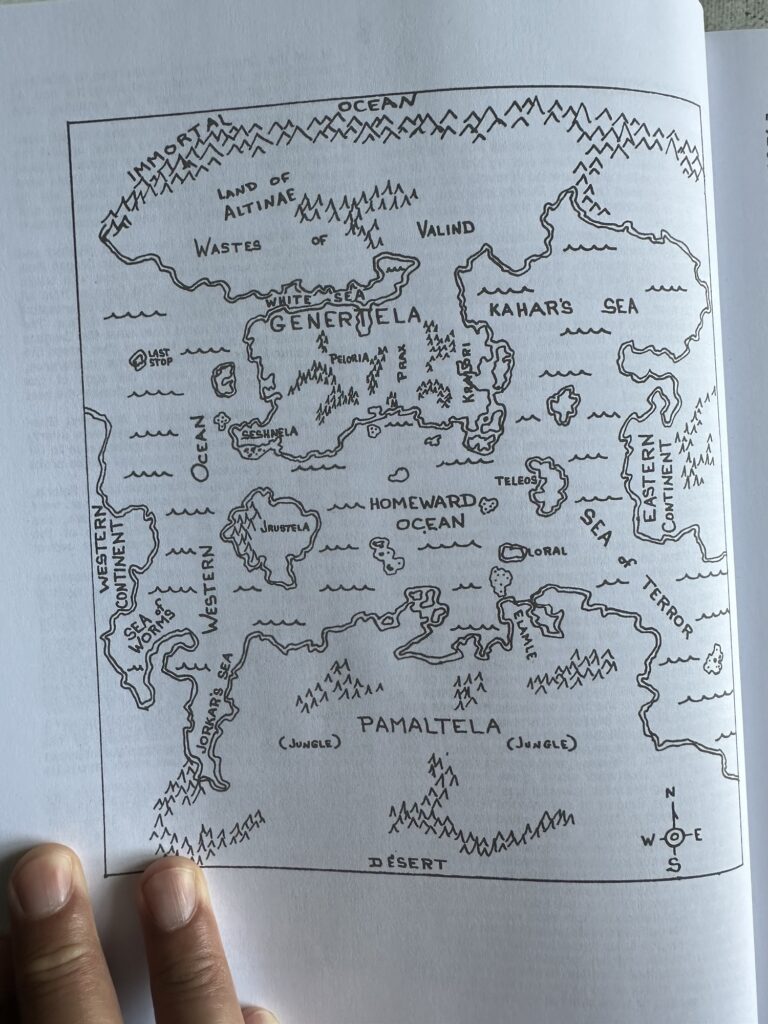
The map in the first edition of RuneQuest (1978) is identical to the one found in the 4th issue of Wyrms Footnotes, Chaosium’s official magazine, published a few months prior. As maps go for the time it’s OK, I guess? It has a sort of “hand-drawn in my GM notebook” charm, but it misses points 1 and 3 from my list. Interestingly, it labels Prax but not Dragon Pass.
It is worth noting that changes already occurred in the two years between the 1st and 2nd edition of RuneQuest. The “Last Stop” island was removed1 or at least un-labelled, along with the cool-sounding “Immortal Ocean”. The blandly named “western” and “eastern” continents were turned into the much more evocative “Lands of Dusk” and “Lands of Dawn”. The connections between these “border” continents get fuzzier. And several new labels appeared to flesh out the world, from Fronela and Ralios to Teshnon2, the East-Isles, or Fonrit, among many others.
RuneQuest 3rd Edition
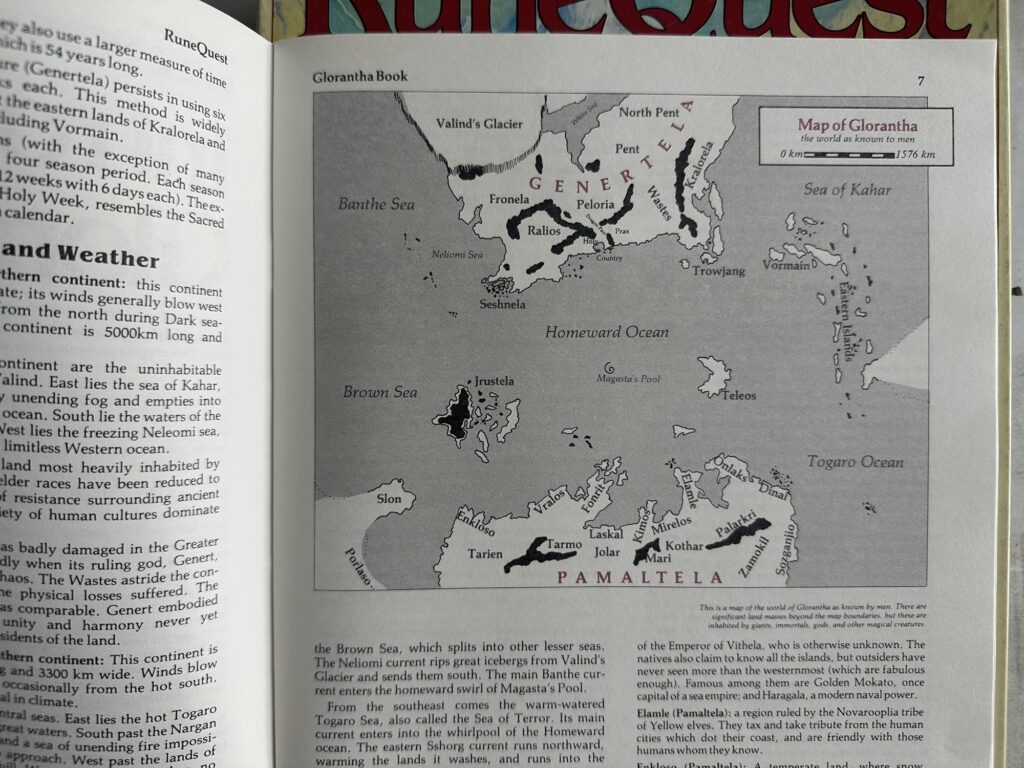
The next game after RuneQuest 2nd edition is of course RuneQuest 3rd edition, released in 1984.
The map is better drawn, with finer landmass detail, and there’s an actual scale insert, even though its scale is ridiculous… 1576 kilometres? WTF? Also, again if my math and measurements are correct, Genertela shrunk a bit and is now about 4,700 kilometres wide.
But we have lost point 1 on the list: there is no indication that “here is where you play”. This is because, well, for one, RQ3 infamously told you to go play in Fantasy Earth anyway. The map in the above picture is from the “Glorantha Book”, an optional 30-pages booklet included in the Deluxe RuneQuest boxed set. The actual default setting for RQ3 is shown on the map below, from the “Players Book”:
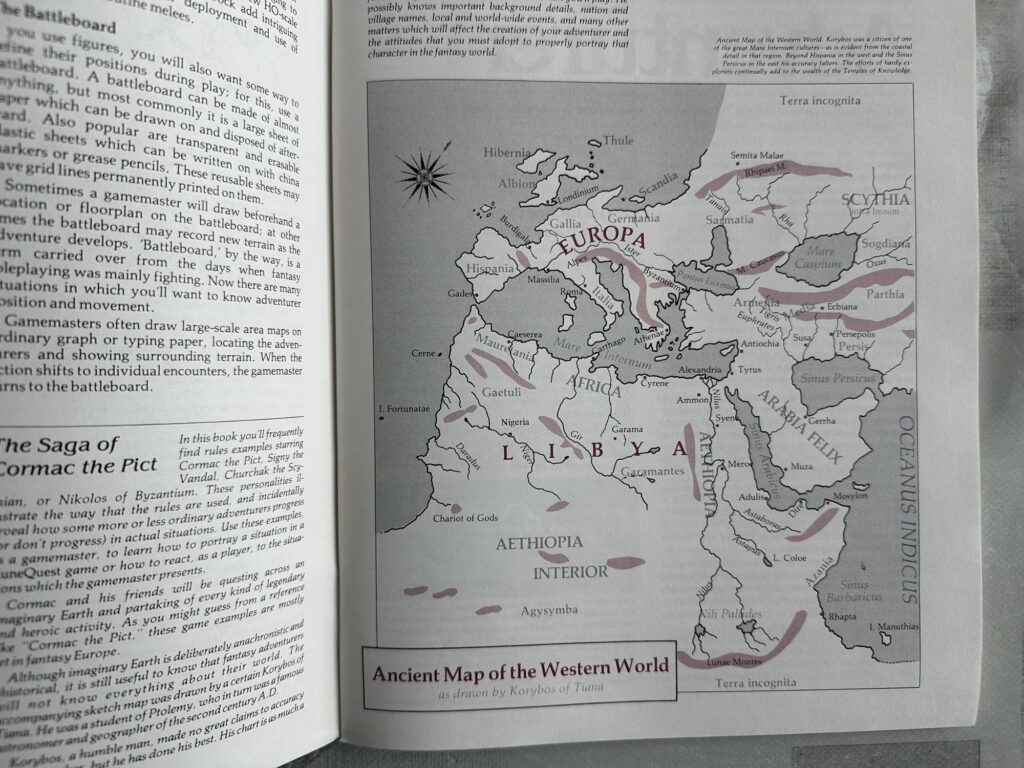
This is a semi-historical map of the Ancient Western World, featuring all the lands around the Mediterranean. As far as I can tell, the game doesn’t make up its mind about where, exactly, you were supposed to play. You had to pick yourself, from Scythian nomads to Egyptian priests, Celtic tribal warriors, or Roman soldiers. Almost no setting material is provided for this Fantasy Earth, though… at this point, I wonder why they didn’t just publish RQ3 as a generic game system3.
And so the Glorantha Book is just as wishy-washy about where you should play. The map and the text take a very high-level view of Glorantha, telling you to play anywhere you want, just as the Players Book tells you to play anywhere you want in the Ancient World. Which is to say it barely tells you anything at all.
I suppose this may be a selling point for the OSR or indie-zine gamer types who only want an elevator pitch and a handful of bullet points at most to get started. But what’s cool about RQ2 is that it zoomed into two specific sandboxes, Dragon Pass and Prax, and gave you material specific to these places: detailed maps, encounter tables, monsters, treasures, etc. So the elevator pitch and the bullet points, so to speak, were more focused, and more practically useful in my opinion.
And yeah, it all starts with how the overview map of Glorantha is presented. No, I’m not overthinking this, shut up.
What I find most disappointing about RQ3’s map of Glorantha is the removal of the “soft edges” indicating “weird mythical shit starts here”. In fact, the map is effectively truncated. It’s telling us that we shouldn’t go to the cool weird places where fantastical and mythical things happen. The text that accompanies this map doesn’t even really talk about it. Boooh.
While we’re here, let’s finally note some further modifications to the map. Many island formations gain in detail, and the northern White Sea is now closed off by Valind’s Glacier. Someone changed their mind about the Sea of Kahar, which was foggy in RQ2 only, but not anymore.
King of Sartar
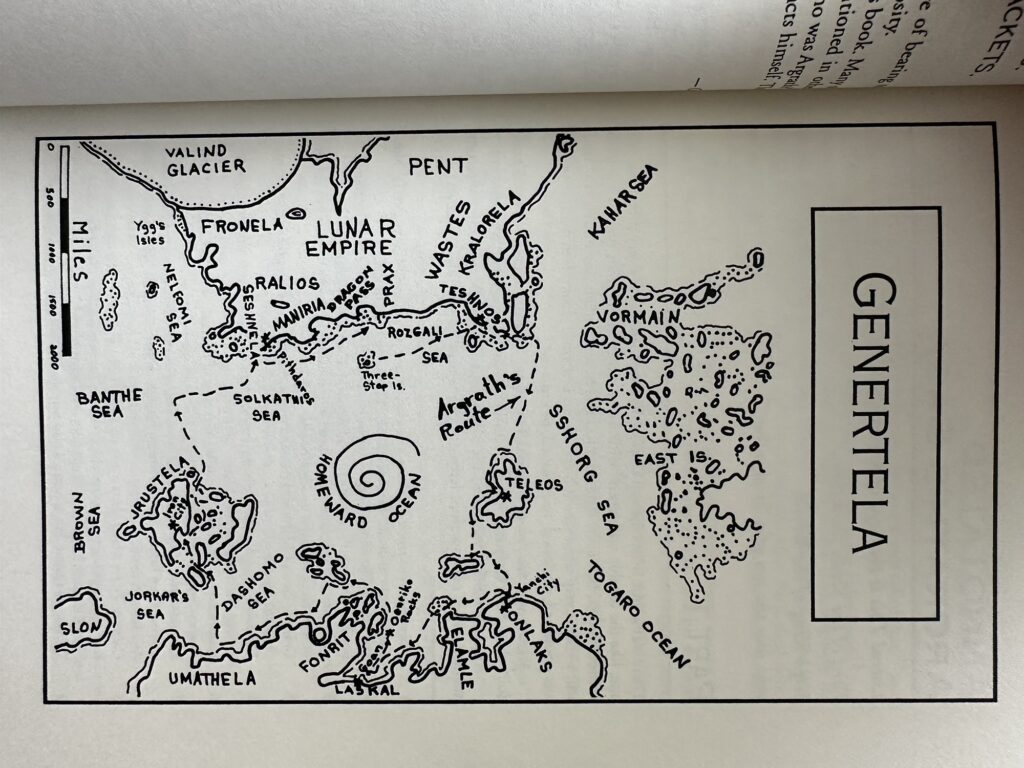
Okay so this is far from an “introductory map”, but since I’m going in chronological order, I might as well make a quick stop here. “King of Sartar” is of course the super niche and obscure book of Gloranthan lore that Greg Stafford, that mad genius, wrote pretty much entirely “in-world”. It reads like a collection of “real” Gloranthan archaeological sources, which means they are in turn incomplete, contradictory, and tedious to read. Lists of kings, accounts of battles, genealogies, fragments of mythology, and more. It’s like history homework, but for fun! The kind of book that makes Glorantha unique, but also makes some people go a bit crazy.
Anyway, the map in “King of Sartar” mostly picks up from RQ3 when it comes to presenting Glorantha to the reader. The scale is the same, albeit converted from kilometres into miles and using some sane, round numbers. All the latest changes are here, and all the stuff from my beloved “shaded areas” remains gone. The label for the geo-cultural region of Peloria is now replaced by the geo-political label of “Lunar Empire”, which raises many questions about what all the other labels relate to.
It’s worth noting that this map isn’t meant to show Glorantha per se as much as plotting Argrath’s route around the world.
Hero Wars
The next proper game book that could introduce Glorantha to someone was Hero Wars. This was the game that Greg Stafford asked Robin Laws to design to overcome the problems with trying to play heroic and mythical stories in RuneQuest. A vastly innovative system that was a bit ahead of its time, it was also, as I understand it, a very rough and messy first draft.
Well, if you could believe this: there is no map in the Hero Wars rulebook. None. Zero. Nada. An absolute travesty!
The Narrator’s Book, meant for the gamemaster and bundled in the “Deluxe Edition” of Hero Wars, does include a map somewhere in the middle (after a few chapters on GMing Hero Wars), but it’s almost as much of a travesty.
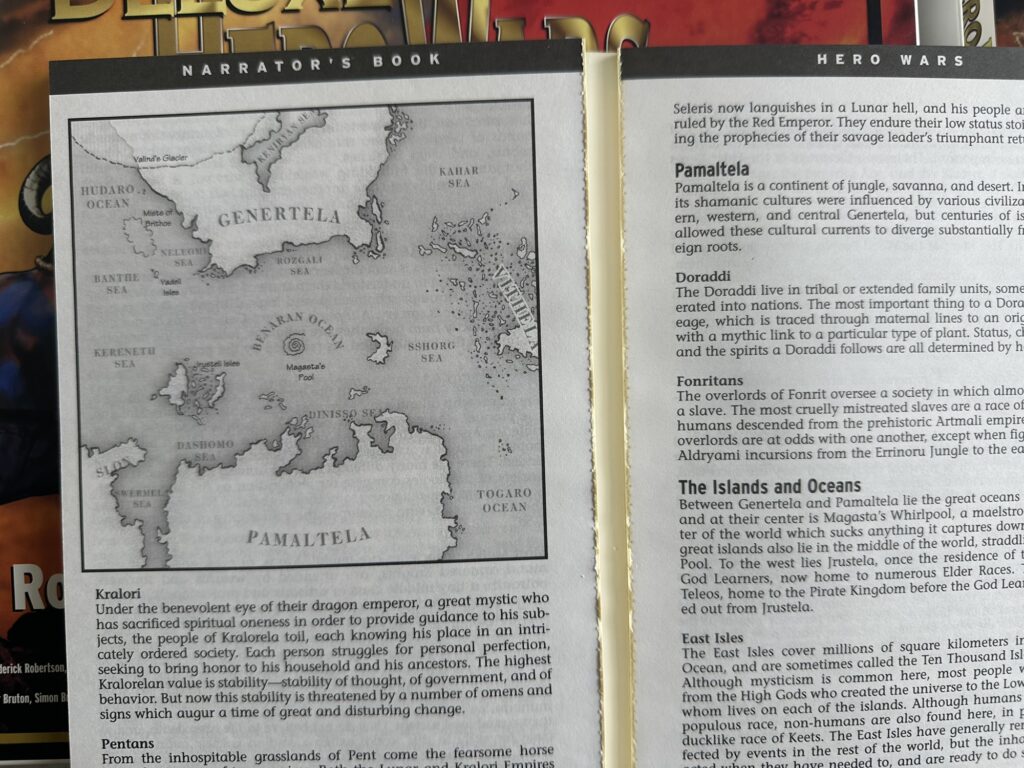
First, while trying to take a good picture of that map, I broke the binding! Ugggh. You can tell from the photo above. Please join me in a silent moment of mourning. And given how shitty this binding is, I’m certainly far from being the only one who did that. After taking the picture, I re-glued the spine and shoved the book back in the box. I’m probably not going to open it for another few years anyway.
Second, I broke my book for a shitty map. What is this? It labels only the continents and the oceans! It has no recommended starting location! It has no scale! It’s almost entirely useless! Ugggh.
HeroQuest
The next game is the renamed and revamped version of Hero Wars called HeroQuest, thanks to an elapsed trademark from Milton Bradley and their once-very-popular board game of that name. This created a wonderfully fertile ground for decades of confusion and misunderstanding4 in Glorantha-related discussions and online searches…
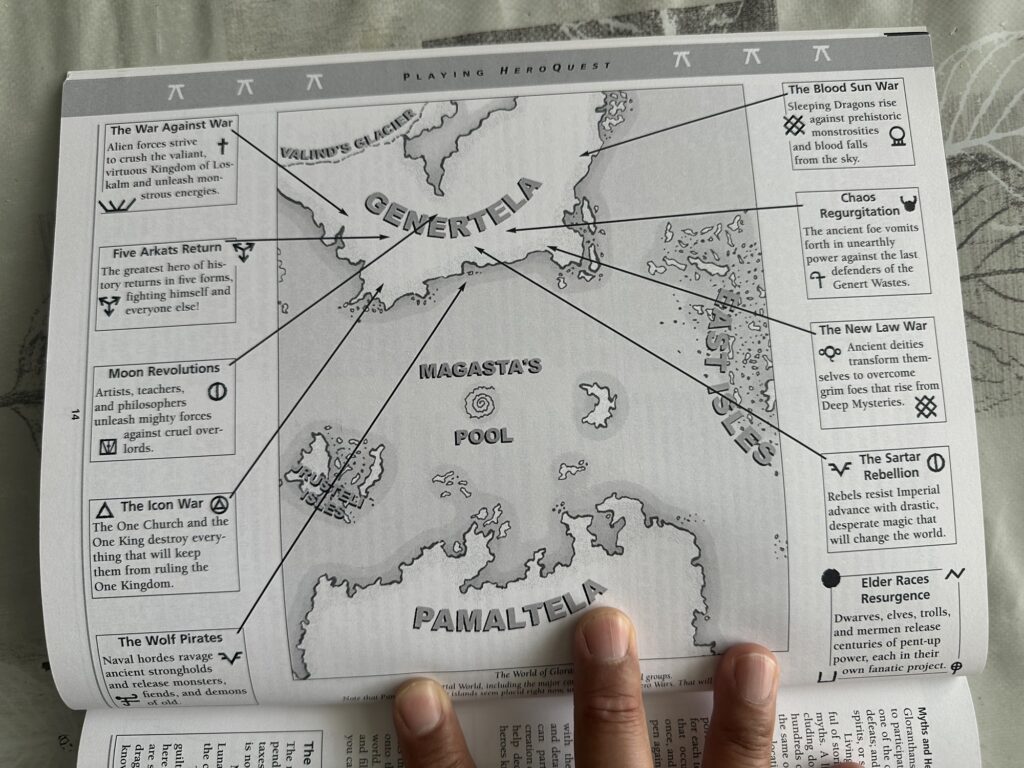
Yay, the map in HeroQuest is also quite useless! For the same reasons as the HeroWars map!
However it does have some intriguing stuff all around it. It’s got arrows pointing (rather ironically) to various blank spots over Genertela, with strange descriptions like “Five Arkats Return”, “The Blood Sun War”, “The Sartar Rebellion”, etc. These all point to things happening in Glorantha right now, or things that will possibly happen soon, and each one is sort of tied to a Rune. It’s an interesting way to present the setting, and I’d love to see this idea implemented better in other games!5
The Guide to Glorantha
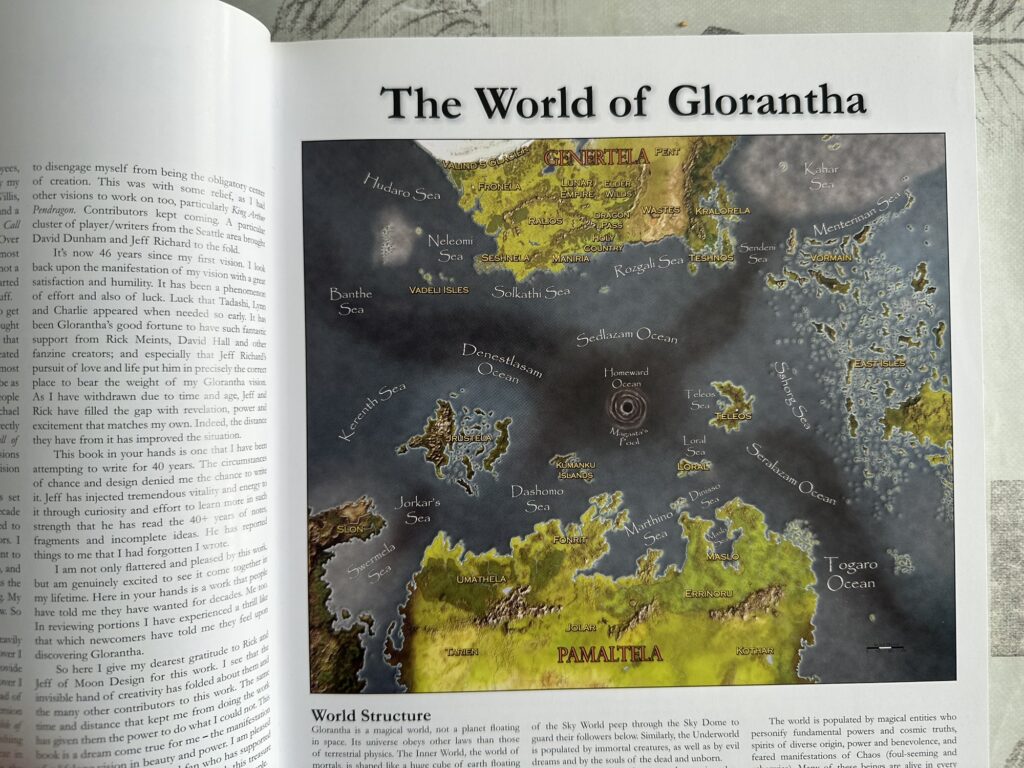
Once again we dive into a book that certainly isn’t what any sane person would discover Glorantha with6, and which therefore doesn’t qualify for my original point about RQ2’s map. But frankly at this point I’m committed to pulling books from my shelves and I’m having fun doing that.
The “Guide to Glorantha” is the monstrous, amazing, glorious mammoth encyclopedia that won the Diana Jones award in 2015. It’s an 800-pages-long, coffee-table-sized, pure lore, system agnostic, back-breaking book that I probably love the most in all my Glorantha collection. At the very least it’s in the top 3.
The Guide to Glorantha is basically a big-ass gazetteer that only needs to give a general view of the world before zooming in across the next several chapters. In this case, the map looks decent despite some readability issues. By now Glorantha’s cartography has pretty much stabilized, except for the East Isles getting more intentionally mapped out.
The scale in the map above seems wrong, by the way. According to it, and if my math and measurements are correct, Genertela would be about 3,400 kilometres wide. But the text mentions over 5,000 kilometres (3125 miles). The Argan Argar hexmaps used throughout the Guide take about 9-and-a-half pages to cover the width of Genertela, with each page being 67 hexes wide, and one hex being 5 miles. That gives us about 5,100 kilometres, so at least the text and regional maps are broadly in agreement, and Genertela is almost back to its RQ2 size. Yay!
One interesting thing about this map is that while it it doesn’t bring back my beloved “shaded areas” back per se, it does kinda show them a couple pages later:
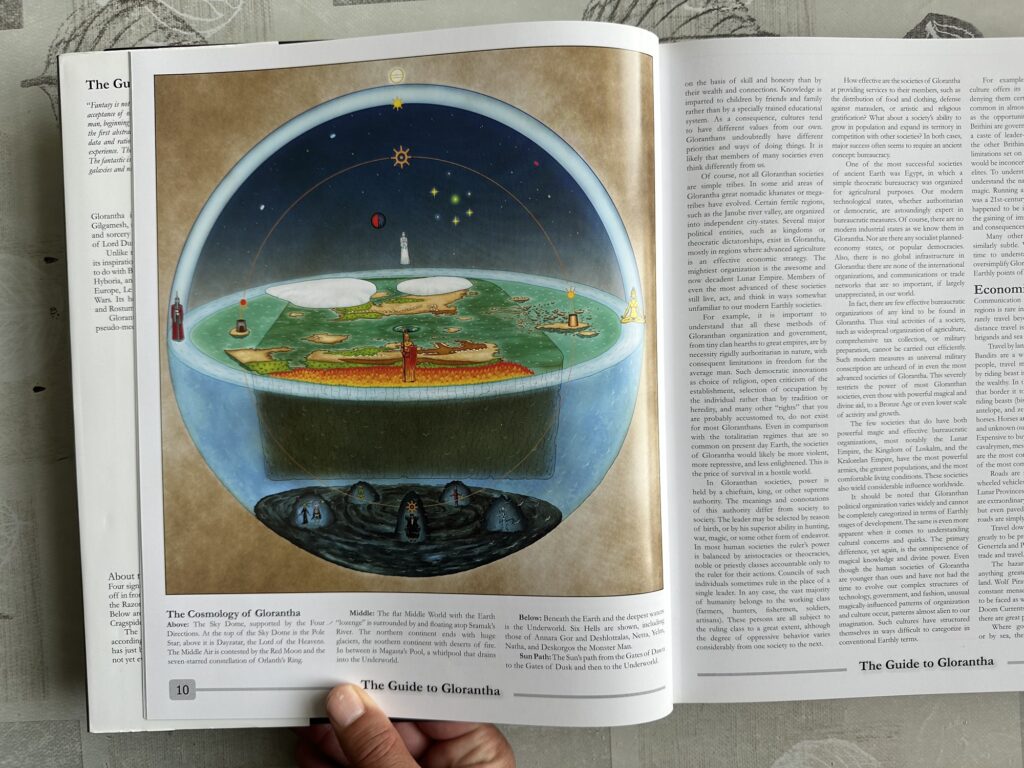
This “Cosmology of Glorantha” shows the map of Glorantha in perspective, surrounded by the weird mythical stuff from RQ2’s shaded areas. There are no labels, because this isn’t really a map, but we can for instance clearly see the “Lands of Dawn” and “Lands of Dusk” here, as islands with titanic well structures through which the sun rises and falls. It even shows stuff you can’t show on a flat map, such as the Sky Dome above, and the Underworld below.
So while the “shaded areas” are gone from the overview map, they are sort of brought back here in a secondary sort-of-map-but-not-really. It’s worth noting because we’re going to see this illustration again soon.
HeroQuest Glorantha
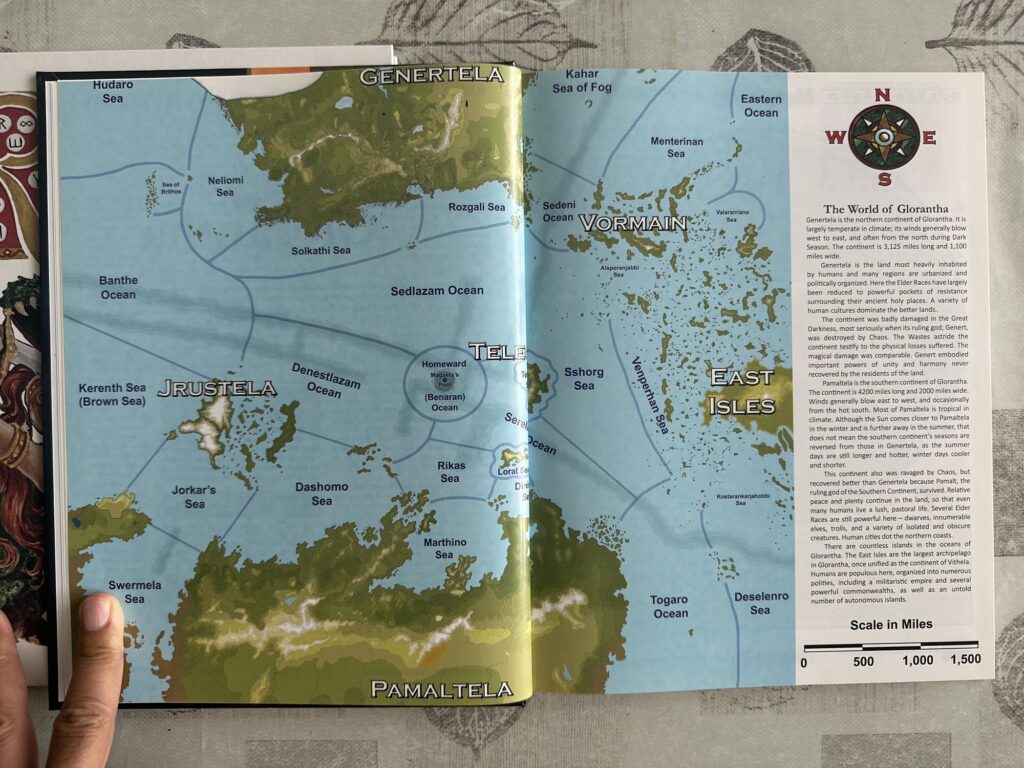
Okay, back to actual games. HeroQuest gets a second edition in 2009 in the form of a setting-agnostic rulebook, but a standalone “HeroQuest Glorantha” game emerges a few years later, hot on the Guide’s heels. In fact, HQG uses the Guide’s cartography to present the setting to the reader… and falls on its face immediately. For some reason, once again since Hero Wars and HeroQuest first edition, only the continents and oceans are labelled, and none of the geographical regions that matter are indicated. Go figure.
Also, the scale of the map is once again wrong, I think? Genertela looks 3,700 kilometres wide here. Uggh7.
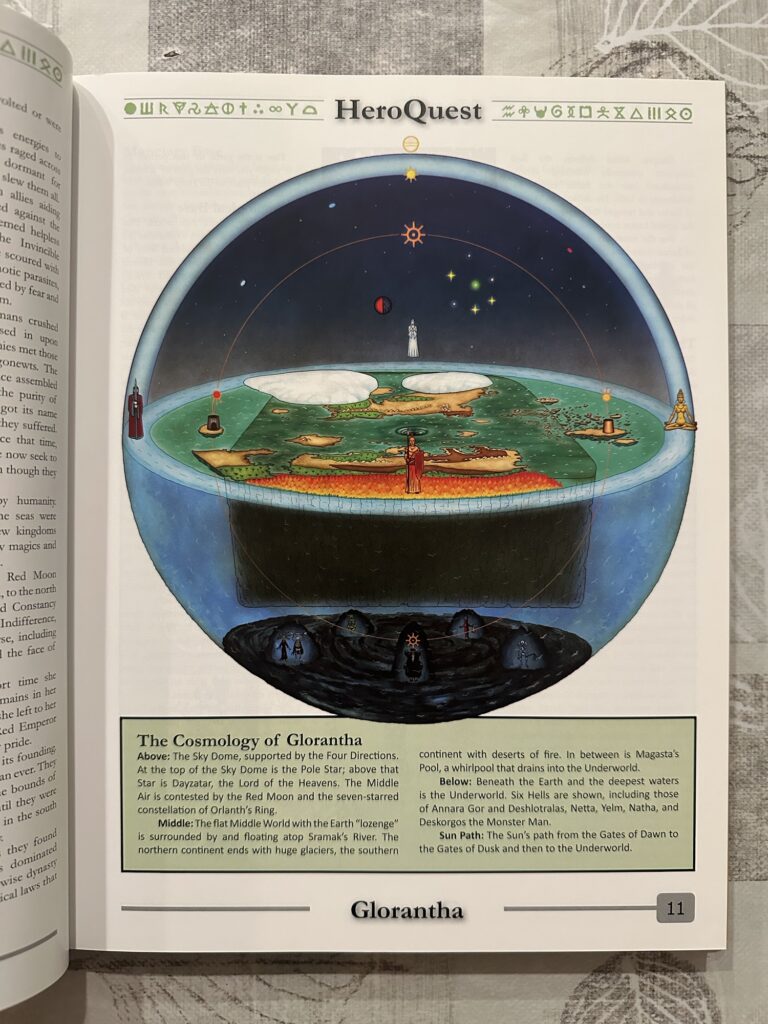
On the plus side, the book also includes the “mythical” map from the Guide to Glorantha, so not all is lost, but I still prefer the “shaded areas” of RQ2. By being seamlessly included in the map that shows where the players can go in the game, it invited these players to, well, go there too.
13th Age Glorantha & The Glorantha Sourcebook
In 2018, a Glorantha supplement for 13th Age is released, along with the “Glorantha Sourcebook”, thanks to a fairly successful crowdfunding campaign. Now, “13th Age: Glorantha” isn’t a standalone game (you need the 13th Age rulebook), but I guess it could be considered a possible entry-point to Glorantha, so it might qualify here. The Glorantha Sourcebook, on the other hand, is a system-agnostic, pure-lore book like the Guide to Glorantha, so it doesn’t qualify. We’ll look at it anyway because this is how I roll.
The 13AG book does not include a map of Glorantha, sadly. Booh! Booh again! It only includes, near the back of the book (after all the rules and character classes and spells and special feats that F20 people love), a very nice looking map of Dragon Pass and Prax. In fact, I like it so much that I include it below, even though this is a post about Gloranthan world-overview maps.
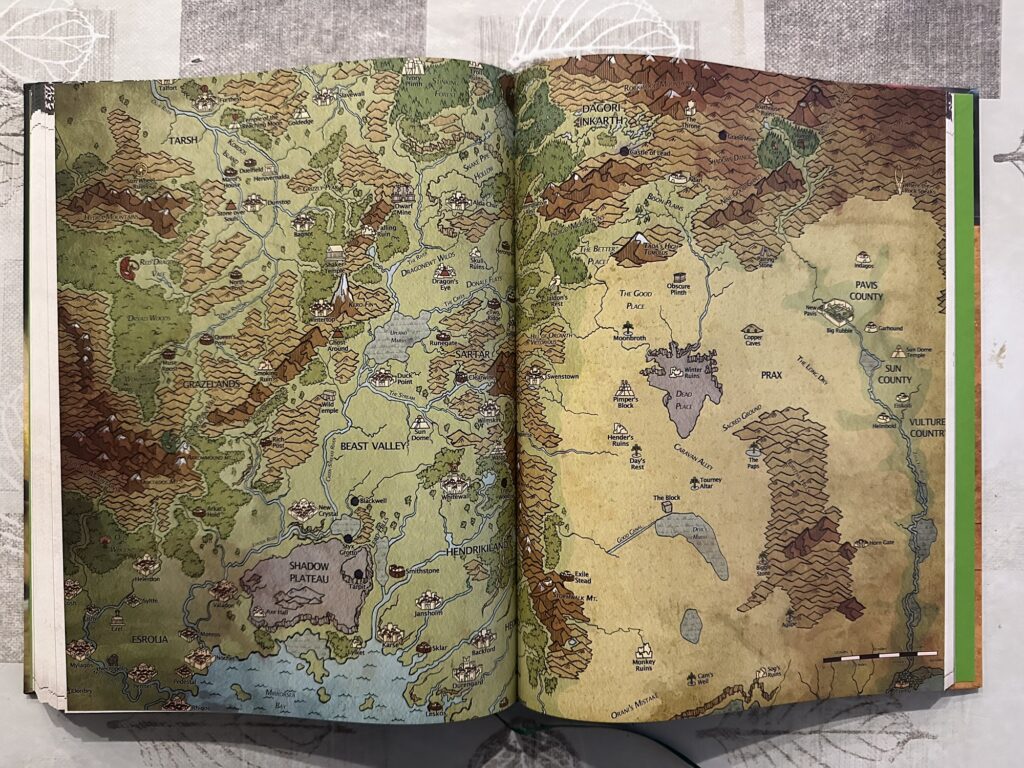
On the plus side, you remember when I talked about the Glorantha map in HeroQuest being augmented with various Rune-tied events you could feature in your game? Well, 13AG does kinda-that but much much better and over a whole chapter of the book. It places all kinds of adventure sites and story seeds across Dragon Pass and Prax, sorted by Rune. So for instance you can see all the Chaos-infested places together, all the spots where Earth-related things happen, and so on. At this point it’s a lot less about cartographic presentation, and a lot more about information management and editing, so it’s a bit off-topic, but it’s still very cool!
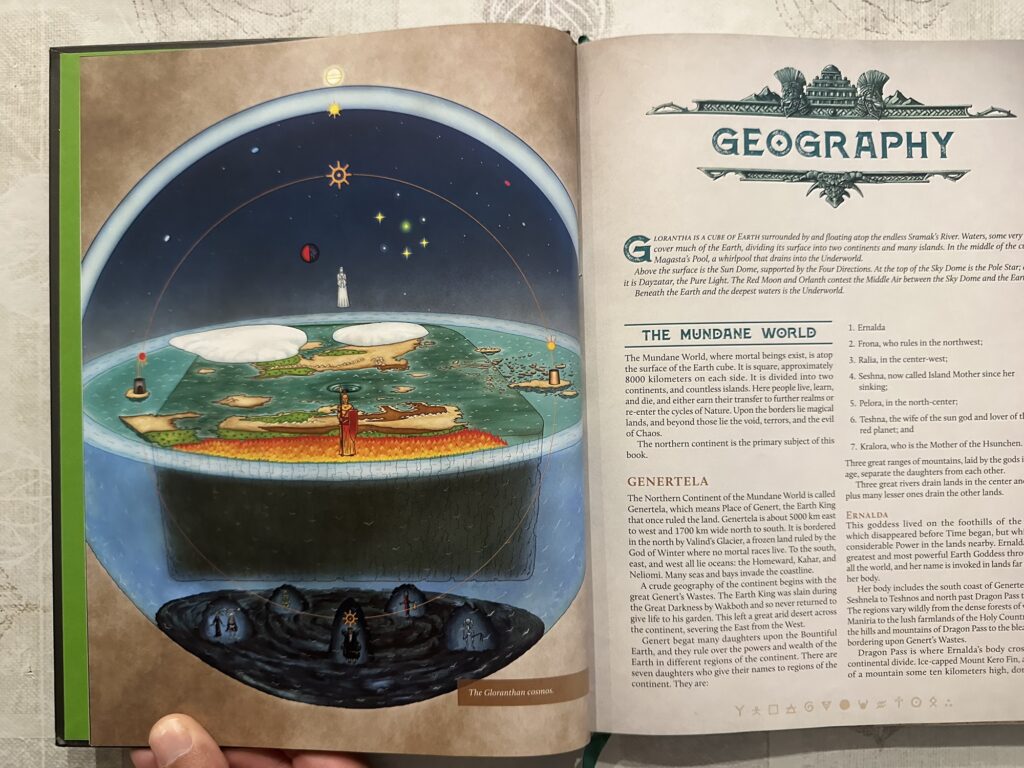
The Glorantha Sourcebook is another travesty. It starts its Geography chapter with that “cosmological” map of Glorantha, which is nice, but then doesn’t include any actual map of Glorantha either! This is much worse here because this Geography chapter talks about all the lands of Genertela and Pamaltela, from Fronela to Peloria to Kralorela… and we have no idea where any of them are. Booh booh booh.
RuneQuest: Roleplaying in Glorantha
We finally come to the present product line, RuneQuest Glorantha, released the same year as 13AG! Aaaaand…. it doesn’t have any map of Glorantha. Boooh again! Thrice booed! Boooed be your kin for three generations! It only uses the “cosmological” map of Glorantha:
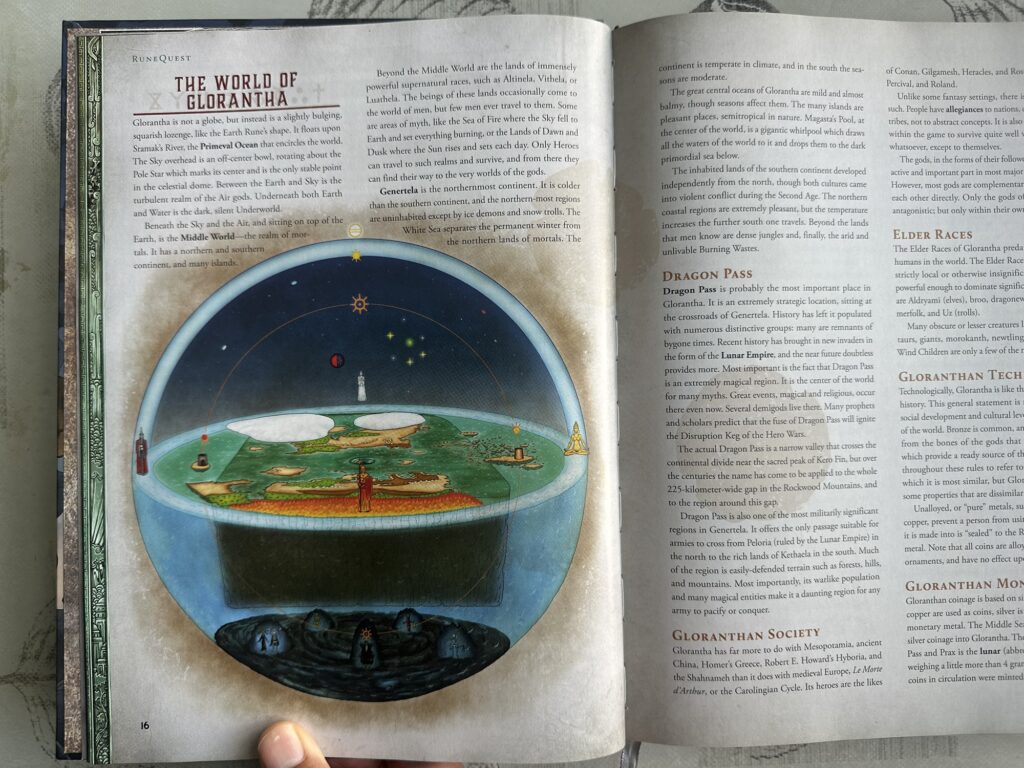
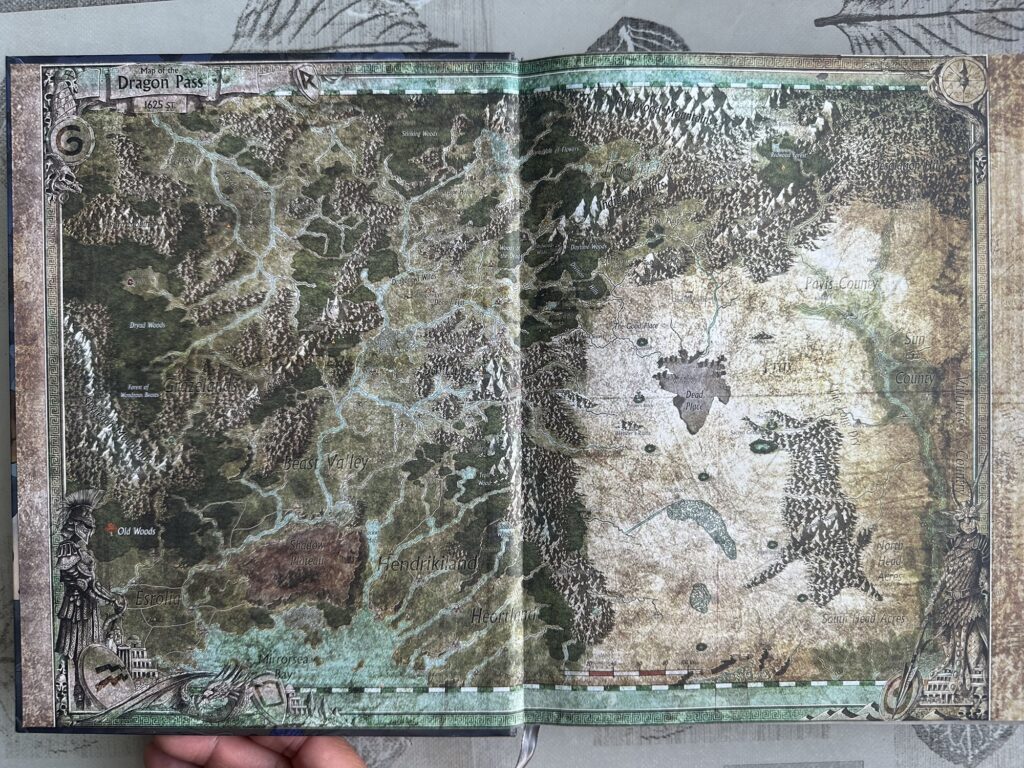
The game does focus on Dragon Pass and Prax, so that’s good, but we have little idea where these regions are located in the grand scheme of things. Also, the regional maps found in RQG, while skilfully painted, are utterly unreadable:
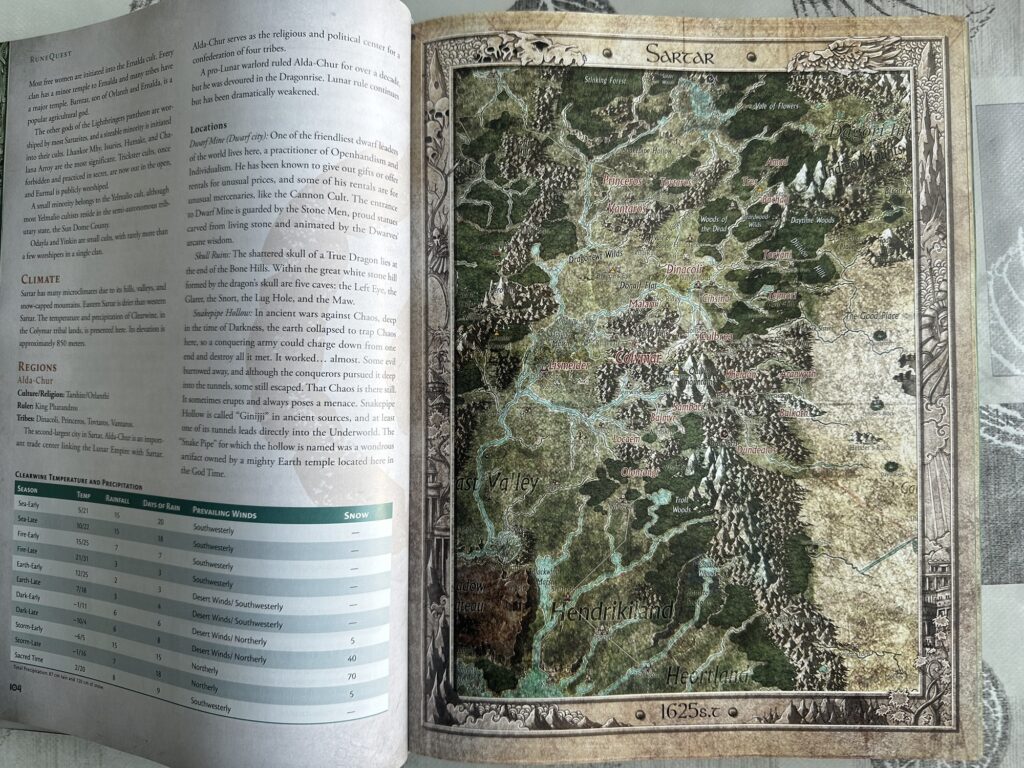
Here’s a page in the Homelands chapter, zooming in on Sartar, with more hard-to-read labels, and no scale (I guess you have to go back to the first map for that). Ugh booh.
Jury Deliberation
So there you have it, between scale problems, unfocused maps, and the lack of hints towards the mythical, none of the other games ever recaptured what was good about the overview Glorantha map in RQ2. This is based on an opinion of one person, me, formed after applying requirements and criteria defined by one person, me. So it’s just science, and you can’t really disagree.
It’s all a bit sad because the RQ2 Glorantha map seems quite easy to improve and expand upon, if only someone recognized what makes that map great.

Okay so joking aside, what do you think makes a good introductory map of Glorantha? Which one is your favourite? Did I miss any? Do you have other scale-related gripes to share? I’d love to hear your cartographic opinions!
Until then, happy gaming!
- I think it was moved a bit and renamed to “Old Trade” in the Guide to Glorantha? I’m not sure. ↩︎
- Later renamed to “Teshnos”. ↩︎
- This is how most people used RQ3 at the time anyway, as I understand it. ↩︎
- But hey, at least it allowed Chaosium to get a big pile of money from Hasbro in 2020, so it’s not all bad! ↩︎
- Actually I may have, already. Keep reading. ↩︎
- Unless you’re me! ↩︎
- Maybe it’s because they’re using the Mercator projection. On a flat world. Yes, cartographic jokes are very funny. ↩︎