Reading Classic RuneQuest: Basic Role-Playing
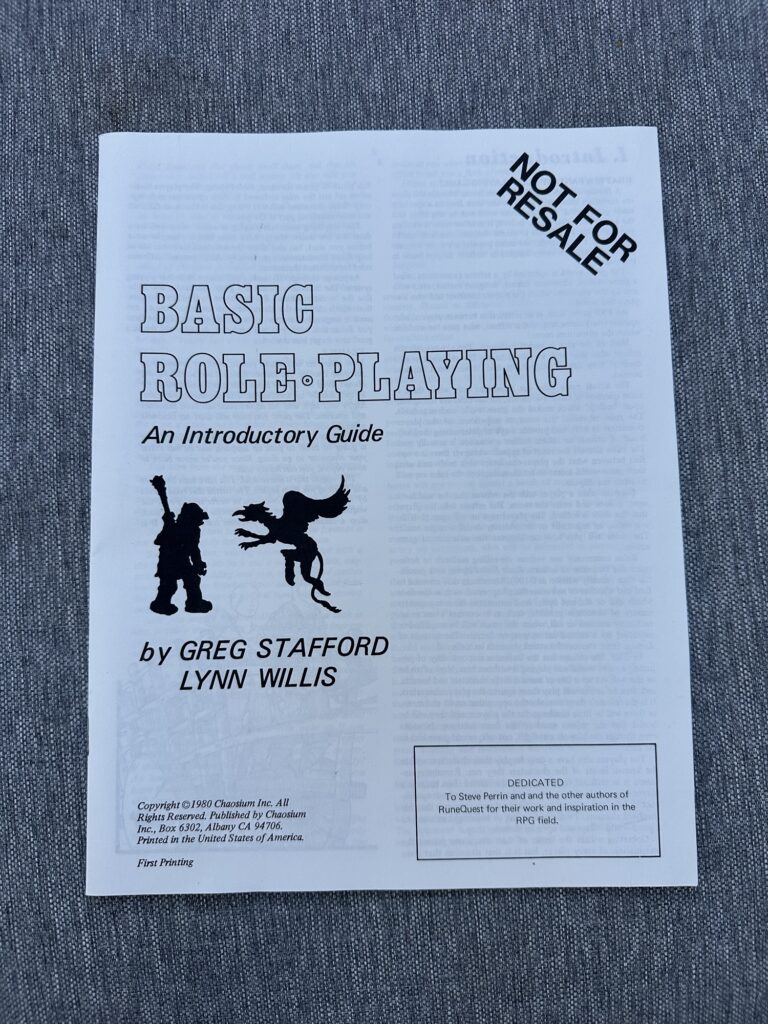
I’m back to reading the classic RuneQuest 2nd edition boxed set! See the first and second articles in the series if you missed them. Today we are reading the “Basic Role-Playing” booklet, written by Greg Stafford and Lynn Willis, with a couple illustrations by William Church.
This “introductory guide” to fantasy role-playing (FRP) and the Basic Role-Playing system (BRP) is a 16 pages-long booklet that, we are told, presents a “whole game system”. So in theory, you could completely ignore the rules in the bigger RuneQuest book and just play BRP directly from this. The BRP rules differ quite a lot from the RuneQuest rules, in that they’re much simpler, but you can tell they share the same chassis. I wonder how many early 1980s players decided to simplify aspects of RuneQuest by “downgrading” select rules to their BRP equivalent?
Anyway, let’s dive in!
Introduction
The booklet starts with a definition of FRPs: a game wherein players take on “characters” living in a “specially made game-world”. Allow me to spend a lot more time on this chapter than on any other chapter in the booklet: I find how people viewed the hobby in 1980 to be a lot more interesting than what sort of dice they rolled under what number.
The given definition for FRPs is quite broad, hinting at a rather “free-form” experience. By comparison, the Dungeons & Dragons Basic Set (a.k.a “Holmes” version) that was available in 1980 describes the game as specifically playing characters who go into “a series of dungeons, tunnels, secret rooms, and caverns”. Other games like Traveller1 didn’t even bother explaining what a role-playing game is!
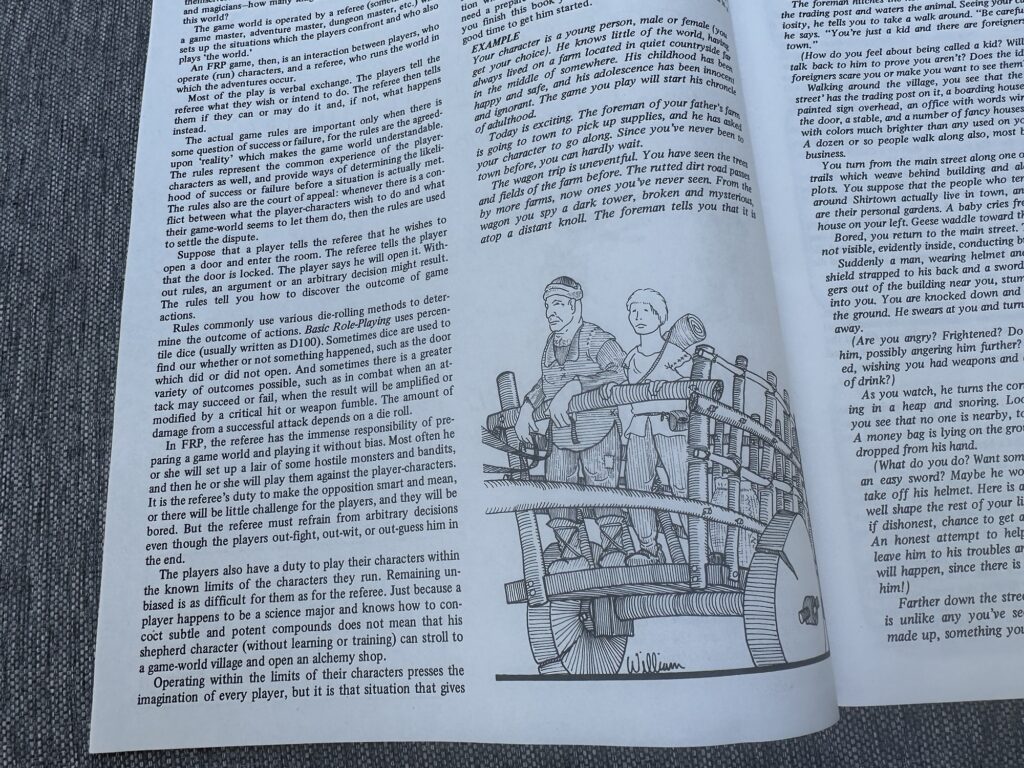
Most of the introduction to FRPs is what you’d expect, with the usual explanations and examples for how role-playing games go. It’s interesting to see one paragraph start with: “Most of the play is verbal exchange”. This is quoted, verbatim, in most editions of Call of Cthulhu (including the latest 7th edition), and gets echoed in the 2010s by all games Powered by the Apocalypse (PbtA) who similarly state that “Role-playing games are a conversation”.
This chapter of the BRP booklet puts a frightening (although not entirely false) amount of responsibility and homework on the referee, with an arguably outdated emphasis on impartiality. For instance, one paragraph starts with: “In FRP, the referee has the immense responsibility of preparing a game world and playing it without bias”. This idea that the referee should lack any bias was probably the source of many headaches and arguments, and now I think it’s generally accepted that it wasn’t a great idea. PbtA games and other modern game-mastering advice directly go against it, actually, by recommending that the GM be a “fan of the player characters”2. Interestingly, though, the BRP introduction does frame this GM impartiality as a way to limit confrontational relations at the table: “[…] the referee must refrain from arbitrary decisions even though the players out-fight, out-wit, or out-guess him in the end”. So eschewing GM “bias” here is mostly pitched as a way to, effectively, make the player characters succeed!
The introduction continues with a similar responsibility for players to play their characters with bias either. What the authors mean here is that players must act according to their character’s knowledge, even if they themselves know more. In other words, this is about meta-gaming, without yet having a term for it. It made me smile, too, when the text gives the example of a player with a science diploma, who explains how their character does chemistry or engineering, even though the character isn’t supposed to know any of that. We’ve all had that sort of player once at our tables, don’t we?
Later in the chapter, we are told that “gaming is social” and that there “needs to be cooperation between players and the referee”. Rules allow everybody to understand what’s possible and what’s not possible in a concrete way, but communication is paramount to figure things out. The example of playing a “backstabbing thief” is addressed: “if all your characters are cut-throats, who will be interested in playing with you?” RPGs not having any “winner” or “loser” in the conventional sense is also addressed.
There is even a section on “bleed”, once again written before there was any term for it: it addresses the problem of being “too close” to your character, and then experiencing the trauma of that character dying in the game. The text encourages a “proper mental attitude towards the game”. It also reminds us that the “possibility of loss makes success rewarding”, something that modern game designers may want to remember sometimes.
A lot of this section still feels valid to me, more than 45 years later, even if some of the phrasing is outdated. Let’s end with this quote: “Simple communication will build an enjoyable and understandable world to play in . The rewards of cooperation are great; hostility and resentment are fatal to play. Remember, the object of all this is to have fun.”
Character Personality
Among this long introduction is an almost-as-long “Example” section which, at first, looks like an example of play, but quickly turns out not to be. Instead, it’s an example of imagining a day in the life of the character you’re going to create, with small encounters and incidents that help you define that character’s personality.
In this example, you travel to town with the foreman of your father’s farm (which you barely ever left). The first event on the way is passing by some ruins that, the foreman tells you, is home to ghosts and trolls. The text asks you what your character thinks of it. Do you worry about the danger? Are you curious about the ruins and its inhabitants? Or are you confident in being able to fight these monsters off if they attacked?
This emphasis on defining your character’s personality first feels of course very Staffordian, given his work on Pendragon a few years later, but here it’s mostly a narrative, prompt-based approach to figuring out a character. I wonder if any game took that idea and ran with it?
Later in this section I stumbled upon a classic Staffordian mind-fuck. While in town, you bump into man wearing armour and weapons. He looks drunk and, soon after, walks in a back alley and falls down, snoring loudly. You notice that he dropped his coin purse next to him. The text asks whether you want to snatch these coins, or maybe even the man’s sword and helmet, while no one is looking… it ends with: “Whatever you wish will happen, since there is no referee right now to wake him!”
It wasn’t a realization per se that the drunk man wouldn’t wake up unless someone narrates that he wakes up, but it was a bit shocking to me to see it written down like this! We truly create these stories at the table, and the people that populate our fictional worlds don’t actually do anything until someone takes control, directly or indirectly.
Materials
The next section is about the materials needed to play a BRP game: dice, a character sheet, figurines, and “focus”.
We already went over dice in the last article, looking at those provided in the box. If you haven’t read it and are under the age of 45, I really encourage you to check it out because you may not be aware of how people used to roll dice at the time! It’s crazy.
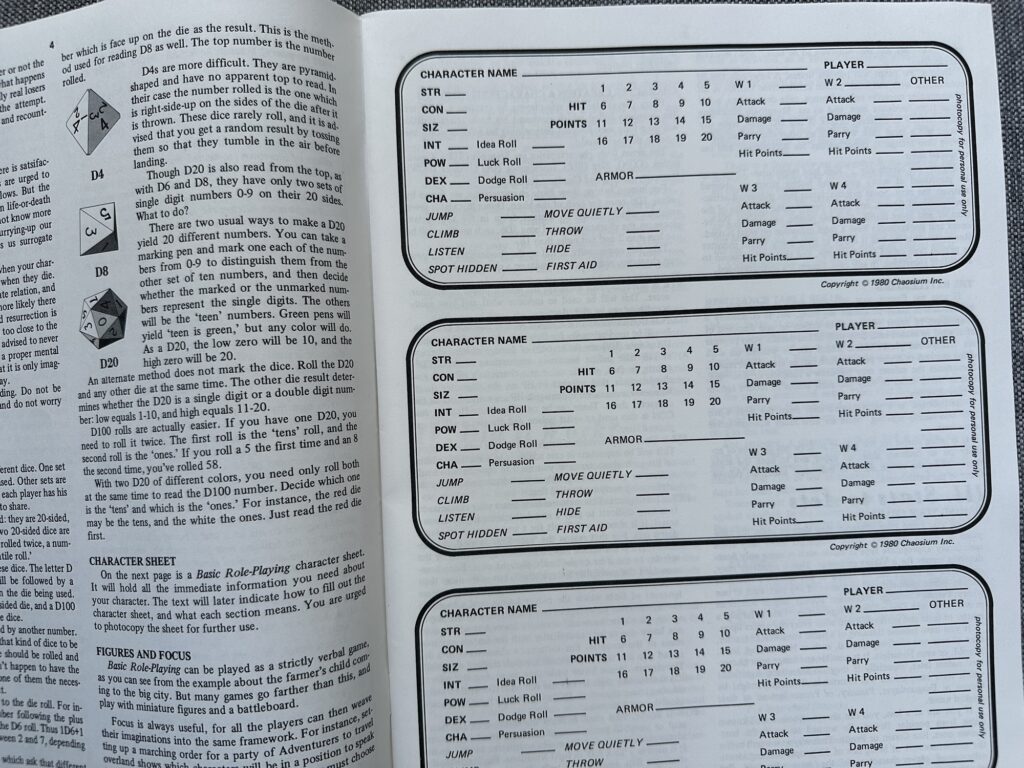
The BRP character sheet is wonderful: it fits on an index card! We’ve seen, from the other contents of the box, that it’s definitely not the case for the RuneQuest character sheet, however…
The figurines are optional. The text once again lacks gaming terminology invented later, and explains that BRP can be “played as a strictly verbal game”, which we now colloquially refer to as “theatre of the mind”. However, the text justifiably explains that using figurines helps reduce the amount of questions and misinterpretations, allowing more fluid play. It recommends scrounging for “railroad props, cake decorations, weird things from hardware bins, and so on” for building your battle-maps. It even recommends adding interesting opportunities for players by dropping “a few HO trees, some toy fences, and a large rock” onto the table. I suspected that “HO trees” were probably props from the model train hobby, but I had to look up what “HO” means.
The last bit is “focus”, which a surprising and interesting addition… if only the authors knew that, 40 years later, portable computers would lead to easy distraction from the game!
Stats to Acts
After a short section on naming your character (including the advice of avoiding well-known names like Conan or Frodo!), we are finally introduced to some actual stats. The seven recognizable BRP characteristics are here: STR, CON, SIZ, INT, POW, DEX, and CHA.
In this version of BRP, the character’s Hit Points (HP) are directly equal to CON. The concepts of the “Ideal Roll” (rolling under INTx5) and “Luck Roll” (POWx5) are mentioned. We can even see Greg Stafford talking himself into removing INT in Pendragon by stating that it is equally hard to play a smart character when you’re not smart, or a stupid character when you’re smart.
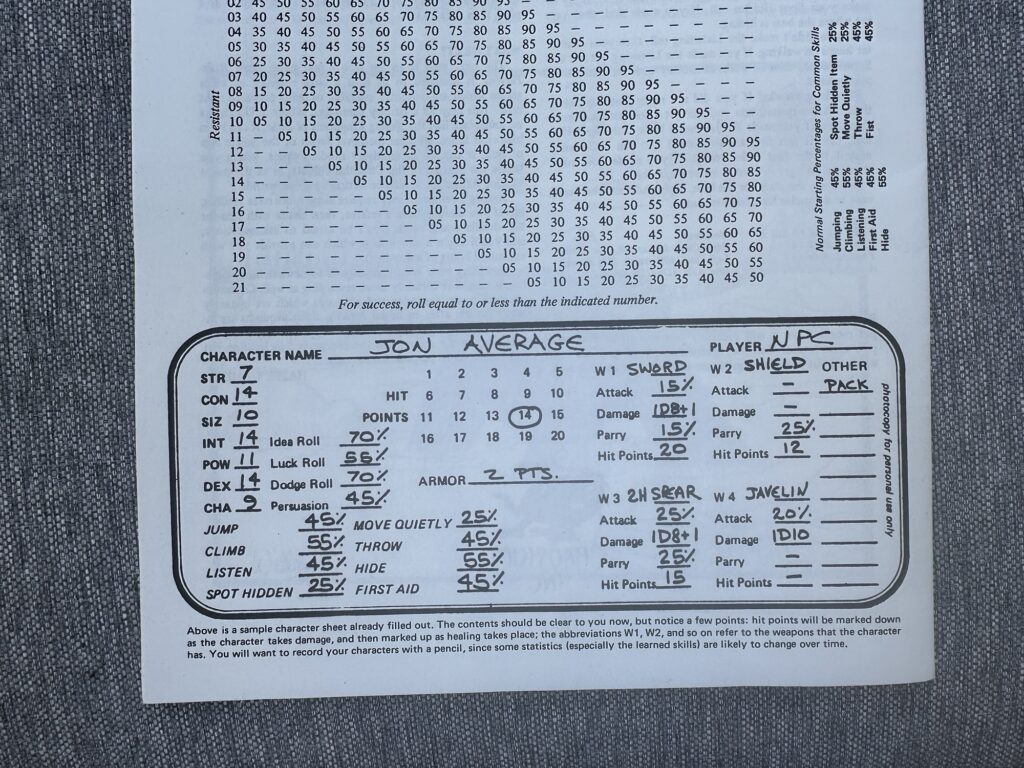
The second edition of this BRP booklet will mention optional “personal rules” such as adding 3 or 4 points to anything below 10, and add an example of rolling a character named “Jon”. In my first printing booklet, however, we are left to roll our own character, although the future-aforementioned “Jon” is described on the last page with the example character sheet.
Did It Work?
The Core Percentile Rolls
The core BRP mechanic is explained in this chapter. Of course, this is the mechanic of rolling percentile dice and trying to get a number lesser than or equal to a character’s ability score. The skills listed here are Jumping, Climbing, Listening, Spot Hidden Item, Move Quietly, Throw, Fist, Hide, and First Aid. For some reason, the authors don’t like round numbers and all the default skill scores end in 5 (45%, 55%, etc.) As is tradition, the example of play has you fighting a large rat!
These skills are obviously biased towards adventuring, so the idea that FRP is about “living” in a fictional world is a bit dishonest given the lack of other skills. However, the descriptions of characteristics in the previous chapter do address some of this. For example, we were told that CHA×5 would handle persuasion rolls – or CHA×3 if the interlocutor is suspicious.
One thing that we often overlook is how early RPGs offered the “automatic action” option, where you just succeed without rolling. Of course, this was mostly offered for “mundane” things like walking around, riding a horse to town, or chopping wood for the fireplace. But the option existed. I might be doing some heavy lifting here, but spotting a monster, convincing an NPC, or finding a clue without rolling was always an option. Good refereeing was a mystery still being investigated, but the rules were there.
I’m Resistant to the Resistance Table
BRP’s venerable Resistance Table (which most modern BRP games have eliminated) of course shows up here too. This is for pitting one character’s characteristic against another’s, like with an arm-wrestling contest of STR.
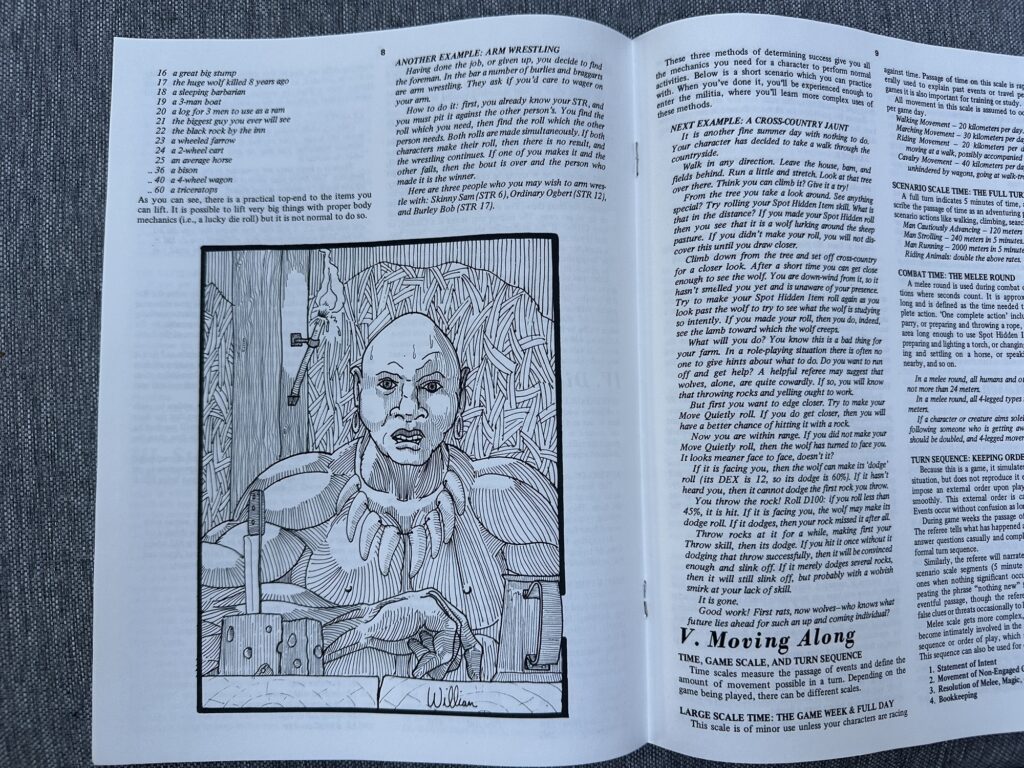
The example of play given here is silly and a bit funny: roll your STR against various items’ SIZ as your father’s foreman asks you to load a number of items on a cart. The items range from small and ridiculous (a hammer, a duck, an eagle) to large and ridiculous (a small donkey, a sleeping barbarian, a bison, a triceratops). A second example of play, the aforementioned arm-wrestling contest, is also given, with a scary illustration of “Burley Bob”, who has STR 17! This is followed by a third example of play where the authors try to bring everything together.
The amount of examples in this short booklet, along with how “interactive” they are, is an interesting editorial decision, actually. Most of these examples of play ask the reader to make choices and roll dice, as opposed to simply telling us about what some imaginary player does at their table.
That 90’s Game
If you allow me a little personal insert, these foundational aspects of BRP always annoyed me a bit, and are the main reasons it was never my “go-to system”: for some things you roll under a skill, and for others you roll under a characteristic, and for yet others you roll on a table, and maybe you roll under the characteristic even if there’s a skill, and sometimes you express difficulty with a modifier, but sometimes you change the characteristic multiplier, and sometimes, and sometimes… Even in this super-abridged version of BRP, all these different mechanics are present.
I think most BRP fans see this as a great collection of “tools” from a “toolbox system” to be used as desired. But as a child of the 1990s, I’m used to unified mechanics where characteristics and skills blend seamlessly. This is something that Traveller actually gets right from the start3, even in the late 1970s. I suppose BRP is in the middle of the pack, here, above D&D and its blend of D20s and D100s and THAC0 and Saving Throws and whatever else, but below Traveller with its unified 2D6 system.
Moving Along
The next section introduces time scales, movement speeds, and melee rounds. The text tries, with some difficulty, to explain how a referee may speed up or slow down the narration of the game based on the needs of the story. It mentions how sometimes the story needs slowing down to a round-by-round breakdown (each round being about 12 seconds), while in other moments the referee can brush over minutes, hours, days, or weeks.
The booklet tries to give some structure between these scales, but has to specify that not everything needs a “formal turn sequence”: “there’s no point in repeating the phrase ‘nothing new’ for 20 times during an uneventful passage”! Yeah. I guess all of this is hard to explain to someone who hasn’t experienced RPGs yet…
When it comes to melee rounds, the familiar RuneQuest structure is preserved even in these simplified rules: Statement of Intent, Movement of Non-Engaged Characters, Resolution of Melee/Magic/etc. (the only time magic is mentioned in this booklet!), and Bookkeeping. But hey, at least, there’s no Strike Rank! Character just act in decreasing DEX order, yay!
The Rewards of Success, The Cost of Failure
The now well-known BRP experience system is presented here: if you successfully used a skill during a session, mark it… somehow. There’s no checkbox next to the skills on the character sheet yet, this is something that gets improved in Call of Cthulhu the following year. Anyway, later (it’s not specified when exactly) you have a chance to improve these marked skills.
Weirdly, here you don’t simply rolling a D100 over your current skill rating. That improvement only shows up, once again, in Call of Cthulhu the next year (and is kept for all subsequent BRP games as far as I know). For now, here the rules tell you to do something needlessly convoluted: subtract your current rating from 100% and then try to roll equal to or under that number with percentile dice. The two methods are equivalent, but the one that Chaosium would later settle with is obviously simpler and better. I suppose that they originally wanted to keep the vibe of “rolling low is good”, before realizing the trade-off wasn’t worth it?
Another thing to note is that if you succeed the experience roll, the skill increase is a flat 5%, unlike later BRP rules that will generally use +1D6%. As a friend once said: if everything is a multiple of 5%, why not use a D20 and call it a day? I suppose that the authors just really liked having percentile statistics, for an easier grasp of your chances of success, and only succumbed to bean-counting a few years later? It’s worth noting that the +1D6% experience gain was, once more, a Call of Cthulhu change as far as I can tell. I suspect that the goal there was to reduce character improvement speeds for better “gritty realism”.
Military Skills
Okay, this is an early 1980s role-playing game so we gotta have combat! This chapter starts with an NPC welcoming us to the town militia. It even role-plays through that NPC realizing that the expression “being a man”, as synonymous to “being brave”, is sexist, and reminding us that not all adventurers are men! The 1980s were so woke!
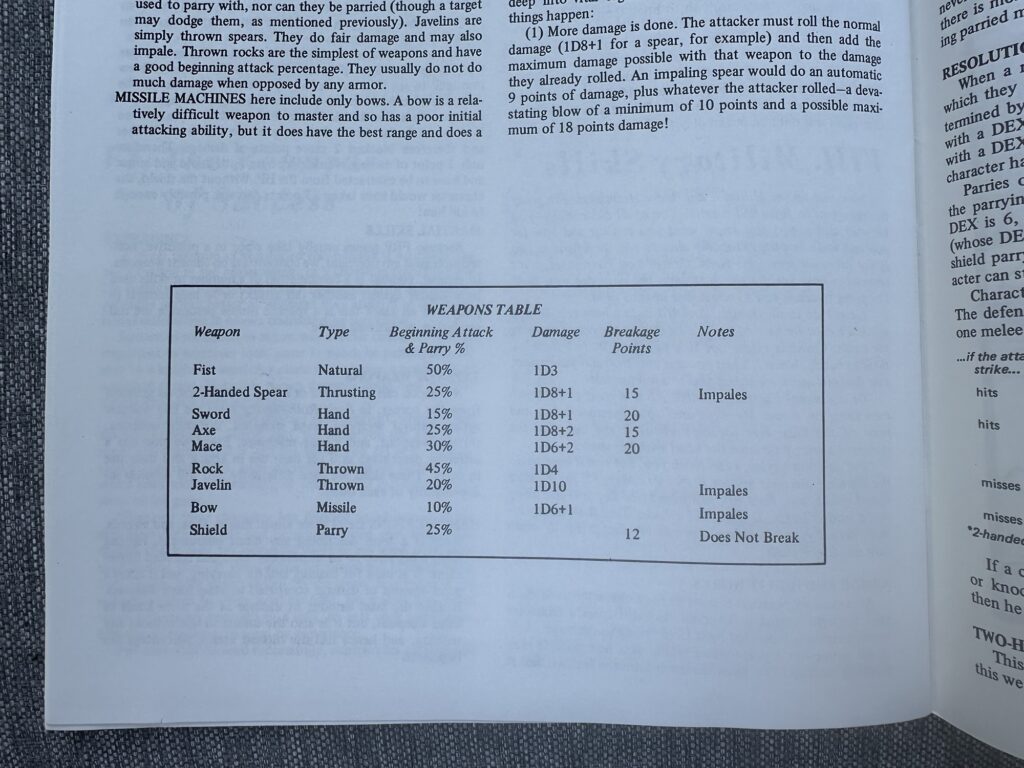
The combat system here is pretty simple. Like I said, there are no Strike Ranks, but also no Hit Locations, for example. Armor and shields simply protect from damage. There is still considerable crunch with weapons, though. Even in this simplified BRP booklet, the authors insist on one skill per weapon type: sword, axe, mace, shield, javelin, bow, and generic “thrown objects” like rocks. That, plus one more skill for a “natural weapon” like punching. Once again, we’re told FRPs are about living a fantasy world, but, well, from the list of skills, it seems to be mostly about fighting.
Pointy weapons, like spears, javelins, and arrows, can “impale” an enemy. This happens when rolling “lower than 20% of the required attack”. This mechanic would later be generalized as “special successes” in RuneQuest 3rd edition4, but here in 1980 this is only for impaling with pointy sticks! It’s not used for any other ability roll!5 Also, note how the rule states “lower than”, not “equal to, or lower than”. I wonder if people actually played it strictly as written… anyway, impaling deals more damage, and the weapon is stuck in the enemy’s body. BRP loves unnecessary math, so the attacker may pull the weapon out by rolling twice their chance of impalement, which I guess is equivalent to 40% of their attack score. Well, strictly lesser than that, of course.
Shockingly, the rules state that a weapon can only be used in a melee round for parrying or for attacking, but not both (although of course shields cannot attack, and bows or thrown weapons cannot parry). This is… basically like Dragonbane? It’s very interesting. Now I can claim that my house rules (which removed Strike Ranks altogether) aren’t ripping off Free League, but actually hearken back to OG-BRP! Although technically that rule is per-weapon, not per-character. So a character with two weapons, or a weapon and a shield, can defend twice in a round. Of course, RuneQuest itself doesn’t seem to have any of these rules, but we’ll get to that when we move on to the actual RuneQuest rulebook.
With special successes reduced to a special case for spear damage, and criticals and fumbles absent from the rules, the “attack/parry table” ends up being just 4 bullet points. Nice! Well, nice until you start tracking damage to weapons. As written, it seems that you simply deal damage to a parrying weapon, without using any sort of threshold or damage reduction on that weapon… so I think no weapon in BRP lasts for more than a few parries? That seems harsh.
The example for combat has two characters (Able and Dair) fighting off sheep-stealing baboons! As I just mentioned, weapons don’t last long here, and Dair’s spear is broken in round 3 through simple accumulation of damage. Still, the two brave characters are victorious. There is no “attack of opportunity” in BRP, so our two heroes simply get one last attack at +20% as the baboons flee.
A Solo Scenario
The booklet ends with a very short solo scenario, in which you are asked by a neighbour to deal with a chicken-stealing bear. She offers you her late husband’s suit of ring mail, which, when worn on top of your leather jacket, adds up to 6 points of armour, and a 5-point healing potion. Feeling brave with all this protection, you head out for a bear hunt!
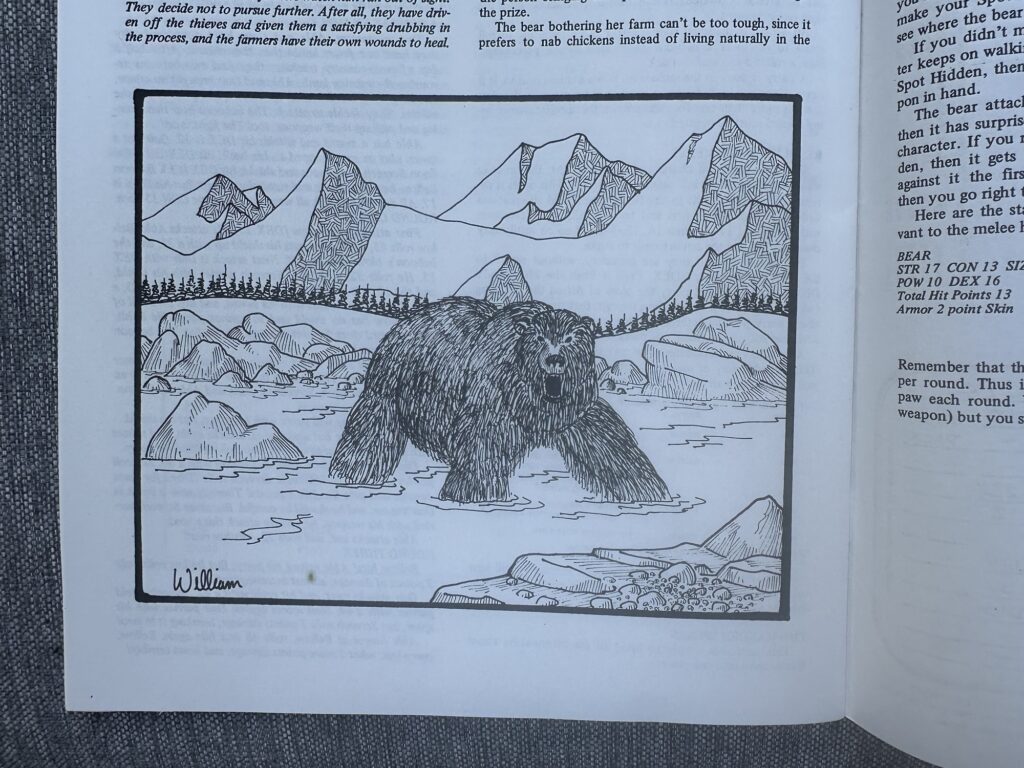
The adventure is basically two skill rolls and a short combat. Nothing to write home about, except for the fact that, apparently, bears are right-handed (it has 35% attack with the right claw, and 30% with the left claw!) The authors might have been already familiar with “Choose Your Own Adventure” interactive stories, which were first published a couple years prior, but I assume this solo scenario was meant to be too short to use that format. Either way, the solo scenario does a decent job of showing the breadth of FRP with many ideas of what your character can do besides simply hitting the bear until one of you falls.
Interestingly, the “What Next?” epilogue teases some the games Chaosium was working on, or at least thinking about, at the time. It tells you to set your game not just in a fantasy world like Glorantha, but also “someplace like the Young Kingdoms of Elric”. It continues with suggestions of “medieval Japan or the heroic Age of Sail”, tackling “the horrors of the Cthulhu cultists”, or “the realm of King Arthur”.
Ludo’s Rolls
Of course, while reading the BRP booklet, I followed the instructions and rolled a character! I named him Glawyn. He’s got STR 12, CON 10, INT 6 (ouch!), POW 11, DEX 13, and CHA 14.
Moving on to the first narrative prompts, and looking at Glawyn’s INT, I figure he’s probably a stupid, hot-headed and over-confident young guy. Passing by Crag’s Ruins, Glawyn definitely saw himself being victorious over whatever troll or ghost might come out of there. He wants to prove he’s strong and heroic, and sadly for him (and everyone around), he’s got the charisma to make people believe it. Glawyn seriously thought about stealing the sleeping man’s sword and purse, but a surprisingly successful Idea roll brought him back to reason.
Later, Glawyn missed the rat that was terrorizing his mother in the kitchen. He couldn’t load a wagon wheel or a big table onto the foreman’s cart. But he beat all three contestants at arm-wrestling!
When a lone wolf came by, Glawyn climbed a tree, but didn’t spot it. He then did spot it as he investigated the area around the farm. Too bad Glawyn then proceeded to fail his stealth roll (and it’s a good thing this version of BRP doesn’t have fumbles!) I technically critically succeeded at throwing a rock at the wolf, and it hilariously rolled a 100 for its Dodge, so there, in your face, wolf! At this point in the booklet, damage wasn’t explained yet, so I was just rolling Throw vs. Dodge for no particular reason. Glawyn only hit the wolf once more after throwing half a dozen rocks. Oh well.
In the solo scenario, Glawyn wandered into the bushes and missed his Listen roll by 1%, so he got attacked by the bear! Then, in classic BRP fashion, nothing happened for several rounds, as all rolls failed. Then somehow Glawyn dealt damage to the bear while parrying one of its attacks, got wounded by the bear’s claw in a subsequent round, and then after more rounds of nothing happening, got a lucky parry that killed the bear! I guess Glawyn is feeling quite cocky, bringing back a trophy of his hunt to the village.

Happy Gaming!
Well, that was a lot of writing for such a small booklet! But hey, as Blaise Pascal said, I didn’t have time to make it shorter.
In the next article, I will finally start reading the RuneQuest rulebook proper! This will probably be split by chapter, or something close to that, and hopefully each article will be shorter as a result.
In the meantime, happy gaming!
- The “Deluxe Edition” of the Traveller boxed set does have an explanation of RPGs in its “Book 00: An Introduction to Traveller”. That definition is similarly broad and free-form as the BRP one, but not as elegantly written in my opinion. ↩︎
- Ironically, various interpretations of this statement also leads to many headaches and arguments, so maybe the problem is just people. ↩︎
- You know what, maybe I should start a “Reading Classic Traveller” series soon? ↩︎
- One of the several ways RQ3 added unnecessary crunch to an already crunchy system. ↩︎
- I actually knew about this, and this is why I removed special successes in my RQG house rules. ↩︎