Reading Classic RuneQuest: The Introduction Chapter
I’m coming back to my “Reading Classic RuneQuest” series after a hiatus caused by, you know, having to deal with my twelve other hobby projects 😄 Last time I read through the “Basic Role-Playing” booklet and now I’m finally getting into the actual RuneQuest book proper! Yay! But don’t get too excited, we’ll only do the Introduction chapter! Booo!
Who Did What
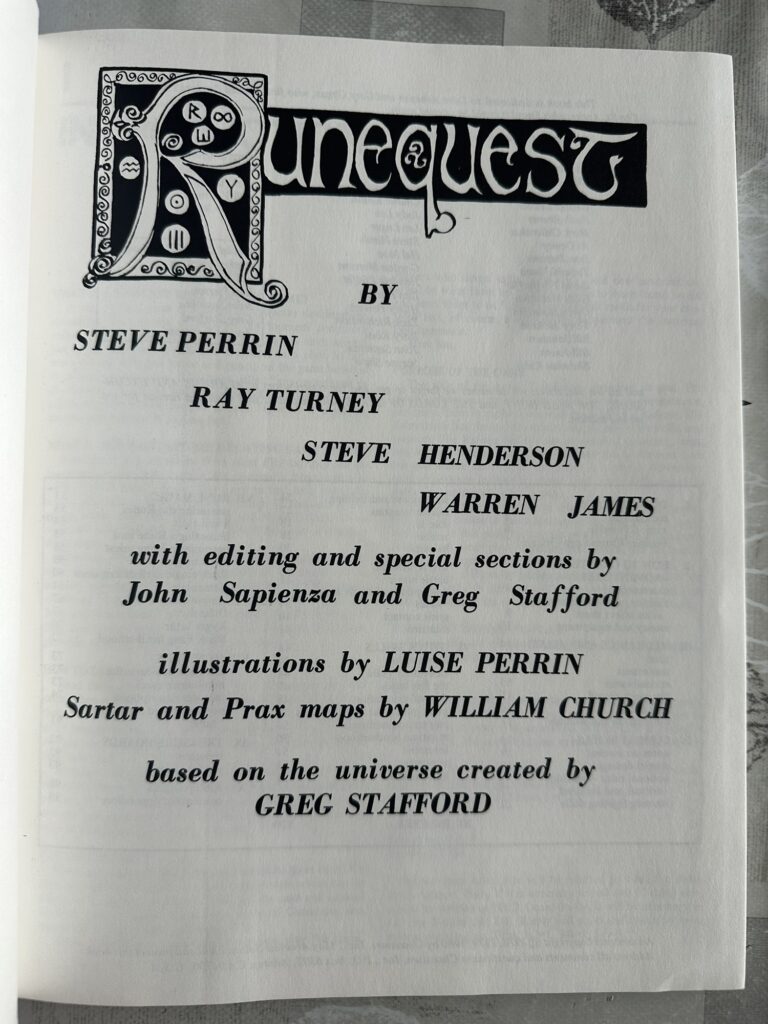
Before we even get into the Introduction, I want to stop at the Credits page. The reason for this is that I think it’s a common mistake to think that Greg Stafford wrote and designed RuneQuest. It’s just not the case.
The Credits are pretty explicit about it: RuneQuest 1st and 2nd editions are written by Steve Perrin, Ray Turney, Steve Henderson, and Warren James. Greg Stafford is only credited for “editing and special sections”, along with John Sapienza, and for the setting of Glorantha. Luise Perrin (Steve’s wife) and William Church are credited for illustrations and maps, respectively.
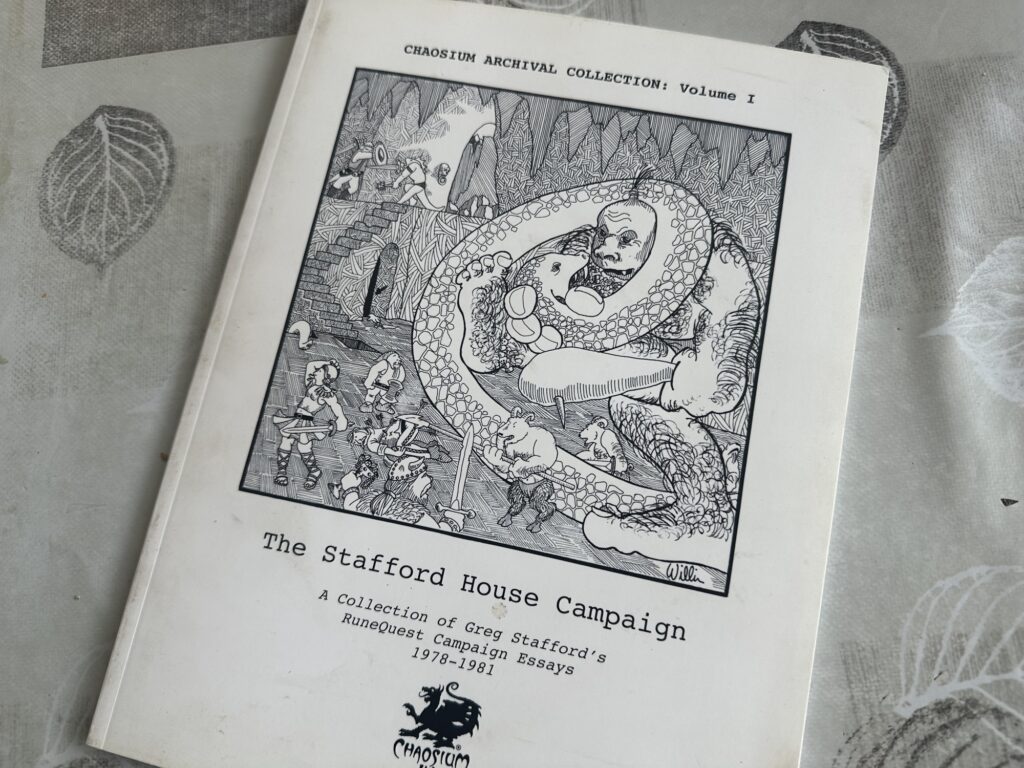
We can find some more details about who did what in the “Stafford House Campaign”, a collection of articles and letters that Greg Stafford published in APAs1 (Amateur Press Association).
In a letter published (“probably”) in The Wild Hunt #34, Greg talks about how he came across a copy of the first edition of D&D2. Greg became fascinated by the emergent scene of “Fantasy Role-Playing” games (FRP), although that article is pretty brutal when it comes to Greg’s opinion of D&D and his early experiences playing in other people’s games. When fans approached Greg asking for an FRP set in the Dragon Pass setting of his wargame White Bear & Red Moon, he looked for partners, as he didn’t feel knowledgeable enough in FRP design. He writes: “Although RUNEQUEST is set in Glorantha I had little part in making the rules. As I mentioned earlier, I was busy learning how to play and had no skill to write rules for FRP at the same time.”
Greg had a set of requirements for a Gloranthan FRP, including the fact that it had to be a full system (not a supplement to D&D or whatever), be “clear and logically presented, with many examples”, have “mana points” and spirits, and no character classes or alignments. He also mentions that “battle magic” (known as “spirit magic” these days) should be present, listing Viking poems like Hávamál and Grógaldr as inspirations for its design3… see? There are Viking tropes in Glorantha!
After a couple of projects and designers that didn’t pan out, Greg ended up with Steve Perrin and Ray Turney. Perrin did “most of the combat rules, skilfully advised by [Henderson and James]”, while Turney did “most of the magic rules”. The rest is a mix of contributions, but Greg credits Perrin for doing a lot of the work needed to flesh out many of the other sections. Not credited somehow was Lynn Willis, who apparently did much of the layout work in record time with the first edition, to meet the deadline for a release at the Origins Game Fair. Finally, the “thanks” section contains many names you might recognize from the “Chaosium sphere”.
The dedication is also worth a quick look:
This book is dedicated to Dave Arneson and Gary Gygax, who first opened Pandora’s box,
and to Ken St. Andre who found it could be opened again.
It’s interesting to see Arneson credited before Gygax. The nod to St. Andre and his Tunnels & Trolls (first published in 1975) is quite nice. It feels very Staffordian to me, even though I have no evidence Greg wrote it.
Edit: Nick Brooke notes that Greg, or whoever wrote this dedication, surely knew what came out of Pandora’s box, and maybe the message here is more ambivalent, or joking, about the rise of TTRPGs than it might seem at first glance…
Edit 2: Brian Duguid reminded me that when Steve Perrin passed away, Chaosium published a bunch of articles featuring interviews with him about the development of RuneQuest. The last one in the series is here, with a handy list of links to the previous ones.
FRP Rules Can Only Be Guidelines
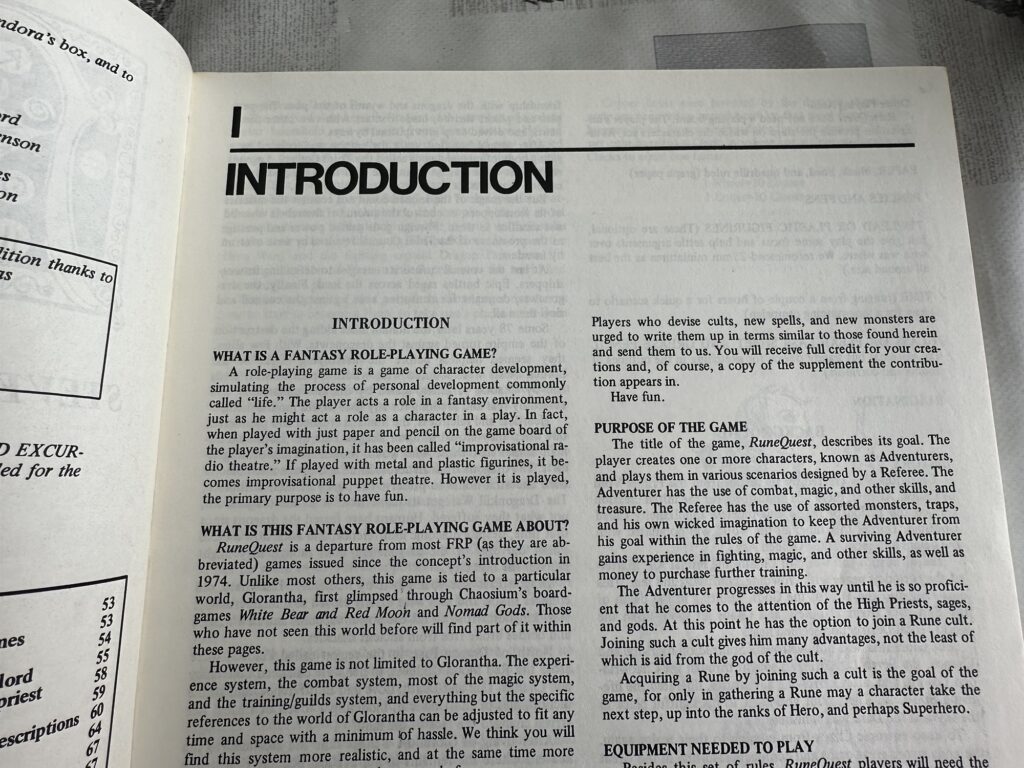
The introduction chapter starts with the same sort of explanation about the game as what was found in the Basic Role-Playing booklet, although the text is a bit different. It makes the distinction between playing with maps and miniatures, and playing on the “game board of the player’s imagination”. It calls the former “improvisational puppet theatre”, and the latter “improvisational radio theatre”. I support that the now accepted term of “theatre of the mind” wasn’t invented or popular yet. The text also immediately sets RuneQuest apart by stating that, unlike other FRP games, this one is “tied to a particular world, Glorantha”. It’s important to remember that this was quite unique at the time, actually4. We are told, however, that most of the rules could be lifted and used with other settings.
The game is very self-aware about players invariably cherry-picking rules and tweaking things5. Newcomers to the hobby are encouraged to read the book carefully and try it as written, but experienced gamers are given the permission to ignore rules, make up new cults and spells and monsters, and even send those as submissions to Chaosium. “Like any FRP system, [these rules] can only be guidelines. Use them as you will.”
The Purpose of the Game
Interestingly, RuneQuest is a game with a purpose. The title “describes its goal”, which is to “acquire a Rune”. You play an adventurer that progresses in experience until they “come to the attention of the High Priests, sages, and gods”. Then, you join a cult, which symbolizes having acquired one of that cult’s Runes, and are on your way to “take the next step, up into the ranks of Hero, and perhaps Superhero”.
This isn’t really clear, frankly. Is the goal of the game to join a cult? Do you stop playing after that then? Or do you stop playing when you’ve reached the rank of Rune Priest or Rune Lord? Maybe you try and push further, to become a Hero or Superhero?
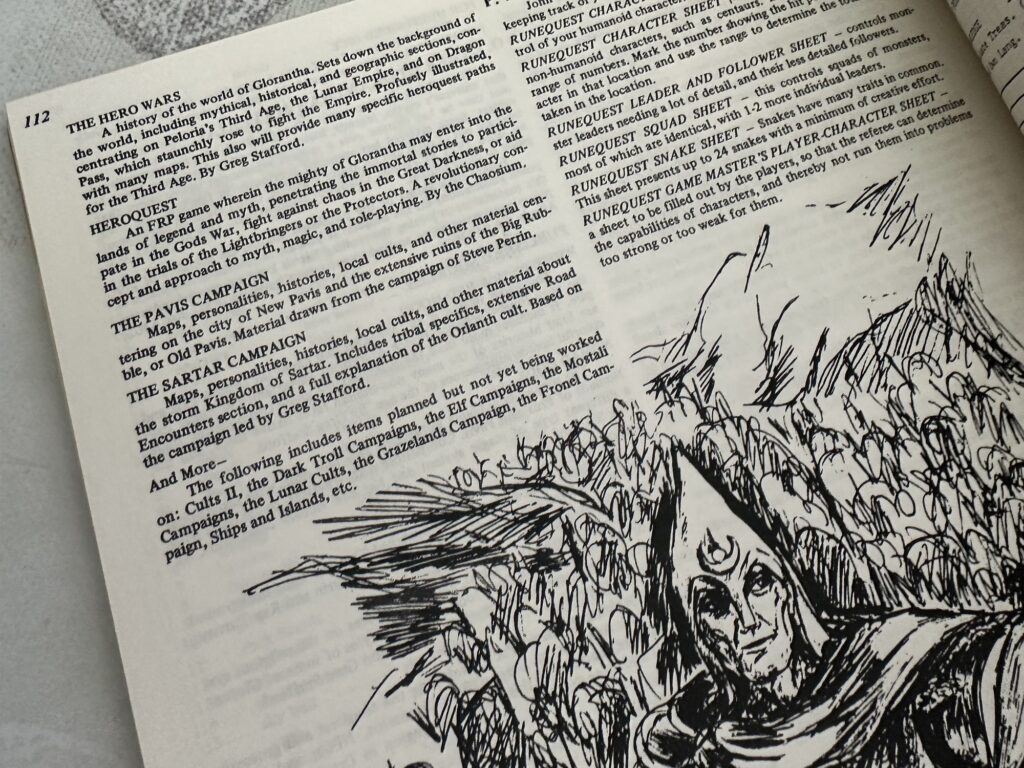
On the one hand, the sample cults presented later in the rulebook include rules for Runemasters, so surely you’re meant to play as one if you can get there. On the other hand, RuneQuest would forever tease the ability to rise to the rank of Hero and Superhero, without ever addressing it. I suspect that Greg was never satisfied with RuneQuest as a system for high-level play, and that’s why these plans never materialized, despite some mentions here and there over the years about such a supplement for the game. For instance, in some Wild Hunt letters from 1978, we already have a teaser for a RuneQuest supplement tentatively called “HeroQuest”, which would provide rules for adventuring in the “realms of Legend and Myth”, as opposed to the basic RuneQuest rules that are concerned with adventure in the “Mundane World”. “HeroQuest” is also teased in the appendices of this 2nd edition of RuneQuest rulebook. These are the fabled “heroquesting rules” that Chaosium kept saying are “coming soon” for over 40 years, and have become a recurring joke in the fandom. Greg would finally publish heroquesting rules 20 years later, for another system called Hero Wars, renamed HeroQuest shortly after, so I guess he kept his word in the end… it just wasn’t a RuneQuest supplement.
So from the start, RuneQuest told you to gain power in order to reach the levels of Kallyr, Broyan, Argrath, Jar-Eel, or Harrek. It told you that it’s the goal of the game! But it would end up never letting you… Oh well. Let’s keep reading, we can probably at least kill a few trollkin?
Welcome to Glorantha
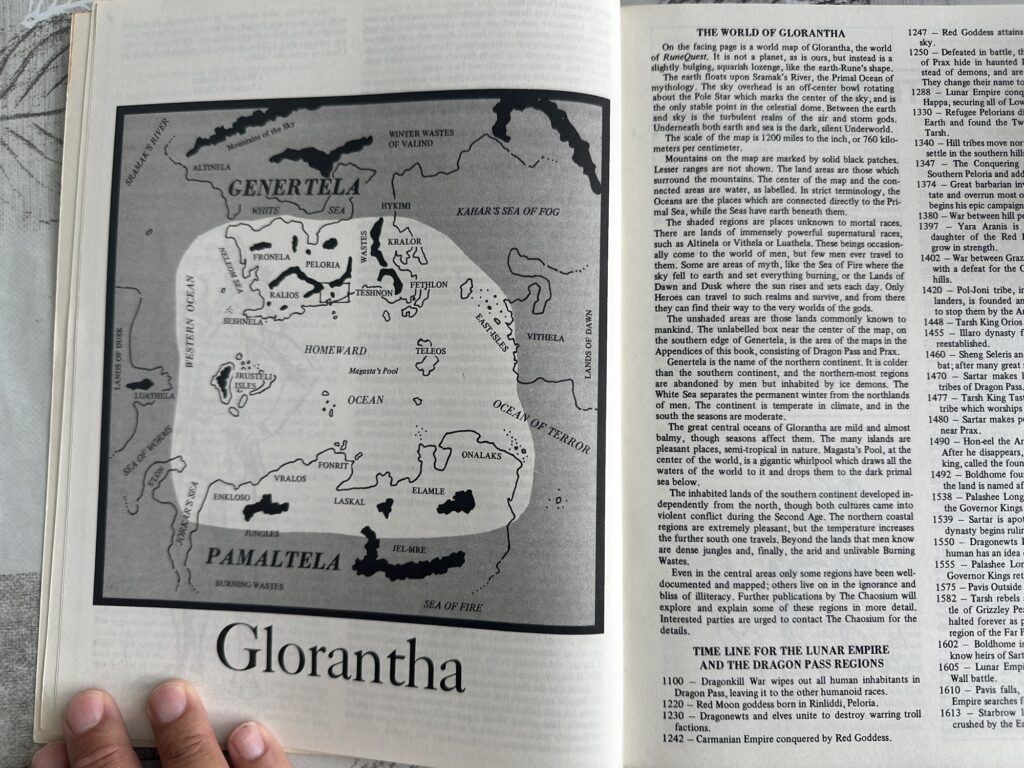
The presentation of Glorantha as a setting takes about 3 pages, plus a map. That’s very compact! I wonder what people thought about it at the time? Too short? Too vague? Just right? Useless fluff?
The “History” section spends an economical single page bringing us up to speed with the creation of Glorantha, the highlights of the God Time, the First and Second Ages, the birth of the Lunar Empire, the Dragonrise, and the Hero Wars, which we are told is the period for the game6. This background material does suffer a bit from the problem of telling us what happened a thousand years ago, which doesn’t matter much in practice, but frankly it’s pretty minor. Some of what it tells us about the past actually does matter a bit. There’s the fact that the Red Goddess is a new god (unlike all the other ones), and she includes many “dichotomies of the Universe, including a touch of Chaos”, which most people hate, hence the Lunar Empire being the “bad guys”. Or the fact that people are afraid of dragons ever since they killed all humans in Dragon Pass a while ago, and yet a dragon helped strike a critical blow to the Lunar Empire.
As you might expect, we are told that Glorantha is a “Bronze Age world” in terms of “social development and cultural level”, and yet the “sociological base” of the setting varies between an “ancient period and early Dark Ages”. Make your mind, Greg! We are also told that Glorantha has more to do with “Mesopotamia, ancient China, Hyboria, and Lankhmar” than it does with Medieval Europe… Sure, I suppose Mesopotamia and Hyboria have similar vibes if you squint a bit, but I kinda pictured Lankhmar as a 12th-to-14th century European city? Am I wrong? This is all a bit messy and not super clear. I’m not sure I would have understood what they authors actually intended, and might have just ignored it.
Oh, and I like the dig at D&D, when it says that “there is no alignment”, and that people have “allegiances to nations, cities, religions, and tribes, not to abstract concepts”. It also sets Glorantha apart from fantasy settings where gods are in direct opposition to each other. I suppose this is a reference, without saying it, to things like Moorcockian “Law vs Chaos” cosmologies. Instead, here “most gods are complementary”.
Hey There’s A Map
Next there’s a cool map of Glorantha! I actually have a bunch to say about this map so I’ll reserve that for another article. Yes, that’s yet another whole article before we get to the good crunchy BRP stuff. Sorry.
For now, let’s just say the text accompanying the map gives us some proper understanding of the “mythic” aspect of Glorantha: it’s not a planet, it’s square-ish block of land floating in a “primal river”, and the outer rim of the world is “unknown to mortal races”, “areas of myth” inhabited by “immensely powerful supernatural races”. That’s cool! It conjures mental images of how ancient civilizations saw the world.
Time Line of the Lunar Empire and the Dragon Pass Regions
The end of the Introduction chapter is a historical timeline from 1120, when the dragons kill everybody in Dragon Pass, to 1627, when Argrath becomes Prince of Sartar. This list of dates and events would be of course very familiar to any modern-day Gloranthaphile, but for someone who discovered the setting with this book in 1978 or 1980, it must have looked very mysterious.
In fact, it’s easy now for me to skip over a lot of the lore sprinkled across the entire chapter, because I know all about it. But this would have been all new to someone who never played Greg’s board games. We see mentions of the Seven Lightbringers, Gbaji the Chaos God, the shaman Sheng Seleris, the Pol-Joni, and even the Syndics Ban, which was probably not explained until many, many years later. Maybe even Greg didn’t know what some of that stuff was!
Again, I don’t know what people thought of it back then, but I suppose they were intrigued, since Greg writes in some APAs how surprised he was at the increasing number of people asking him for more information on Glorantha. He had assumed, wrongly, that most people would rather make up their own setting. Funnily enough, this assumption came from the “vocal” crowd contributing to the APAs, when of course the quieter majority prefers someone else doing the hard worldbuilding work. In the end, Greg promised both Prax and Dragon Pass sourcebooks (the former from Steve Perrin’s campaign, the latter from Greg’s own game), but only the Pavis material ended up published. Sad face.

Anyway, enough ranting! When my ranting is longer than the material I’m ranting on, I’m probably doing something wrong… let’s just end on the funnily tantalizing reference to ducks (“Year 1380: War between hill peoples of Dragon Pass and Ducks.”), which pays off on page 90 where ducks are presented in the Bestiary section as an actual sentient race in Glorantha! I would have loved to see people’s faces back then.
Happy gaming!
- These were basically an old mix of a fanzine, a mailing list, and an internet forum. People would send pages and articles to a central address, all this material would get collated into a fanzine, and the result would get mailed out to all subscribers. This allowed a certain conversational tone, in which contributors replied to one another. A lot of today’s TTRPG discourse about player behaviour, GMing techniques, and types of games was already present in these APAs in the late 1970s! ↩︎
- By the way, it’s sometimes said that Greg bought the first-ever sold copy of D&D from Gary Gygax himself, but that’s a slightly misleading, incomplete truth. One of Greg’s friends, Jeff Platt, met Gygax at a printing shop in Winsconsin, as he was waiting for the delivery of the first D&D booklets. Jeff had a chat with Gygax, realized he was a game designer, and figured he’d buy a copy Gygax’s game to give to Greg during his next trip in California. So the story is true, but only indirectly. Also, some people wonder if, as a result, Greg’s copy was incomplete, in the sense that he only got the booklets and not the box, since the box might have been produced elsewhere. I haven’t found anything conclusive about that but didn’t look very hard. ↩︎
- I can’t really figure out what, in these poems, would help drive the design of the battle magic system. They’re pretty vague verses when it comes to the spells being cast. I’d love to know more though! ↩︎
- I explored this a bit in a previous article in this series, while looking at the marketing blurb on the back of the box. ↩︎
- Sometimes known as “Rule Zero”, or “The Golden Rule”. ↩︎
- It was not. Most RQ2 content would end up set more than 10 years before the date set here. ↩︎