Corporate Gavage
In the past couple years I’ve been thinking about an aspect of 21st century technology that I’m not sure has a name. I thought about it again when I read this recent post by Cory Doctorow on “The ordinariness of evil”. Cory talks about gen-AI CEOs touting the impending danger of their products as a weird and evil way to promote them as something with immense potential in the near future. Something you’d want to invest in now. It’s basically snake-oil salesmanship:
In other words, AI is mostly a novelty, a heavily subsidized toy that produces little more than distraction. Where AI does produce value, that value is comparable to a plug-in, a new feature for your word processor or image/sound/video-editing package that might help you do your job somewhat better, or it might not.
That doesn’t make AI useless, it just makes it a normal technology: useful for some, useless for others, capable of being abused and likely to waste a lot of time when used unwisely.
And so this relates to that thing I’ve been thinking about: that there have been an increasing number of technologies that seem useful for some use-cases, but that we were somehow sold as useful for everyone. Here’s a non-exhaustive list of examples of this phenomenon:
- From the 1980s to the 2000s, 3D-movies were mostly a novelty in theatres. And then some people figured they wanted to turn this into mass-market appeal. We got 3D televisions, 3D cameras and camcorders, and 3D video game consoles. People saw it for what it was, and the market for 3D consumer equipment died in the mid-2010s.
- Virtual Reality was at first either for novelty entertainment gadgets and R&D projects. When the technology had enough breakthroughs, some people identified several relevant use-cases, from architecture to therapy to dedicated entertainment spaces. But once again a few corporations insisted this was the next big thing, pushing VR headsets as mass-market products. They still are, despite consistently failing at it.
- Blockchain, the technology underlying crypto-currencies, is interesting. It was originally meant for digital document signing and other cryptographic use-cases. But it was then decentralized (again, an interesting innovation) and applied to one of the most mass-market products of all: money itself. Many startup CEOs tried to apply this idea to other mass-market products such as art or video-games. They were rightfully ridiculed, but somehow this is still going on.
- And now we have generative AI, which is also based on interesting and useful technologies, from statistical algorithms to machine learning. Anybody can think of a few use-cases where that technology would be incredibly useful, but it’s all been spoiled because, once again, corporations and people with too much money are trying to push it as a mass-market product. And because, unlike previous technologies, the cost of training LLMs is astronomical, we are seeing an equally astronomical push.
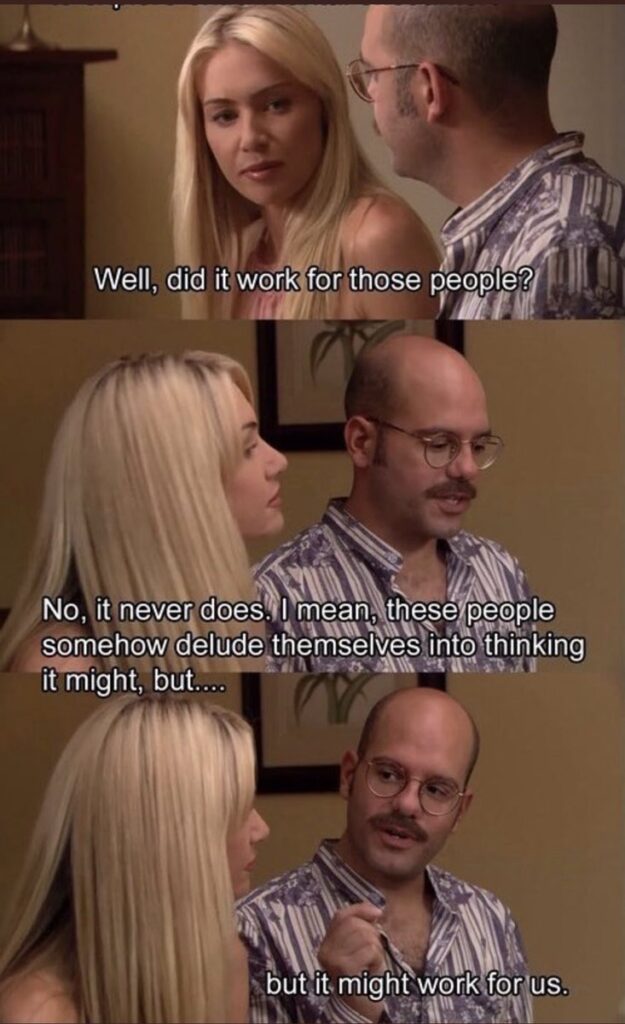
Each time this same phenomenon can be observed: some smart people make a cool technology, and it can be very useful in some specific or niche applications, but greedy people instead want to sell it to as many people as possible. Ideally, they want to sell it to everyone. To make it even shorter:
A technology that could be useful in limited markets is utterly ruined by some assholes pushing it to be mass-market.
The incredible financial successes of the iPhone and Facebook and other similar staples of modern society have rewired the brain of executives everywhere. Any new product or company is a failure unless it makes a gazillion dollars from a billion users. Everything needs to be mass-marketed, even when it doesn’t make sense.
I’m sure this phenomenon has already been noted somewhere, but frankly it’s hard to search for it online when you don’t know what it might be called. So until someone points me at prior art on the topic, and until someone comes up with a better term, I’m going to call it “corporate gavage”, where “gavage” is a French-borrowed term for force-feeding, especially force-feeding animals. I think the metaphor is unsubtle enough that you’ll get it.

I’m going to tentatively use “corporate gavage” liberally from now on, but I’d be happy if anybody could point me to prior writings on this topic! Again, I did some online searches, but didn’t find much that was relevant.
Granted, I didn’t search very long. I’m lazy.