Reading Classic RuneQuest: Open Box!
Welcome to Open Box, the part of the blog where we look backwards to look forw… wait, no that’s not correct1. It’s the part where we open the 2nd edition RuneQuest boxed set, like I said we would in the preamble! Let’s be careful with those corners, lift the lid, and take in the wonderful smell of old paper!
Which Box Are We Opening?
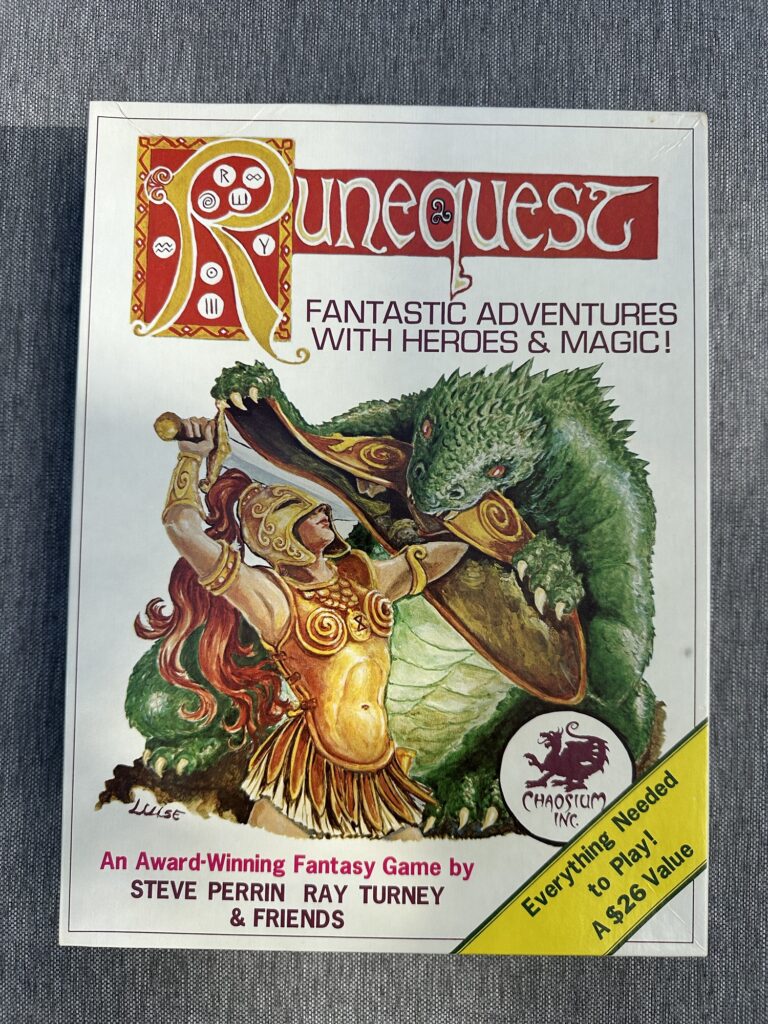
According to Chaosium president, historian, and “head of the nostalgia department” Rick Meints’ excellent Meint’s Index to Glorantha (aka “MIG”), this 2nd edition box is a first printing.
- The 2-inch deep box has the extra “A $26 Value” statement on the front yellow strip, used for 1st and 2nd printings.
- The rulebook inside has the brown monochrome cover, indicating a 1st printing.
- The Basic Role-Playing booklet has a “NOT FOR RESALE” warning on the cover, which also probably points at a 1st printing. The MIG doesn’t mention it but others on the internet do. I actually reached out to Rick Meints who very kindly replied that this BRP booklet was originally used as promotional material as well, to be handed out at conventions and sent to game stores, hence the warning (which was dropped in subsequent printings).
Front and Back of the Box
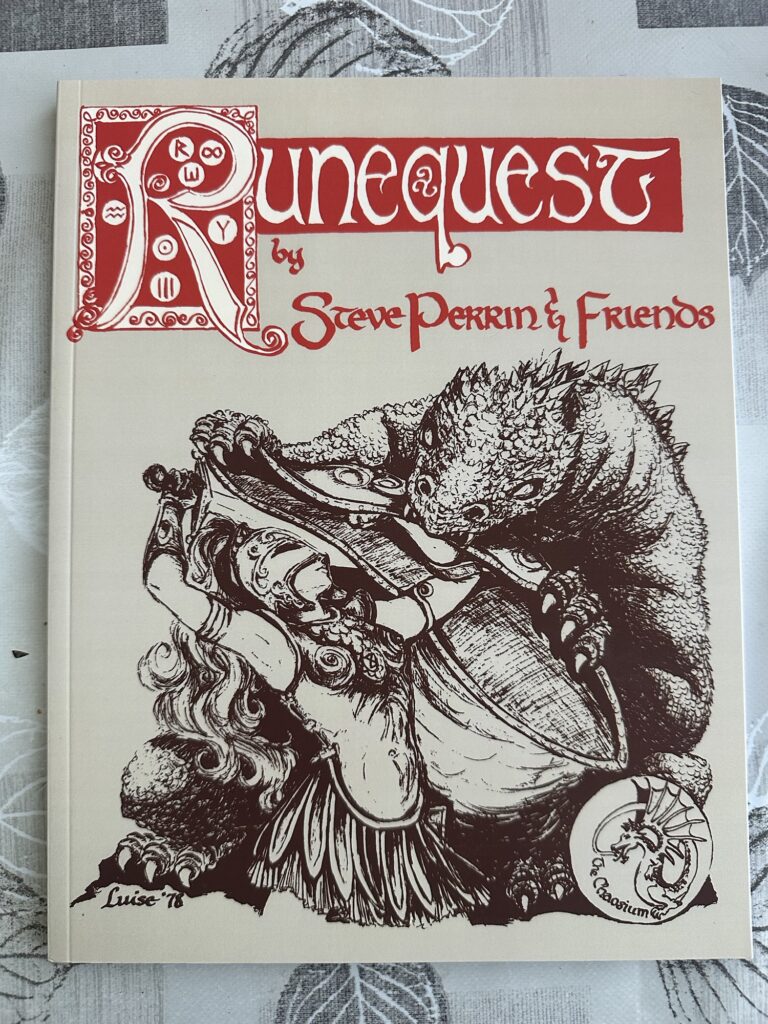
The front of the box is of course the famous and iconic painting by Luise Perrin (Steve Perrin’s wife), which is itself a colour version of the cover she did for the 1st edition of RuneQuest (pictured above).
I don’t have much to say about this cover except trying to identify who the protagonists are… is that monster a Bolo Lizard, or a Dragonewt, or what? And who is that lady warrior? Is that “Life/Fertility” Rune on her chest an indication of her cult, or simply some enchanted medallion with a Healing spell?
Edit: Rick Meints tell me that he spoke to Luise about her art. The monster is a Rock Lizard2, but the lady warrior is just a generic character with some Rune slapped on to make it look Gloranthan. Luise wasn’t very much into Glorantha.
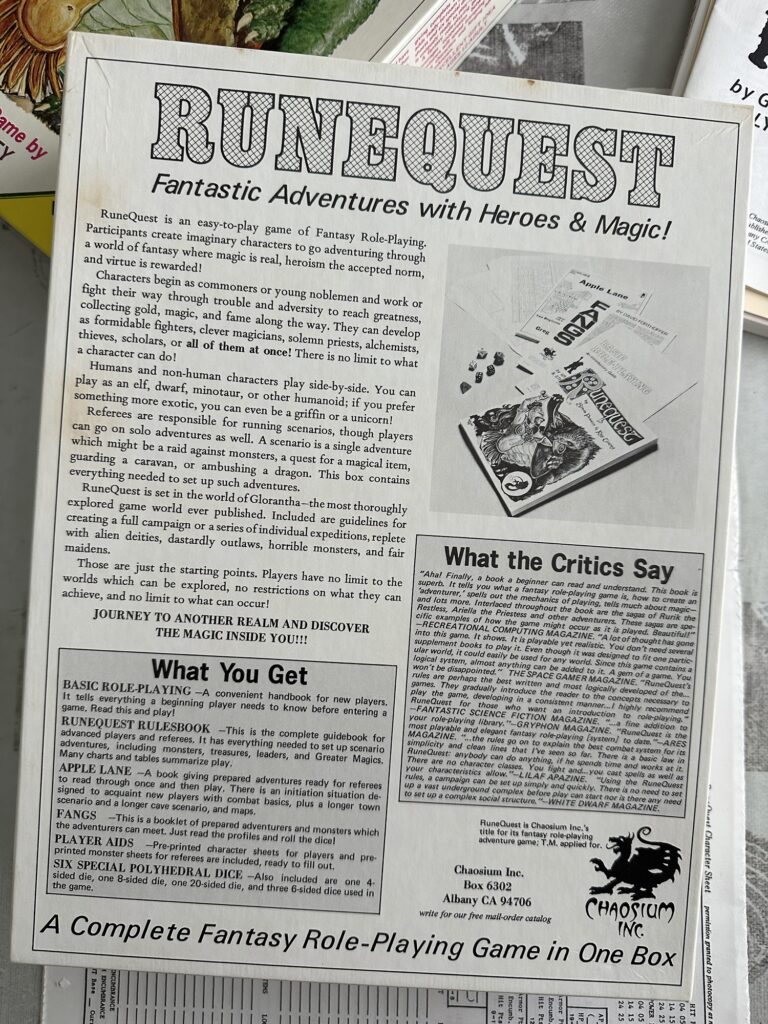
The text blurbs on the back of the box promise many things. For instance, it mentions that you can develop your characters as “formidable fighters, clever magicians, solemn priests, alchemists, thieves, scholars, or all of them at once! There is no limit to what a character can do!”. Take that D&D! Your arbitrary, gamist class limitations have no power here! We are in a simulationist heaven!
More interestingly, it says that not only you can play as an elf, dwarf, minotaur, or other humanoid, but you can also be a griffin or a unicorn! Did anybody actually do that? This suddenly opens up many new horizons for playing in Glorantha…
The mention of the world of Glorantha adds that it is “the most thoroughly explored game world ever published”. I don’t know if we should take this claim at face value but it frankly can’t be too far off? Let’s see… in 1980, RuneQuest content set in Glorantha already had half a dozen official publications, adding up to almost 300 pages, plus 8 issues of Wyrms Footnotes for another 250 pages3, plus at least a couple of Judges Guild supplements for another 80 pages or so. What else was there?
- Tekumel? As far as I can tell, it only had the one book published so far, clocking at about 120 pages.
- Greyhawk? The original supplement was about 70-pages, and I think that was it.
- Blackmoor? There was a 60-pages supplement a few years prior, and a 96-pages Judges Guild campaign book. The rest came only a few years later.
- Gamma World? Again, only the first book was released, less than 60 pages long.
- City State of the Invincible Overlord? Just a couple books out, for about a 100 pages of content.
- Forgotten Realms? That was barely a mention in the pages of Dragon Magazine at the time.
- The Third Imperium? Arguably that’s the one that comes the closest. I can maybe count around 250 pages of official content by 1980, plus 5 issues of the Journal of Traveller’s Aid Society for another 200 pages… But it’s debatable how much of that content would be considered “Third Imperium content” and not just “example content for your own galactic sandbox”. Traveller in 1980 was arguably still trying to be a “generic sci-fi game”. It’s only later that GDW finally caved in and made the Third Imperium an official setting.
What else can you think of? Did I forget something obvious?
Edit: Rick Meints helpfully points out that this part of the back-cover text was already mostly present on the back of the standalone RQ2 rulebook, and was therefore written in 1979. That changes some of the items in the list above, and probably makes Glorantha stand out even more.
Anyway, the other interesting bit here are the quotes from magazine reviews (bottom right), who all praise how simple, playable, and realistic RuneQuest is. I suppose we have to remember that, at the time, D&D only had the “Holmes” Basic Set, and the “Advanced D&D” trilogy of books. These were the days of THAC0 and switching between D20s and D100s in a confusing way depending on what you’re doing. On the other hand, games like Traveller came out around the same time as RQ1, so there was no exclusivity on simplicity, elegance, and class-less skill-based systems. Either way, this is the kind of historical context I will probably struggle to grasp because I obviously wasn’t there.
What’s In The Box?
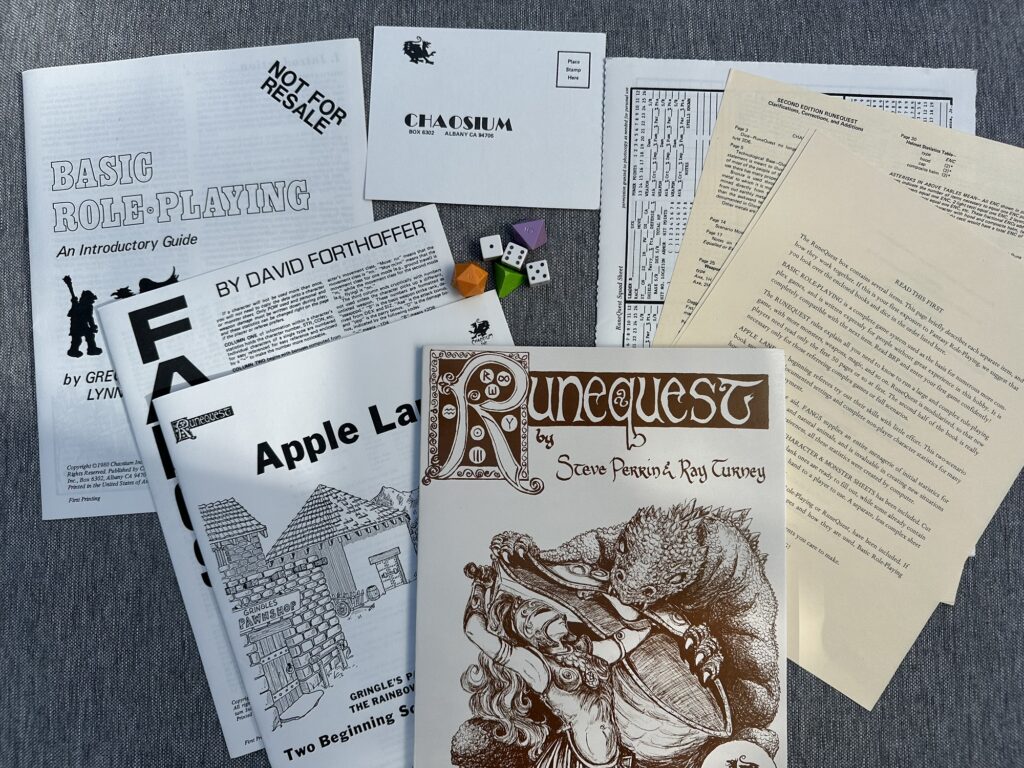
The box contains a bunch of good-looking stuff (in a “retro” kinda way), and I would have definitely been all giddy about it if I got this box as a 13 year old. Hell, I’m getting all giddy about it now. I love a good boxed set! This one contains:
- A “READ THIS FIRST” sheet, which helpfully describes what you’ll find in the box, what to do with it, and in what order.
- A feedback card, to send to Chaosium’s PO Box in Albany, CA.
- Six plastic polyhedral dice.
- The “Basic Role-Playing” introductory guide, a 16-pages booklet that presents the basis of the BRP system.
- The “Runequest” rulebook!
- A sheet titled “Second Edition RuneQuest: Clarifications, Corrections, and Additions”, better known these days as the “errata”.
- The “Apple Lane” booklet, with 32 pages of scenarios and maps.
- The “FANGS” booklet, with 16 pages of pre-generated monsters and NPCs.
- Some character sheets and NPC sheets.
Read This First!
Interestingly, I have two copies of the “READ THIS FIRST” sheet. I have no idea if the person who sold this box to me had some spare one that they shoved into it, or if Chaosium occasionally grabbed two pages instead of one. I’m leaning towards the latter.
The text recommends to look at the contents in the following order:
BASIC ROLE-PLAYING
This is described as a “complete game system” used for “numerous more complex games”. I’m not sure what these other games are, though. This boxed set is from 1980 and I don’t think Chaosium was publishing any other BRP game at the time? Maybe they wrote it with Call of Cthulhu and Stormbringer in mind, both of which would be published the following year? In fact, the back of the “READ THIS FIRST” sheet lists the “RuneQuest Family of Games and Game Supplements”, and includes a teaser for “ELRIC”, coming in “early 1981”.
The BRP booklet is said to be “written expressly for people without great experience in this hobby”. Great! It’s like a Quickstart booklet sold along with your core rulebook! What an idea.
I can’t help but think that a 16-pages game system would probably be called a “zine game” nowadays. This goes to show how rulebook sizes have changed over time. Anyway, we’ll dive into that booklet with the next article.
RUNEQUEST
This apparently contains “all you need to know to run a large and complex role-playing game”. More importantly, it notes that “RuneQuest is modularized, so that new players need read only the first 50 pages or so at first”. This basically includes the introduction, character creation, game system, and “battle magic” (known in these modern RQG days as “spirit magic”). So reading only the first 52 pages (to be exact) only skips Rune Magic, the bestiary and treasure chapters, and the appendices, which are described as necessary only for “refereeing complex games or full scenarios”.
If you’re wondering how that compares to RQG: after 52 pages, you’re not even done with character creation! And at 120 pages (the full length of the RQ2 rulebook), you still haven’t learned the basic mechanics! To me, 120 pages hits a sweet spot of “plenty of material” without having “too much material”. This is a great page count. We’ll look at this after the BRP booklet.
APPLE LANE
The text here describes the two scenarios and “fully-documented settings” therein as a way to let “beginning referees try out their skills with little effort”. We’ll look at this after the RuneQuest rulebook.
FANGS
This is a “more generalized referee aid” that provides “an entire menagerie of initial statistics for human characters, monsters, and natural animals”. I’m not sure why it feels the need to add that, “for comprehensiveness, all these statistics were created by computer”. I suppose it sounds super cool and futuristic to a 1980 kid? We’ll look at this last.
RUNEQUEST CHARACTER & MONSTER SHEETS
Some of these are blank, and some supposedly already contain beginner character statistics, “ready to hand to a player to use”. Imagine that, we’ve got a Quickstart and now also pre-gen characters! What another idea. Sadly, my copy doesn’t seem to include these pre-gens: I only have blank ones.
We are also informed that a “separate, less complex sheet” exists for BRP. I suppose that’s in case you wanted to play non-RuneQuest games with only the BRP booklet. Sadly, I also seem to be missing those.
If anybody has pictures of these pre-gens and of the BRP character sheet, I’d love to see what they look like!
SIX DICE
Those are supposedly “sufficient to play either Basic Role-Playing or RuneQuest”. Well, reader: they barely are. More on this later. But I love how the text says that dice usage is described in the BRP booklet “if you are unfamiliar with these interesting shapes”.
Does Someone Need… Persuading?
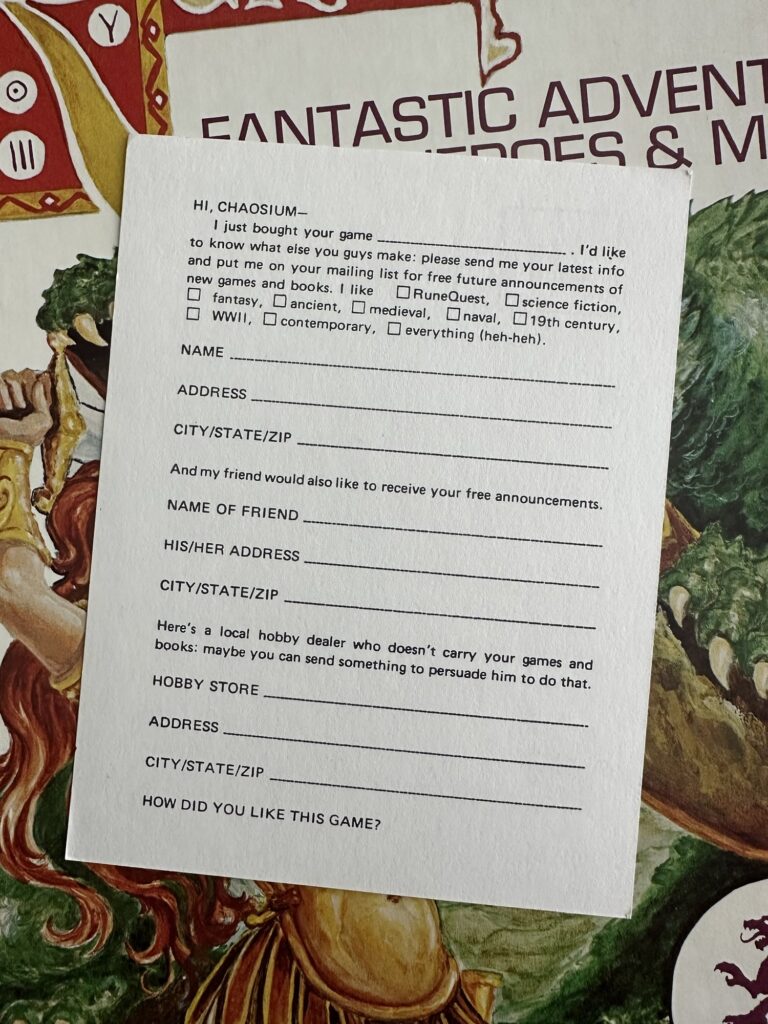
The last line of the “READ THIS FIRST” sheet invites you to use the “enclosed response card”, pictured above. Yes, I’m interested in “everything (heh-heh)”!
I also love how you could, at the bottom of the card, rat on your local game store’s owner for not carrying Chaosium products. I’m not sure if “maybe you can send something to persuade him” meant “send him promotional material and a few free books”, or “send him a severed bison head and some disease spirits of Mallia”…
Between the Sheets
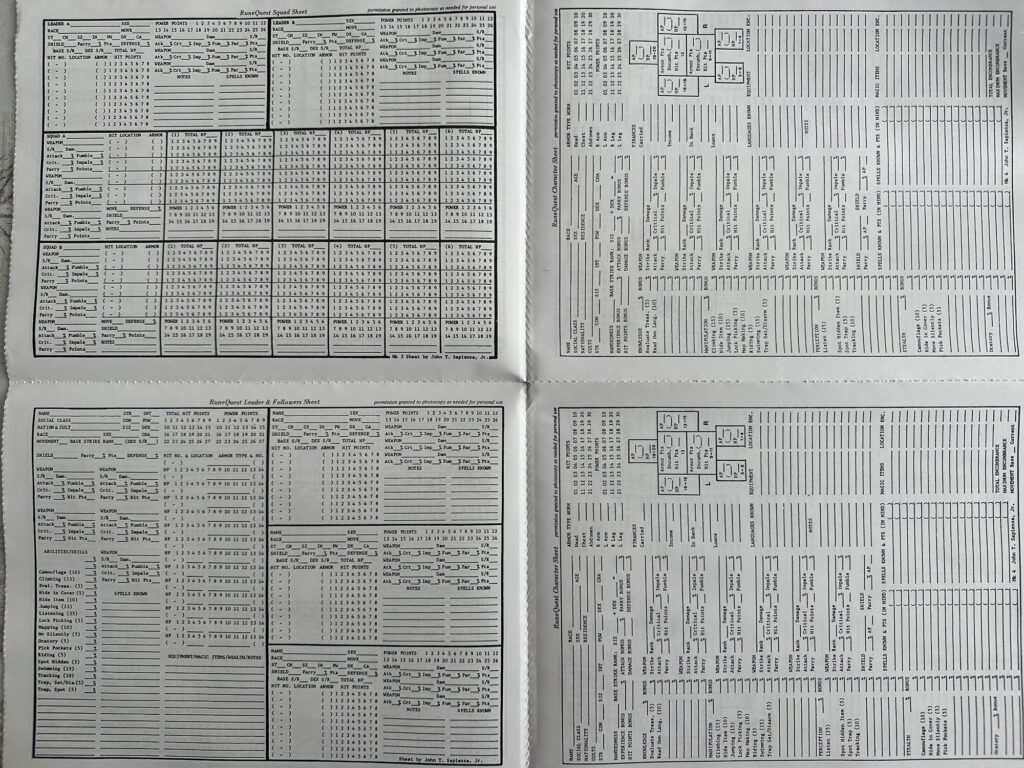
The collection of character and monster sheets are printed in various orientations on what feels like old-timey newspaper pages. They’re easy to tear off thanks to some perforated folds.
The “RuneQuest Character Sheet” looks quite busy and complex by modern standards, but also probably by the standards of 1980. It does look more complicated to me than the D&D “Holmes” Basic Set’s character sheet (which can fit on less than half a page), or whatever Traveller would have needed at the time… interestingly enough, I don’t think Traveller had any character sheet: you could just write down what you needed on an index card.
Other sheets include the “RuneQuest Squad Sheet”, with two “leaders” and two “squads”. Each squad has up to 6 characters or monsters, and the whole page is organized to help the referee keep track of hit points and such. Another sheet is the “RuneQuest Leaders & Followers Sheet”, similar to the squad sheet but with only one leader and three followers, and more room for detailed stats. The last sheet type is the “RuneQuest Game Master’s Player-Character Sheet”, which helps track some player character information such as their hit points, nation, cult, characteristics, etc.
It feels like this is one area where RuneQuest shines compared to the other games of the time. I don’t think any of them gave the referee helpful sheets like this… but then again, maybe they didn’t need them because they had simpler systems?
These Interesting Shapes
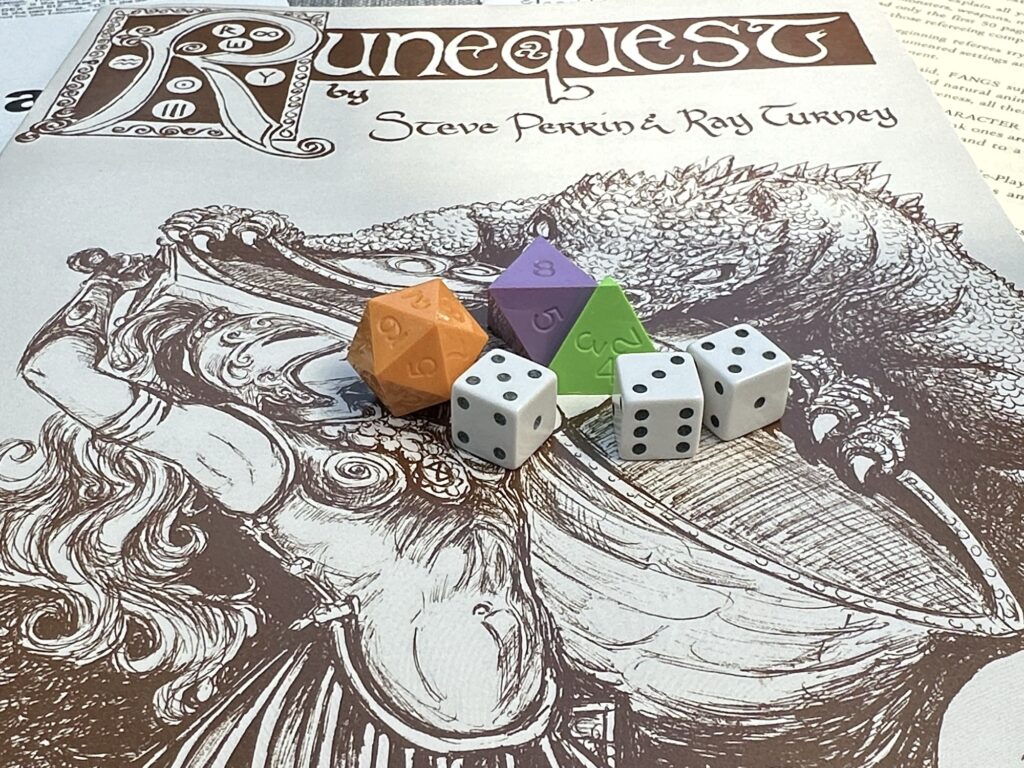
Of all the things in the box, I didn’t expect the dice to be so fascinating… but they are!
Here we have three white D6s, and three other coloured dice: a D4, a D8, and a D20. Mine are green, purple, and orange, respectively. Apparently, every box had different coloured dice because Greg and the rest of the Chaosium staff just grabbed them from a big jar containing dice of all kinds of colours.
At first, I thought the copy I got was incomplete. Don’t you need 2D10s to play a percentile-based system? No worries, I thought. It’s hard to find a 100% complete original boxed set after all these years. These dice are pretty ugly anyway: there’s no consistent colour theme, and the D6s don’t match the scale and style of the other ones.
On the plus side, I guess Lou Zocchi would be happy with how sharp these dice are. The edges are so crisp you can almost cut yourself on them4. Come to think of it, it’s very possible Lou Zocchi actually made these dice. I haven’t been able to confirm it but based on pictures of GameScience dice (Zocchi’s company at the time), these dice look very, very similar, especially the “truncated points” on the D4.
Anyway, I was shocked to realize later that, no, I am not in fact missing any dice. The BRP booklet explains it on page 4.
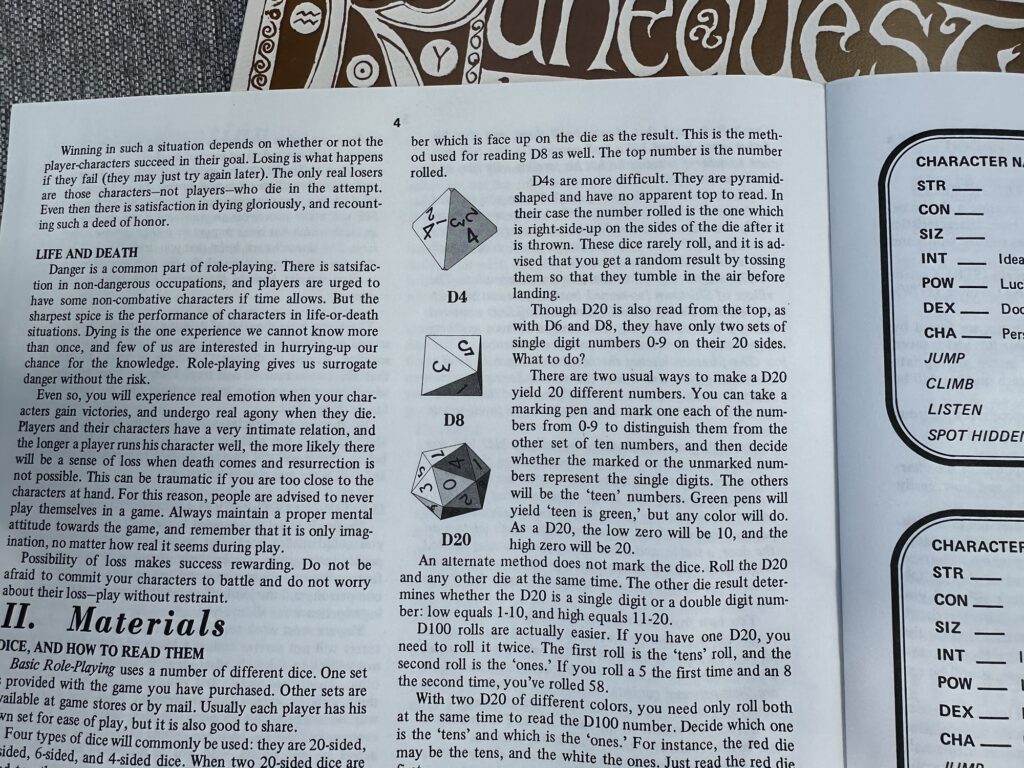
The page explains how to read the dice, and in particular how to read the D20. Or, rather, the 20-sided die… because, reader, I was biased as a 21st century gamer: this is not a D20! This is, basically, a double-D10! It’s a 20-sided die with faces numbered 0 to 9 twice. So what do you do with it? The BRP booklet gives us two ways to actually roll a D20.
- The first option is to take a marking pen and mark one of the two 0-to-9 faces each. Unmarked faces are “unit numbers” and marked faces are “tens” or “teens”. That is, an unmarked 2 is a 2, and marked 2 is a 12. The booklet recommends using a green marker, because then all you need to remember is that “teen is green”. Note that the “unit zero” is actually 10, and the “teens zero” is actually 20.
- The other option is to roll another die to determine “units” vs “teens”. For example, roll a D6 along with the D20. If the D6 comes up 1-3, the D20 is a “unit number” (in the 1-10 range), and if the D6 comes up 4-6, the D20 is a “teens” (in the 11-20 range).
Very straightforward, isn’t it?
I looked up some information on the D&D “Holmes” Basic Set and, from what I’ve seen, it has similar instructions… how did I never realize that people playing D20 and D100 systems in the late 1970s did that without actually having any D20 and D100?? That’s wild! It’s like looking at old 1990s video-games like “GoldenEye 007” or “Ultima: Underworld”5 and realizing how they invented 3D controls before anybody knew how to do 3D controls…
Rolling a D100 is, we are told, “easier”: you roll the D20 twice! The first roll is the “tens” roll, and the second roll is the “ones”. It does of course recommend getting your hands on a second D20 of a different colour. Then you can assign a colour to the “tens” and the other to the “ones”… oooof.

Happy Gaming!
Okay, that’s enough ranting about this box. The “READ THIS FIRST” sheet ends with a “HAPPY GAMING!” message, so let’s end these articles the same way. If you got this RuneQuest boxed set yourself in the early 1980s, I’d love to know what you thought of it! Otherwise, see you next time as we dive into the Basic Role-Playing booklet!
- If you don’t get this reference, may I point you to one of the best TTRPG podcasts out there? ↩︎
- Even though, according to the RQ2 rulebook, Rock Lizards are supposed to have gray, stone-looking skin! ↩︎
- Arguably the early issues had a fair bit of that page count dedicated to White Bear & Red Moon and Nomad Gods, the Glorantha board games, but it quickly transitioned to RuneQuest content and general Gloranthan lore. ↩︎
- I’m exaggerating of course but the edges are noticeably sharper than almost all my other dice sets. ↩︎
- If you’re interested to know more about this ground-breaking video-game, this video is really great. In fact, if you’re interested in the Ultima series, or if you’re a big fan of it like me, the whole series’ retrospective by Majuular is a must-watch. ↩︎