Some Notes on Dragonbane
If there’s a sure way to get my attention, it’s including some good looking maps in a game. But a sure way to get an instant buy is to include a big-ass cloth map in a game. That’s what Dragonbane did with their original crowdfunding campaign, and so of course I backed it at the “Deluxe Bundle” level. But wait! Instead of forgetting about it by the time it shipped, and then collecting dust on a shelf after receiving it, we actually played it! Shocking, I know. So here, let’s talk about Dragonbane!
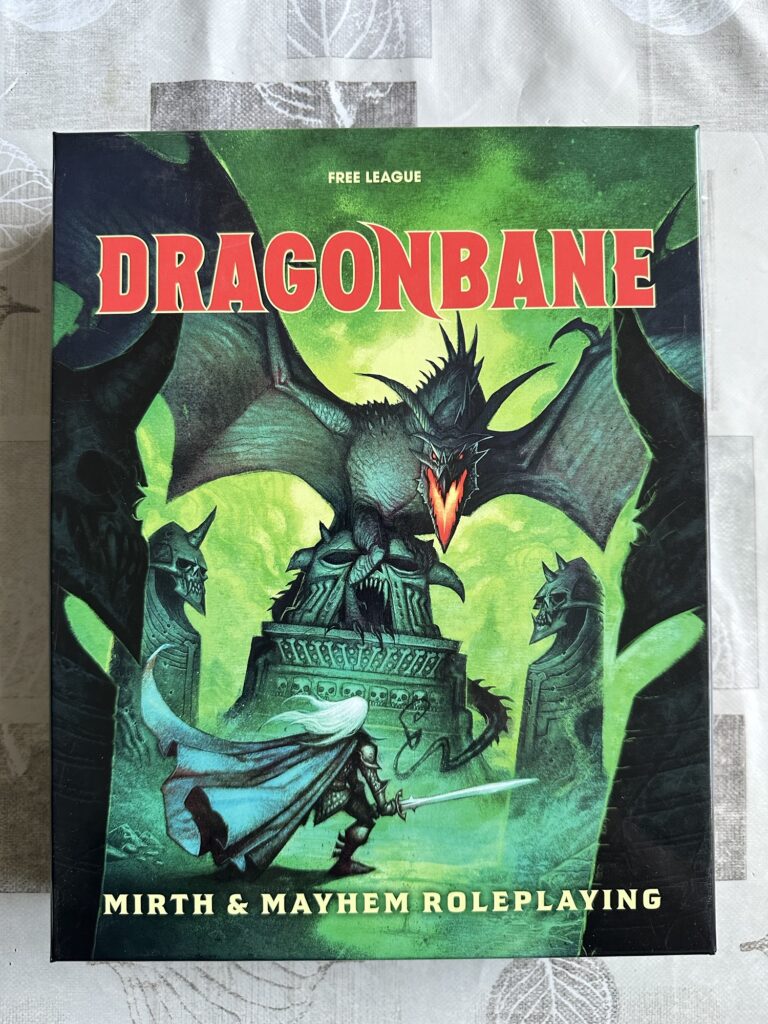
That Nice Boxed Set
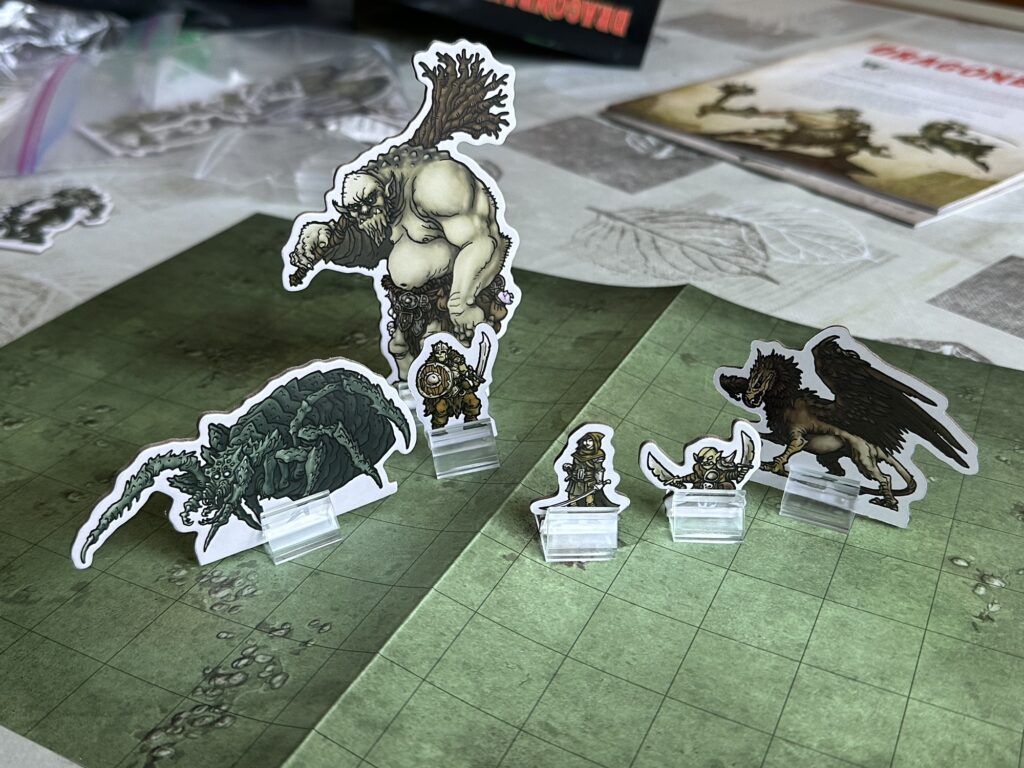
First, we have to talk about the boxed set. It’s great! It includes a welcome sheet, two books (Rules and Adventures), some pre-gens and character sheets, a solo-adventure with solo-gaming tools, a set of dice, some standees, a small generic battlemap, various card decks (including initiative and treasure cards), and a map of the Misty Vale on thick almost-cardboard paper. The art by Johan Egerkrans is, like in Vaesen, awesome, giving a consistent vibe throughout the whole game.
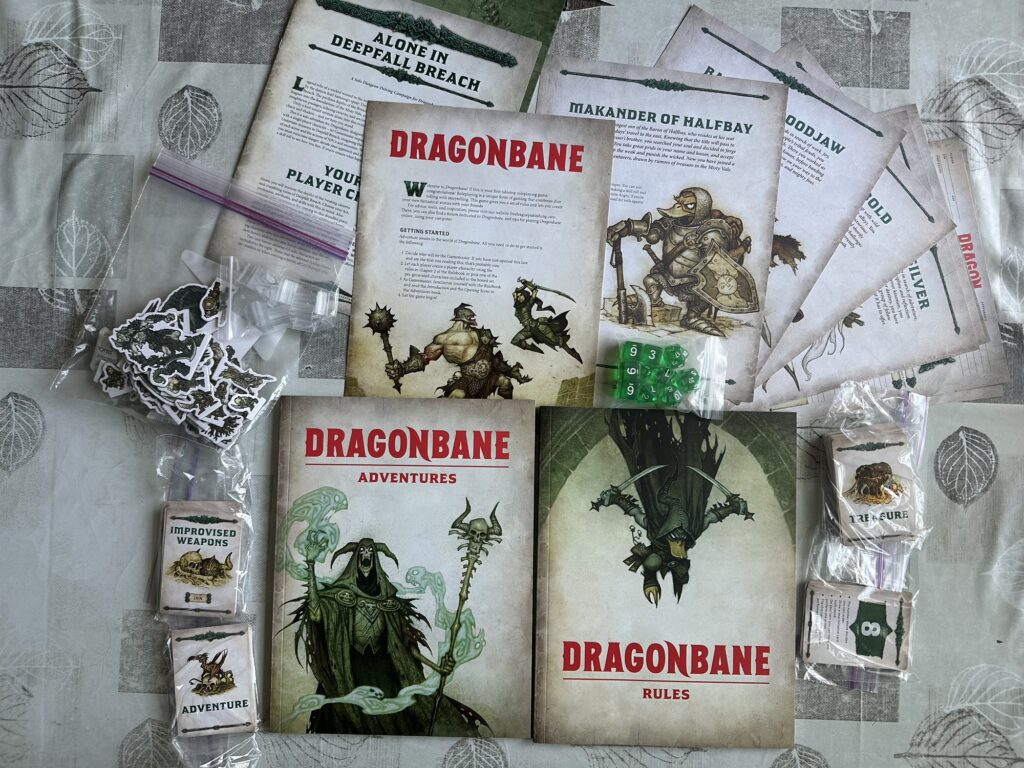
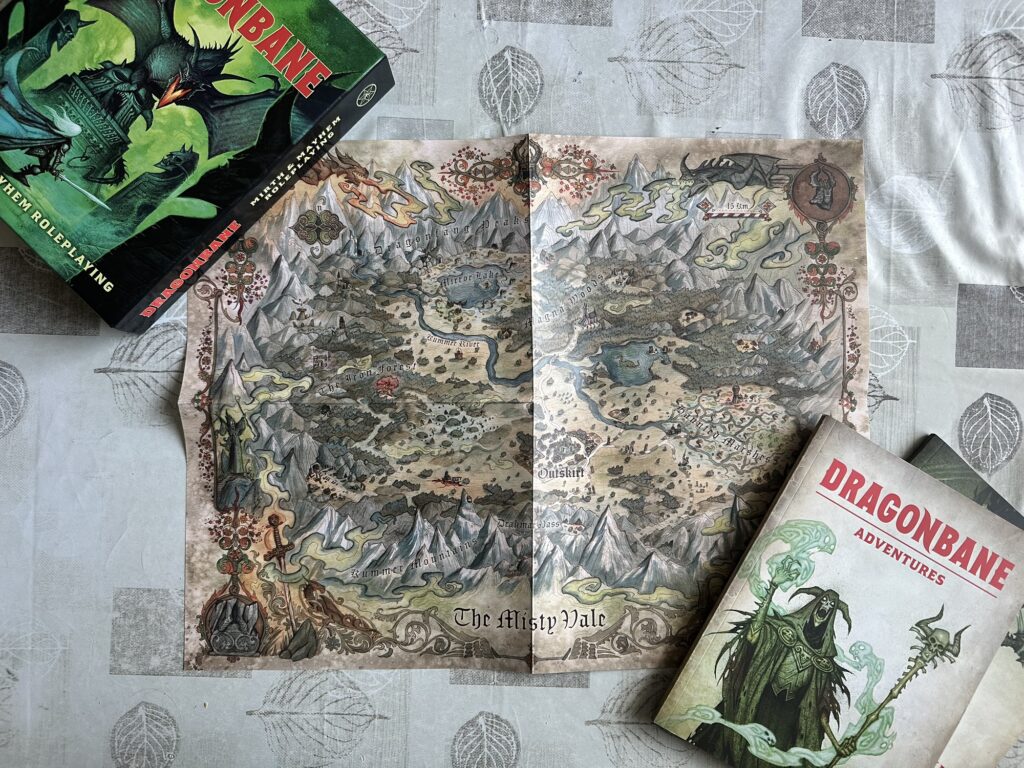
Of course, if you’re like me, you got the aforementioned big-ass cloth map which is much bigger as you can see below. I can confirm that between the cloth map and the standees, Dragonbane got quite a few “oooh” and “aaah” from the players when we did our first face-to-face session.
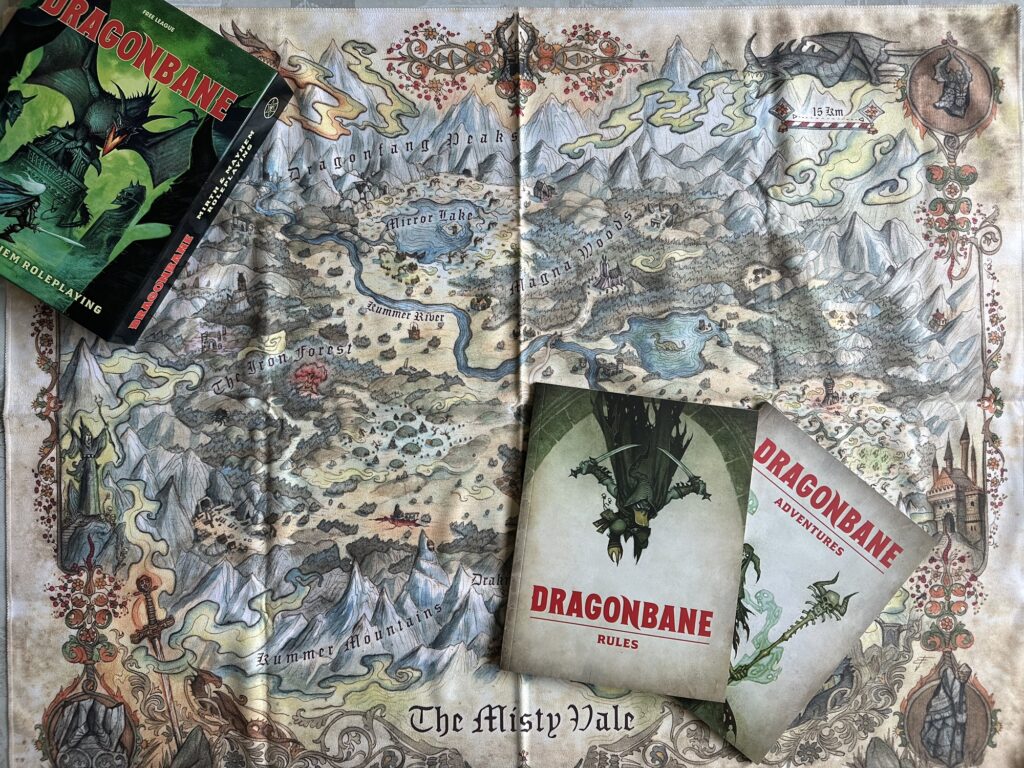
In practice, we played 90% of the campaign online, so it’s worth mentioning the Foundry VTT module which, as is now expected from Free League, is very well done.
The Dragonbane boxed set sort of looks and plays like a Starter Set, with its solo adventure, pre-gens, and general form-factor… but it’s an “actual” game, so to speak. I was recently complaining about the inflation of rulebooks with each subsequent edition of long-running game lines, so it’s refreshing to see a 40-year-old game like Dragonbane receive such a lean and clean new edition.
Now that I started looking at the classic RuneQuest 2e boxed set, I see similarities between it and Dragonbane’s. I think I read somewhere that Free League wanted to give us the “feel” of the old-school games, but with a “modern” ruleset. In that regard they did succeed pretty well… and sure, it’s not like there are many ways to pack a TTRPG boxed set, but the contents and rulebook size are quite similar in spirit, and I dare you to show me many other recent games that were released in a similar boxed set (not a Starter Set!) Big applause to Free League for that as far as I’m concerned.
Drakar och Demoner, Expert
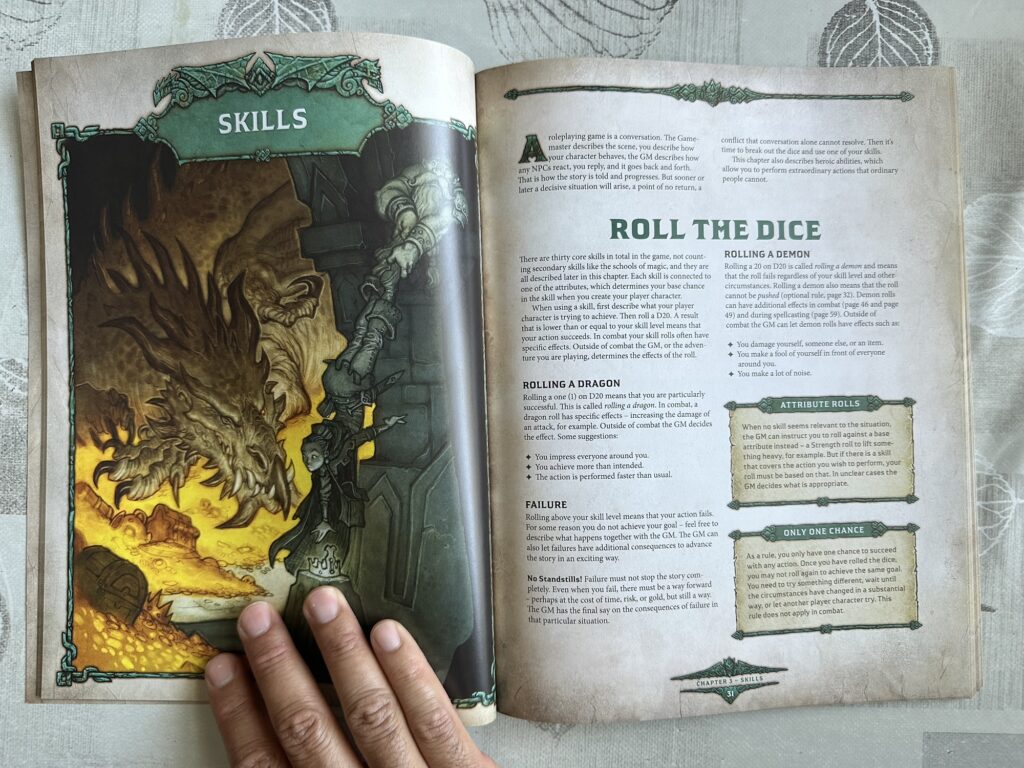
It’s worth noting that Dragonbane is the newest iteration of a Swedish fantasy TTRPG named Drakar och Demoner. It was originally a BRP-based game published in 1982. Contrary to popular belief, Free League didn’t convert it from a D100 to a D20: that was done almost immediately with the “expert” rules of Drakar och Demoner, published in 1985. Stu Horvath (of Vintage RPG fame) has an article about it if you want more information.
I’ve heard quite a few people praise the new system, mentioning (tongue-in-cheek) that Chaosium should have “modernized” RuneQuest in the same way. And while I do agree up to a point (both the need to modernize RuneQuest, and the desire to hack Dragonbane to play in Glorantha), the “feel” of RuneQuest or BRP is gone from Dragonbane. You can see the BRP serial numbers filed off, sure, but it feels like a whole new, different game. It’s much closer to what Greg Stafford did with Pendragon, actually. Chaosium likes to say that Pendragon is a “BRP game”, but frankly we all know they’re lying to themselves. Just because a character sheet has a handful of uppercase acronyms for characteristics rated 3-18, doesn’t mean a game is “BRP based”.
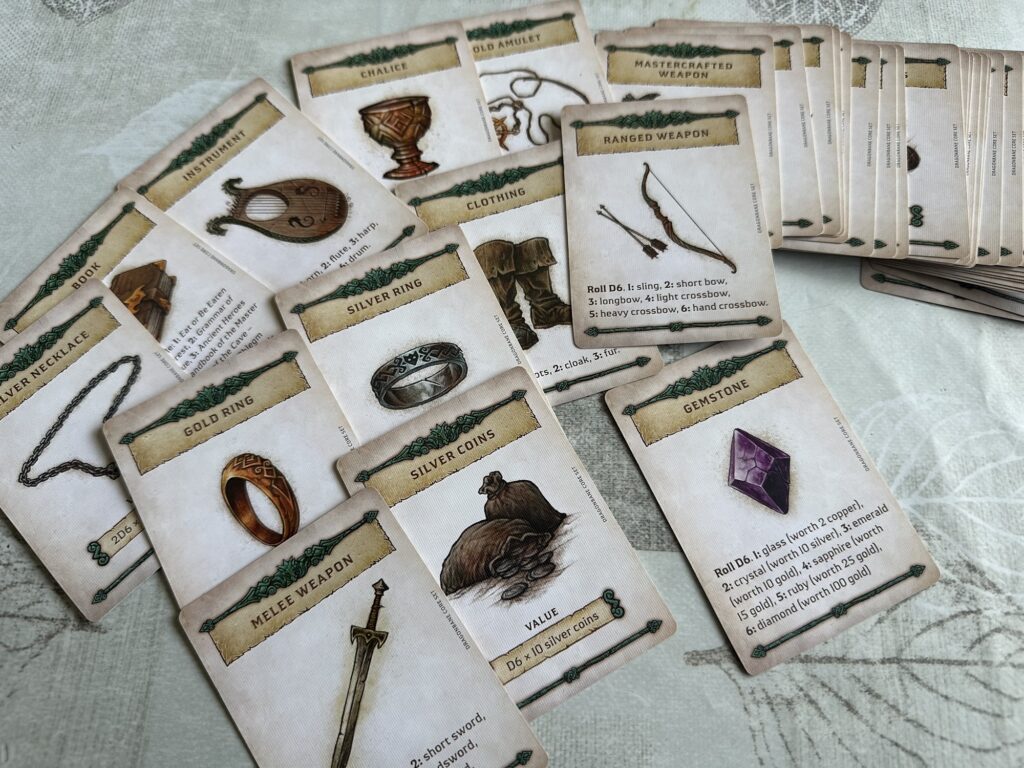
Anyway, I guess my point here is that Dragonbane feels like its own unique self. It’s like fusion cuisine. You get hints of RuneQuest with the basic stats, the damage bonus, the playable ducks, and so on… mixed with hints of Free League gamism such as card-based mechanics, conditions, and a buffet of heroic abilities.
Some Light Crunch for Dungeon Crawling
In my group we all really liked the system. It’s simple enough to get a good grasp of it after a couple sessions, but crunchy enough to keep you occupied for a couple dozen more. The system is really geared towards old-school dungeon crawling and adventuring, with most of the rules focused on combat and wilderness travel. Yet, it spends a bit of room on some social abilities, so you have a little bit to do in between expeditions.
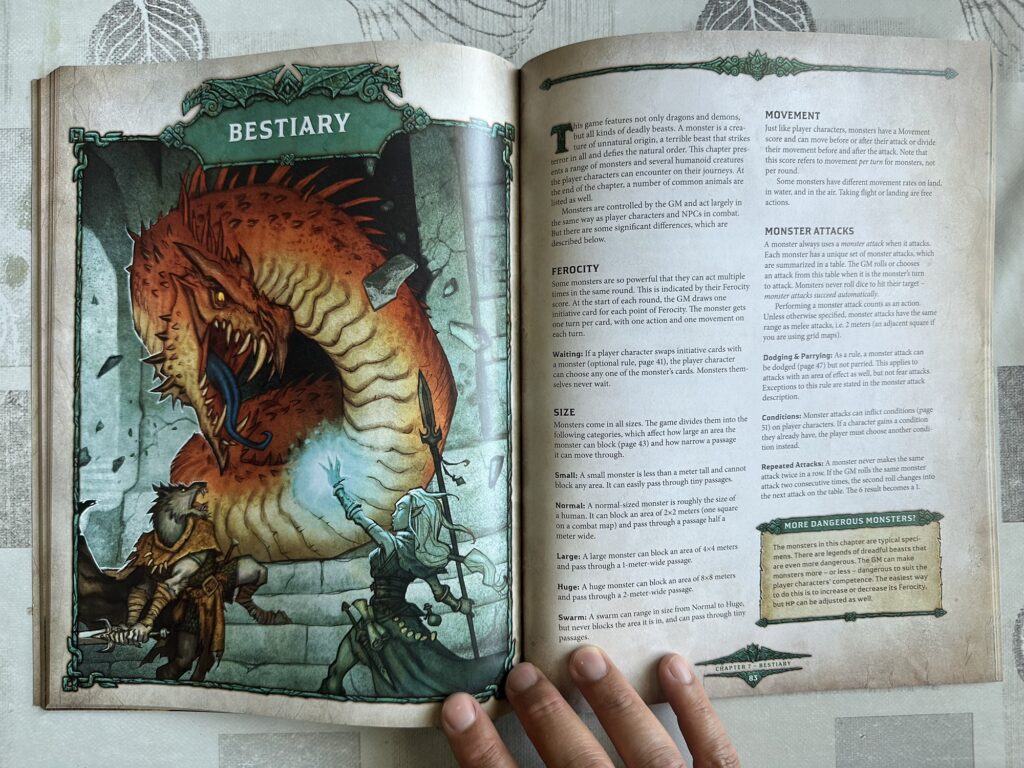
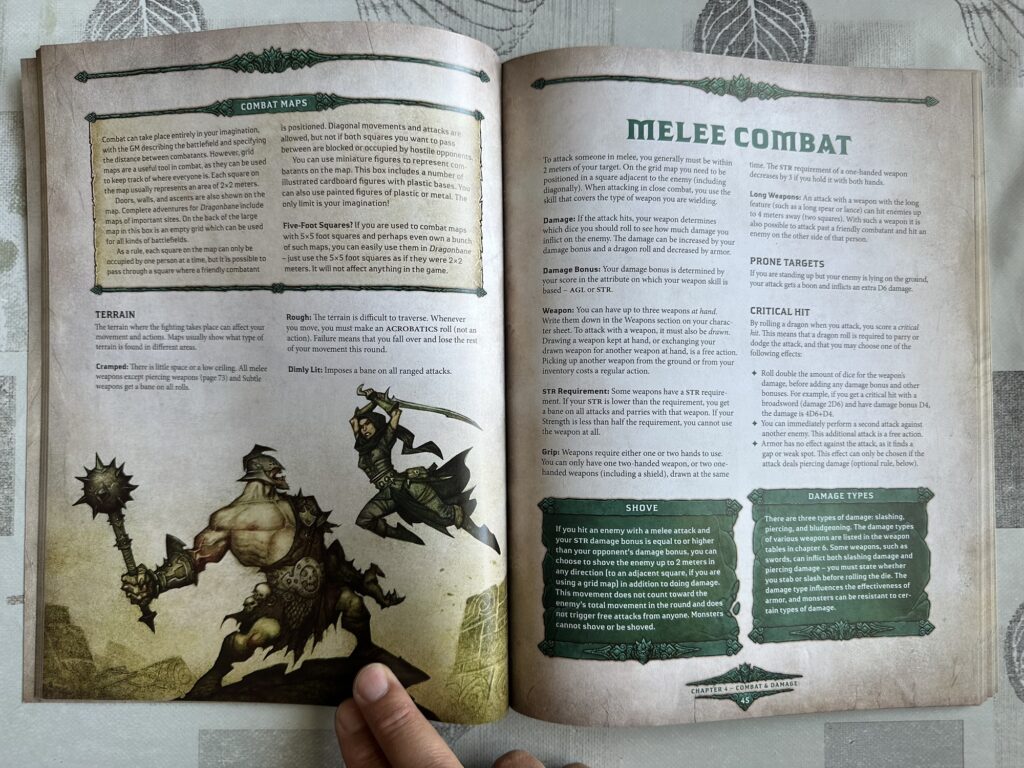
The min-maxers in the group had enough knobs and levers to happily optimize their character, between combat stats, heroic abilities, and a late investment in magic which paid off greatly at the end. Everybody enjoyed the brutal and tactical approach to combat, too. Dragonbane states that defending against an attack requires spending your action… or just getting hit if you have already acted. This means having to either make hard choices, spend Willpower to activate heroic abilities that grant extra actions, or building your character like a tank to absorb most of the mooks’ damage. My players appreciated these options, along with the Willpower economy which also brings its own set of choices. Frankly, every combat felt dangerous, tense, and/or heroic.
Even the inventory and encumbrance system was appreciated because, though straightforward, it also led to hard choices during our adventures. You could summarize Dragonbane’s design philosophy to this: simple design, impactful choices. It’s really a well done game.
The Misty Vale Setting
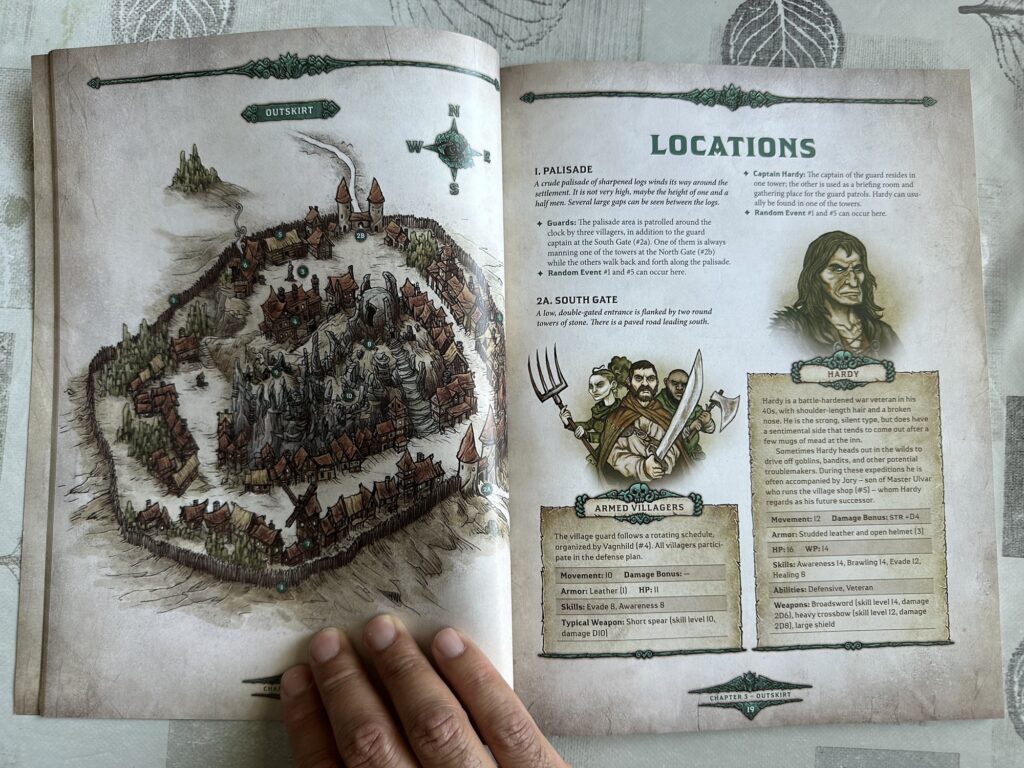
Dragonbane comes with a full campaign, set in the Misty Vale: a valley that was previously off-limits due to a magical fog that has now mostly lifted. There’s a small village called Outskirt, the main human settlement of the valley. Various groups of adventurers (including the players) use Outskirt as their homebase to explore the half-forgotten sites of the area. But as the player characters enter the valley, they stumble upon the start of the campaign’s overarching plot: a dying monk holding one of the four pieces of some old statuette which, it is said, can unlock the tomb of a legendary hero whose sword is the McGuffin various factions are after.
Just as the Dragonbane system looks simple but creates exciting choices at the table, the Misty Vale campaign also looks simple, but is the blueprint for an exciting classic fantasy story.
The setting is organized in a bit less than a dozen adventure sites that the players can visit in any order except for the one with the Big Bad Evil Guy who can only be killed with the McGuffin sword. Three factions are looking for the sword, and a couple more groups can get involved once you stumble upon them, so the gamemaster has a lot of pieces to play with. There are even a couple of plot twists baked into the campaign. It’s a really fun sandbox, simple yet effective.
We played for a bit less than 30 sessions (about 2 hours of play each), and went through about two-thirds of the adventure sites.
Each adventure site is short and to the point (generally between 5 and 10 pages), and quite varied from one to the other. I was originally worried it would just be variations of dungeons with a big monster in it, but that is far from the case. Each site is pretty unique, and often the players have an opportunity to clear it by other means than brute force. My players also praised the quality and variety of the adventure sites when I gathered feedback at the end of the campaign.
On the GM side, I found each adventure site easy to read and prepare for, and super fun to run. In most cases, I only had to read it once before running. In fact, I have to say that Dragonbane is one of the easiest campaigns I’ve run in a long time. It might of course have to do with the fact that I usually run sandbox conspiracies or investigative horror games, which are genres that are notoriously hard to run, but I suspect a big part of it is simply that Dragonbane is designed to be simple and efficient at every level.
Random Tables For The Win
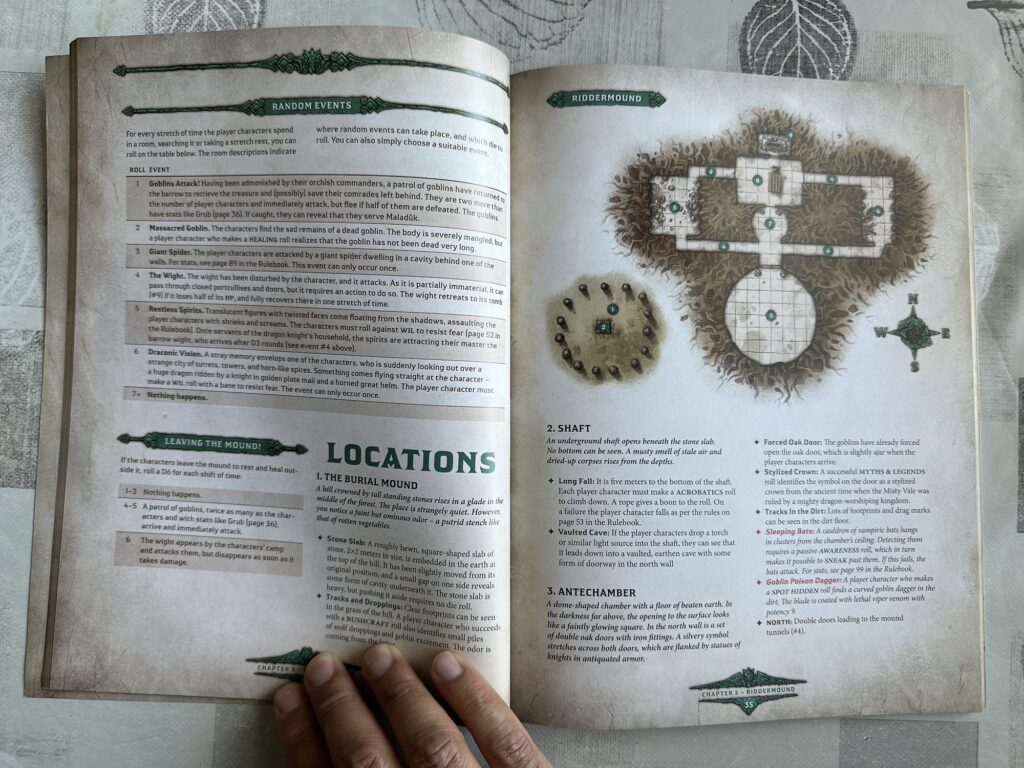
One big reason that Dragonbane is easy to run is that a lot of the game is driven by straightforward subsystems and random tables. Lots of random tables, actually. Each wilderness area has a random encounter table, and adventure sites each have one random event table, for instance. Most importantly, all the “big monsters” have a random table that will look familiar if you’ve run Free League’s Alien RPG. As a GM, you don’t have to think about what your big monsters do: you just roll a die and do whatever attack or action the monster’s table tells you. I’m sure tactically-inclined GMs won’t necessarily like that but in this case, for me, it worked super well. I could just sit back and enjoy watching my players doing all the tactical work. Again, super easy to run. Plus, if you maim a player character, you can’t say it’s not your fault, it’s the random table’s!
Of course, you sometimes need to tweak results. For instance, repetitive wilderness encounters are undesirable, so I had to occasionally adjust a table’s result, or ignore it and make something up instead. As with Mutant: Year Zero (albeit to a much lesser degree here), I found that the random tables tend to start some narrative threads that require a bit of manual care in the following sessions. Otherwise, you keep rolling new things and you end up with half a dozen unfinished storylines in flight. I recommend not rolling on tables when you can instead come up with something that simply continues whatever was started in a previous session.
Character Progression
Another easy thing to manage was player character progression. The improvement system is mostly based on BRP, with experience checks emulating how expertise comes from lots of practice… so it manages itself. Money starts slow but eventually the players will have more than enough to buy days or weeks of training if they wish. As the GM, I only needed to tamper their desire to spend 50 gold coins to roll experience ten times, by telling them about all the horrible things they hear about what the orcs and cultists and other factions are up to every day. Increasing the sense of danger and urgency as we approached the end of the campaign felt like a better approach than letting the player character chill out in Outskirt for 3 weeks.
Apart from that, I handed out a new heroic ability after every two or three adventure site, to keep the players interested. It worked very well. They ended the campaign with around 7 heroic abilities each1. It seemed good enough to make the characters feel quite heroic, and give players enough to chew on without overwhelming them.

We Hate Bats
One of the feedback my players gave was that they loved the epic combats (especially the final one) but they unanimously hated bats. It may have to do with one particularly nasty swarm of bats that almost wiped out the entire party… maybe they got traumatized enough that they will all dress up as bats to fight crime, now?
Anyway, Dragonbane was a blast: simple, pure old-school fun that lasted us a few months. I love this hobby.
To My Players: I’m An Overly Generous Gamemaster! I Have Proof!
I’m adding this section after a couple of people online were surprised to hear that my players ended the Misty Vale campaign with so many heroic abilities… so here are a few extra details:
- The 7 abilities the players had by the end does include the 2 default abilities you get at character creation: your kin’s “innate” ability, and the starting heroic ability.
- Most of my players got one free ability for raising a skill to 18.
- I handed out one ability every 8 sessions or so, whenever it felt like the players did something particularly cool.
- I granted the last ability upon getting hold of the McGuffin sword, just before heading out to the last adventure site to kill the Big Bad Evil Guy. So the players only had that one for the last adventure (about 3 sessions, I think).
- Players were able to retain their abilities for the whole campaign because we didn’t have any PC death. We had many death rolls, and a few near-TPKs, mind you. But what happened was that the very first scene of the campaign, where the PCs merely fight 3 goblins or something, almost ended with a TPK, right in the first session. So my players say “oh shit, this is deadly” and proceeded to bring their A-game in terms of tactics and caution for the rest of the campaign.
- While I think I mostly followed the rulebook’s advice for handing out abilities (see page 29), I was more generous than I would usually be simply because we knew we would play Dragonbane for 6 months or so, and then move on to something new (Pendragon in our case). Given the sheer number of other games we want to play, there’s very little chance we come back to Dragonbane any time soon (or ever), and so I figured I might as well hand out abilities in a liberal manner so we get a good idea where the system goes in higher-powered play. Basically, I figured we might as well use as much of the game’s contents as possible. No reason to hold back.
- If you think the game becomes too easy with many abilities, think again. The party was almost TPK’ed twice during the last dungeon.
- See last section. ↩︎