RuleQuest: Getting Glorantha Back Into Play
Chaosium may have a problem: Glorantha became the very thing that its critics warned us about. It’s mostly just a bunch of lore, now. How did that happen? And what does that mean for my RuneQuest games?
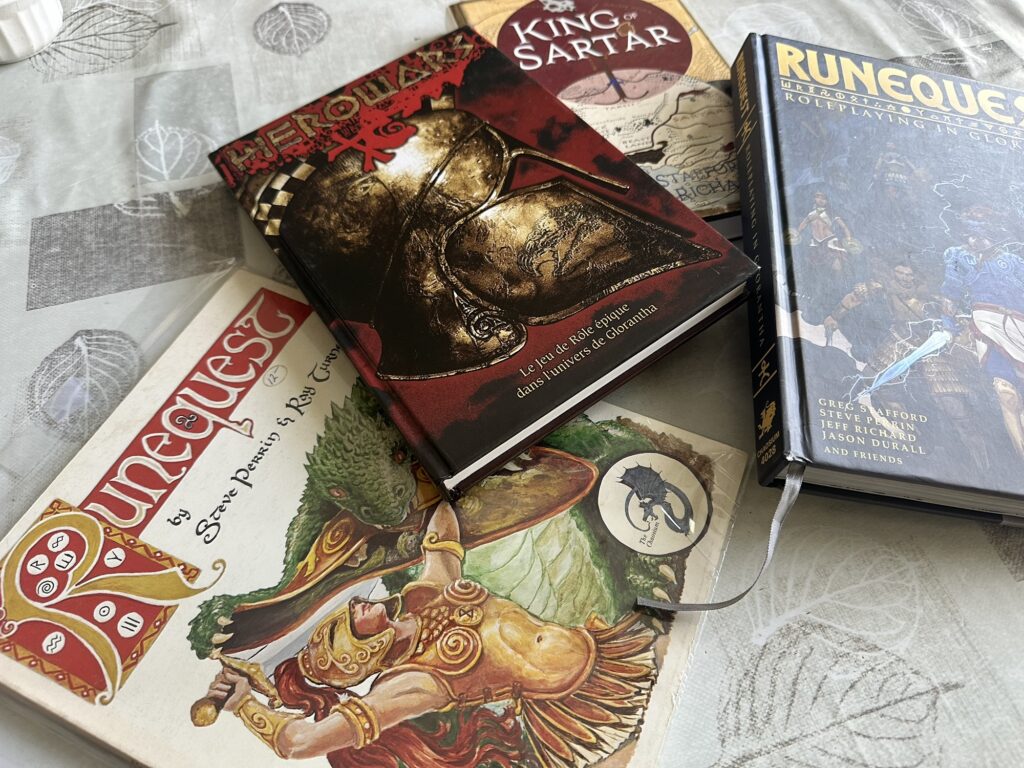
A Timeline of Gloranthan Playability
When RuneQuest was released in 1978, marking the first appearance of Glorantha on the TTRPG scene, it was mostly a set of fantasy rules. Sure, these rules were tied to the setting of Glorantha, but that setting was very loosely defined: two pages of “lore” and a map, a dozen pages of rules on “cults” with just three Gloranthan examples, another dozen pages of uniquely Gloranthan monster and creature stat-blocks, and some encounter tables and additional maps.
What followed was a product line that invited you to discover Glorantha through play. Everything was written through that lens. From ready-to-use NPCs to solo adventures, from sandbox campaigns to scenarios, virtually every release had what I’m going to call “playable content”. The pitch was seemingly “check out this new place in Glorantha, and here’s what you can do there”.
Fast forward through Avalon Hill’s RuneQuest 3rd edition era, the Hero Wars and HeroQuest eras, and the long dark times in between, and we end up in 2018. This is when RuneQuest Glorantha, the latest edition of the venerable game, is released once again by Chaosium. But after 8 years of this (longer than the entire RuneQuest 1st and 2nd edition product lines!), this new product line has a pretty low “playable content” record.
Bold Claim, Show Me The Numbers
Let’s pause for a moment and define what “playable content” is. For the purposes of this article and the numbers that follow, “playable content” is material that is immediately usable to bring play to the table. Obviously that includes scenarios and encounters. I also include NPC/monster stat-blocks and treasures, since you can directly pick any of those and drop them in a game. I debated for a while about spells and ended up including them too. I do not however include cult descriptions: they’re not immediately usable, you need to “apply” them to characters. And of course I don’t include histories, geographies, myths, and other such “lore” stuff (which is what composes most of the cult descriptions anyway). I’m sure that some people will argue and nitpick things. I may or may not care.
With that out of the way, let’s look at some numbers. People who know me would of course expect that I made some spreadsheets for this, and I don’t want to disappoint. Here is the percentage of the total page count dedicated to “playable content”, by product line:
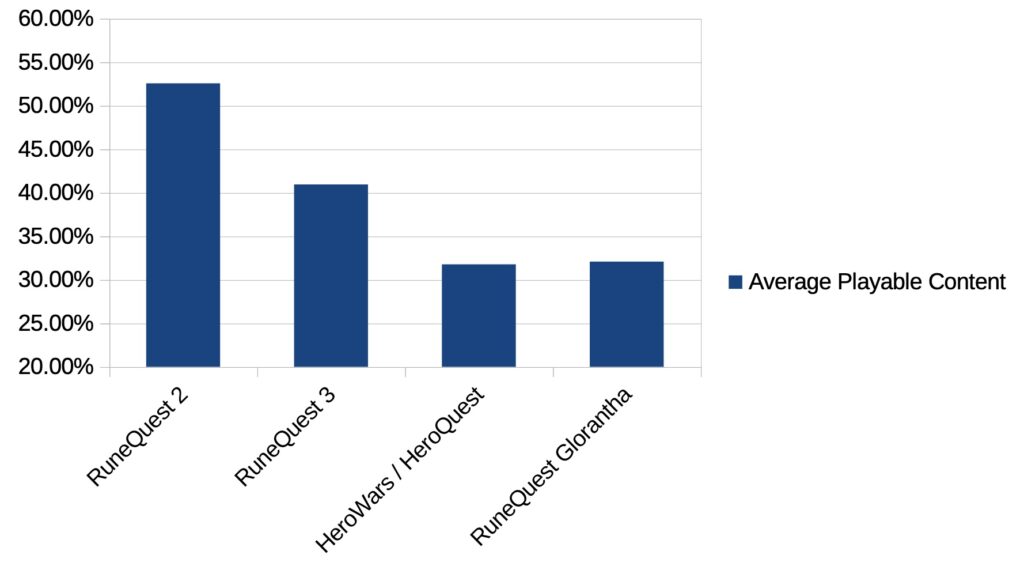
More than half of all pages were immediately usable at the table back in the RuneQuest 1 and 2 days. Only “Cults of Prax”, “Cults of Terror”, and the “RuneQuest Companion” do not have much “playable content”, out of 22 total products. The “Pavis”, “Big Rubble”, and “Borderlands” boxes have a whole bunch of scenarios and encounters. Interestingly, “Griffin Mountain” comes up low on this: even though it’s a big sandbox campaign, and you therefore need lots of locations described for it, I only include the pages with actual encounters and scenario seeds. This is one of the limits of my definition: pages describing a village as part of a scenario would be considered “playable content”, but that same village described outside of a scenario would not. Oh well, them are the rules. Feel free to make your own statistics with different rules… I doubt it would change the point of this article.
The amount of “playable content” drops during the RuneQuest 3 tenure (note that I only include Gloranthan releases in this, so stuff like “Vikings” or “Land of Ninja” aren’t in the data). We start seeing boxed sets like “Gods of Glorantha”, “Genertela”, or “Troll Gods” that are all pure lore or cult descriptions, which affects the overall average across the 17 releases.
During the Hero Wars and HeroQuest era, it drops some more. These books famously introduced so much lore that a few people tell me they got “proper noun fatigue”. Still, we get a few full blown campaigns, with “Sartar Rising”, the “Colymar Campaign”, and the “Red Cow” books. We could even count “Blood Over Gold” here. The total number of products is 21 for that period.
I skipped the Mongoose RuneQuest stuff because (1) I don’t own any of the books, and (2) I can’t be bothered to look things up for it. If you have some data points for it, I’d be interested to know what that looks like!
And then we get to RuneQuest Glorantha, the only Gloranthan product line with no campaign at all. We get four collections of scenarios (two books, plus the scenarios from the Gamemaster Pack and the Starter Set), and a Quick Start adventure, out of a total of 16 releases (I’m only counting print products). Still, at least, the “playable content” average holds steady from the Hero Wars and HeroQuest line… or does it?
Let’s look at the data differently, by considering the median amount of playable content per product. This tells a different story:
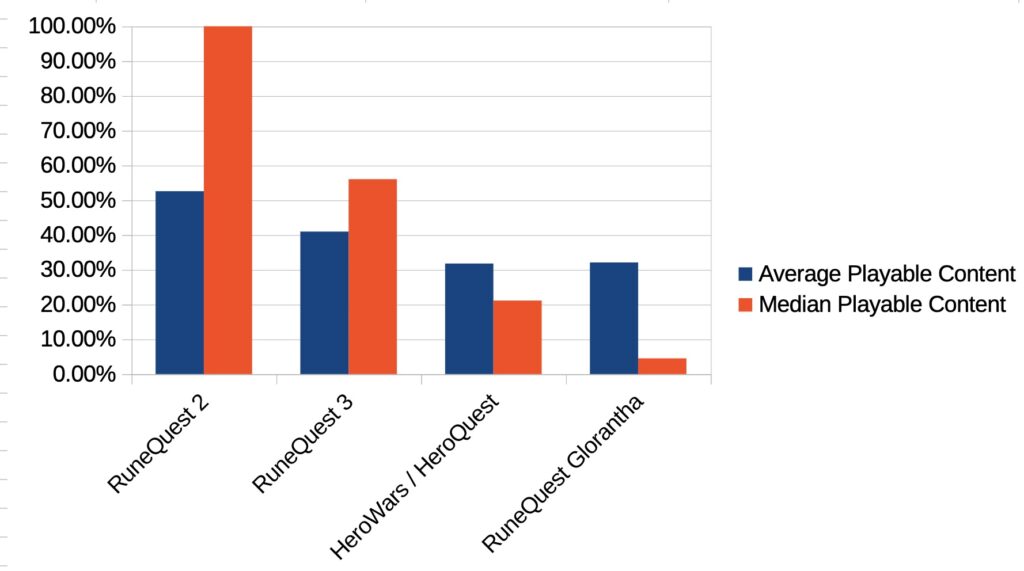
Back in RuneQuest 1 and 2, pretty much every product had “playable content”. In fact, that product line “cheats” here, because quite a few of its releases were short collections of NPC stats and treasures (most of the SP books, the “Plunder” book, etc.) which I consider “playable content”. That skews the statistics a lot in its favour, with the absolutely ridiculous (but mathematically correct) “100% median playable content”.
Compare this with the RuneQuest Glorantha line, where half of the books barely have any “playable content”. Those are the cult books, the geography books, the mythology books, etc. They’re pretty much all “lore”. And maybe you think it’s great lore! I think too! (partially…) But it’s not immediately usable. And it’s still lore, with places and names and dates and stuff. As I was saying at the beginning: it’s what the critics of Glorantha complain about. And it’s all over the new edition.
You can see this decline across product lines in the second chart above. Each product line has more and more lore, and less and less “playable content”. For the obsessive “Gloranthan scholars” in the fandom, this is probably great! For the rest… not so much.
The Chaosium Way
I don’t know about you but the fun thing about Glorantha is playing in it, right? And ideally make some shit up along the way? Sure, I will happily nerd-out for hours on any obscure Gloranthan detail you want any day of the week (gods, I even made a podcast for doing exactly that!), but the whole point is eventually doing something about it with some players.
It’s weird to see Chaosium going down this path. This is the company who built their whole reputation on “big campaigns”, from Call of Cthulhu to Pendragon. Their product lines are usually stuffed with “playable content”. But somehow, they went down the “Gloranthan scholar” route with the new RuneQuest.
The redeeming factor of the RuneQuest Glorantha line is, of course, the Jonstown Compendium, Chaosium’s community content program for Glorantha. This is where you’ll find the “playable content” that the official line lacks. The fans publishing their works there are absolute heroes. Simon, David, Nick, Harald, Neil, Drew, Andrew, Brian, Jon, the other Jon, Austin, Ian, Diana, Dom, CJ, Malin, and so many others. I thank you all. I’m told that it’s not the first time fans have to pick up the ball that a publisher drops.
The New New RuneQuest (Not That One)
All is not lost. Michael “MOB” O’Brien has recently taken the reigns of the RuneQuest product line, and that gives me a bit of hope. MOB is famously not one of the “Gloranthan scholars”. He is of course extremely knowledgeable about the setting, but I think he’s much more interested in playing in it rather than studying it or writing about it or whatever.
MOB came up with the “Maximum Game Fun” motto, his Lhankor Mhy adventures are crazy in a good way, and he’s got the sense of humour and wackiness that used to permeate through Glorantha before anthropological and mythological studies somehow became the editorial focus. Oh and if you’re wondering, yes, his most famous book, “Sun County” is about 61% “playable content” by my count.
Now MOB is doing two things. First, he’s trying to address the lack of “playable content” by digitally releasing the convention one-shot scenarios that Chaosium had in their Cult of Chaos program. These are the few short PDFs we’ve seen coming out since last year. It’s a good short-term solution, while (I assume) longer term solutions are being worked on. Funnily enough, MOB is also adding a PDF adventure to the upcoming Sartar book, which tells me that book was all lore… again… even though the last two times Sartar was presented in official material, it included scenarios!
The second thing is working on a new RuneQuest edition meant to “streamline” the arguably bloated RuneQuest Glorantha rulebook. This is different from the other new RuneQuest that Jeff Richard and Mike Mearls were working on, and which is supposedly postponed for a few years. I’ve got, ahem, “opinions” on both of these projects, but let’s leave that aside. Because I have a confession to make.
Glorantha Thrives With Diversity
I play in Glorantha despite RuneQuest.
I love the setting, but I don’t really like RuneQuest as a system. And the latest edition (which is the only edition I ever played) didn’t do anything to help in that regard. This isn’t going to be surprising to anybody who ever talked to me, but I’ve heard people exclaim “don’t you have a RuneQuest podcast?!” Nah. I have a Glorantha podcast.
After playing RuneQuest Glorantha for more than 6 years, I think I’m done, at least for a while. If I play any RuneQuest again, it would only be for some of the old RQ2/3 classics I never experienced, using vanilla RQ2 or my own Torang Engine hack. But really what I’m more interested in nowadays is a certain diversity of Gloranthan gaming. And diversity has always been a core idea both inside of, and about Glorantha.
Inside of Glorantha, diversity materializes as the wonderful multi-faceted setting we know and love. It has no “simply evil” creatures or races, but various factions with their own values, morals, religious practices, and agendas. It has various points of view, and different versions of the same myths. It definitely has utter bad guys (Broos and Scorpion Men anyone?) but you get to know where they come from.
Outside of Glorantha, diversity is about the different ways you can experience the setting. Glorantha famously started as a board game, with a couple others following. Sadly, the latest one, the wonderful little “Khan of Khans”, is now out of print because the licensing deal between Chaosium and its designer, Dr Reiner Knizia, was somehow not renewed (no idea why).
The A-Sharp video games like “King of Dragon Pass” and “Six Ages” are very often credited with bringing new people into the Gloranthan fandom! More recently, Virtuos released “RuneQuest Warlords”.
If you’re a Gloranthan scholar, you also had your fix, with pure lore books like King of Sartar, the Guide to Glorantha, and the Glorantha Sourcebook. Sadly (again) at the time of writing, the first two are out of print, with only digital versions available for purchase.
Finally, with roleplaying games, besides RuneQuest, Glorantha could also be played in an official capacity using the D&D-esque 13th Age system and its amazingly excellent “13th Age: Glorantha” supplement, or with the free-form narrative rules of Hero Wars and HeroQuest, which have been revised, cleaned up, and rewritten under the name “QuestWorlds” as a setting-agnostic system. We are waiting for a “QuestWorlds Glorantha” supplement or standalone book, though… Last I heard, this was almost finished, but it wasn’t clear whether it would be released as an unofficial “fan project” by the author, or as an official product by Chaosium. Unofficial communication channels point to the latter, which makes me happy since I truly believe RuneQuest isn’t the “end all, be all” of Glorantha.
And this is where I’m getting to my final point. I think Glorantha thrives with diversity, and I’m going to be looking for that next. A diversity of experiences and story and systems in Glorantha.
The World Council of Friends of Glorantha
I wish Chaosium would change the way they see their intellectual property. I may very well be in the minority here, but I believe that their main fantasy IP is the setting of Glorantha, not the game of RuneQuest.
I don’t know if Chaosium would care for this, but Glorantha could become even more special than it already is by being the source of many collaborations with other games and designers. It could become the… I don’t know, the Andy Warhol of TTRPGs? I’m not educated enough to conjure up the name of an artist who would correctly convey this idea of working with many others in different styles. Maybe Prince is an even better reference?
Just like we’ve been able to visit Glorantha in many different ways in the past, imagine how, in this golden age of TTRPGs, we could expand our experiences ten fold. Here are some examples that have been rattling around in my brain since last year:
Dragonbane: Everybody I know who’s played Dragonbane wants to use it in Glorantha somehow. Maybe it’s because it shows us how you can properly modernize a BRP-esque system. Maybe it’s because it’s just super damn fun to play. Surely it would work wonders to go dungeon crawling into the Big Rubble! And we know Free League is open to cross-licensing, since they just announced a Dragonbane-powered Elric TTRPG… remember when Elric was BRP powered?
Savage Worlds: I’ve wanted to run the 50 Fathoms campaign for a while, and now I’m thinking I could just reskin it as a Wolf Pirates campaign! Pinnacle Entertainment is also known for their cross-licensed games. Meanwhile, I’ve heard from someone working on a Wolf Pirate version of Pirate Borg, which also sounds great!
Ultra Violet Grasslands: The amazing UVG, with its sprawling point-crawl procedural gameplay, could be a fun way to play an Issaries caravan! Or, for what I have in mind, an increasingly psychedelic run of the Etyries caravan that goes through Pent!
Spire: I recently finished a small campaign of the excellent Spire, and I’ve been wondering about using it for playing abused trollkin in the Castle of Lead… Civil rights for the trollkin!!!! But can you ever rebel against the Dark Trolls and Mistress Races? I would add some mechanics for quickly replacing your trollkin characters, as they get eaten and killed with any big-enough failure of your rolls…
Paranoia: Speaking of characters dying, what about the venerable Paranoia? (currently held by Mongoose Publishing, who isn’t any stranger to Glorantha… ahem) I’m personally inclined to set this game in a Dragonewt City where the local Inhuman King has gone mad, and the Dragonewt player characters are trying to race their death-rebirth evolution in order to become the new king… but when I pitched this idea to a few people, many said Paranoia could also be well suited for some crazy Mostali shenanigans!
Blade Runner: Speaking of the Mostali, the Blade Runner RPG (once again from Free League) could be the baseline for some investigative campaign set in the Nidan Mountains. You play a mix of human servants and Mostali automatons, working for the Decamony to solve problems across the colony!
Mothership: One of the things RuneQuest has always lacked (besides heroquesting… ahem) is anything to make Chaos as impactful as the lore and the fiction pretend it is. So how about powering your next Dorastor or Snakepipe Hollow delve with some rules that can make monsters truly scary? There are probably many, many games you can use for this (Shadowdark?) but the one I’ve tried is Mothership, and I know it could work well because it’s already being used for many different settings.
Ars Magica: Another game I’d really love to play some day is Ars Magica, which finds some of its DNA in Glorantha anyway. It might be a great way to play Western sorcerers of the Zzaburi caste… after some heavy tweaking of the magic system! (everybody loves tweaking sorcery rules, right?)
Pendragon: Unlike the ideas above, this one doesn’t come from me, of course, since David Dunham already did that a long time ago. But I’m mentioning it because it could be a no-brainer for Chaosium, who owns Pendragon once again. Personally, I would use it to play in Western Genertela but, unlike the Ars Magica hack I just previously mentioned, this would be for playing the soldiers of the Horali caste.
The point here isn’t just about avoiding RQG (although that’s definitely one aspect of it). It’s also about… well, everything I talked about so far. It’s about recapturing the feeling of the early Glorantha: “check out this new place, and here’s what you can do there” (emphasis on “new”!) And it’s of course about embracing the diversity of Glorantha, and its fundamentally collaborative nature. Shit, I was looking for the name of someone famous who loved collaborations and shared creations, and it was of course staring me in the face: Greg Stafford.
RuleQuest, A Compendium of Alternative Gloranthan Experiences
In this spirit, I’ve started a new page over on the God Learners website, which I cheekily called “RuleQuest”.
It’s a compendium of alternative rules for playing in Glorantha. It tries to promote this idea that Glorantha is more than just chopping someone’s left leg off. I really hope that the RuleQuest page will grow over the next couple years. I’m definitely going to try and do at least one or two of the ideas I listed above. Maybe you will do a few of your own, and send me a link I can add to the page! And feel free to steal any of the ideas listed here, I won’t have time to try them all anyway!
And if you really love RuneQuest, there’s also a little section on house rules. If you have some of your own and you’d like to share them, get in touch with me!