Reading Classic RuneQuest: Melee Combat!
This is it, the day has come, we have finally reached one of the hearts of classic RuneQuest: the combat mechanics! And yes, this means we are going to talk about the legendary Strike Ranks! Rejoice! And also strap-in because of course I have a lot to say!
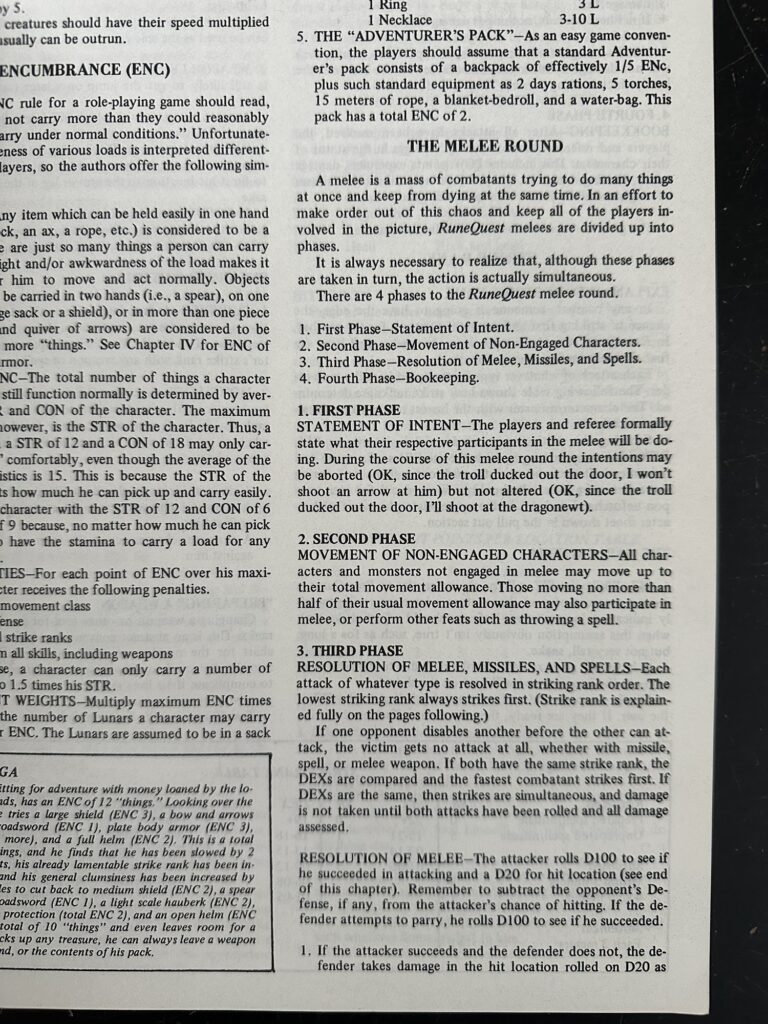
The Melee Round
The Melee Round in RuneQuest is divided into four phases: statement of intent, movement of non-engaged characters, resolution of all the stuff happening, and bookkeeping.
I’m going to take a particular look at the first and third phases, since the other two phases are fairly straightforward:
- The second phase is moving all the characters who are not engaged in melee. Characters that are engaged in melee just don’t move. They stand in place (give or take a step in a 3-meter square) and hit each other until something happens. I already discussed movement last time, including how “static” melee combat feels, and how much of a missed opportunity it is for emulating the epic combats of the “swords & sandals” stories RuneQuest supposedly lets you play…
- The fourth phase is about recording injuries, loss of POW or weapon/shield Hit Points, and so on, on your character sheet. Even I couldn’t find a rabbit hole to dive into1 about this!
Statement of Intent
The first phase of the melee round is when you declare what you want your character to do. This means that, unlike most TTRPGs out there, you don’t just wait for your turn and then declare, roll, and resolve your action in one go. Instead, the gamemaster goes around the table once to hear everybody’s intentions, and then goes around the table a few more times to resolve the actions.
If that feels like a bit of overhead, it’s because it kinda is. It is another one of the small things that add up to RuneQuest combats being slow, but also being highly tactical, I guess, as it infuses gameplay with wargame-like flair. This is fine is you prefer tactical choices over, you know, getting to the rest of the story.
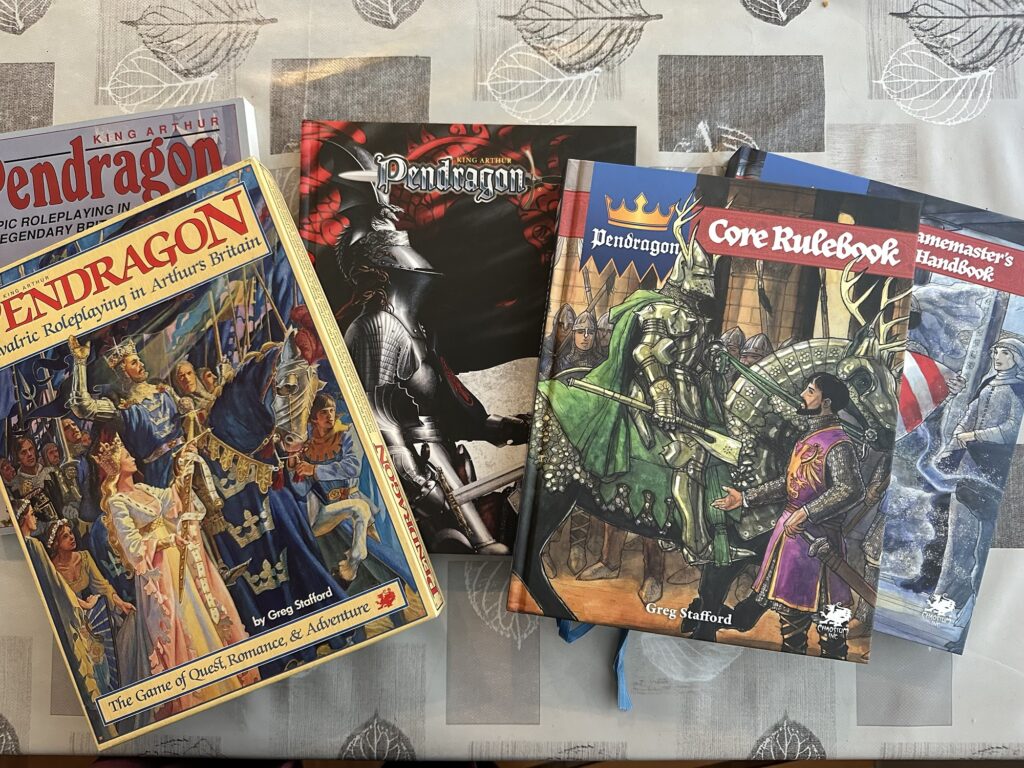
To me, “Statement of Intent” as a separate phase is as idiosyncratic of RuneQuest as Strike Ranks. I frankly can’t think of more than a couple of other games that do it, and one of them, Pendragon, was written by Greg Stafford anyway.
One of the most glaring omissions here is what order should the Statement of Intent be made in. If the rules are aiming for a highly tactical gameplay, they should have recognized that there is incredible tactical advantage to declare your intentions based on someone else’s, especially the enemy.
In Pendragon, Greg Stafford tells us that the gamemaster decides whether her or the players declare their actions first, hinting at players being able to coordinate freely between themselves, before or after learning what the NPCs do. But as far as I can tell, no edition of RuneQuest specifies anything about it. Note that Mongoose’s version of RuneQuest, which later became Mythras, eschewed Statement of Intent and went for a more common “wait for your turn” initiative-based procedure. The current RuneQuest Glorantha edition went back to Statement of Intent. And still doesn’t say in what order to do it.
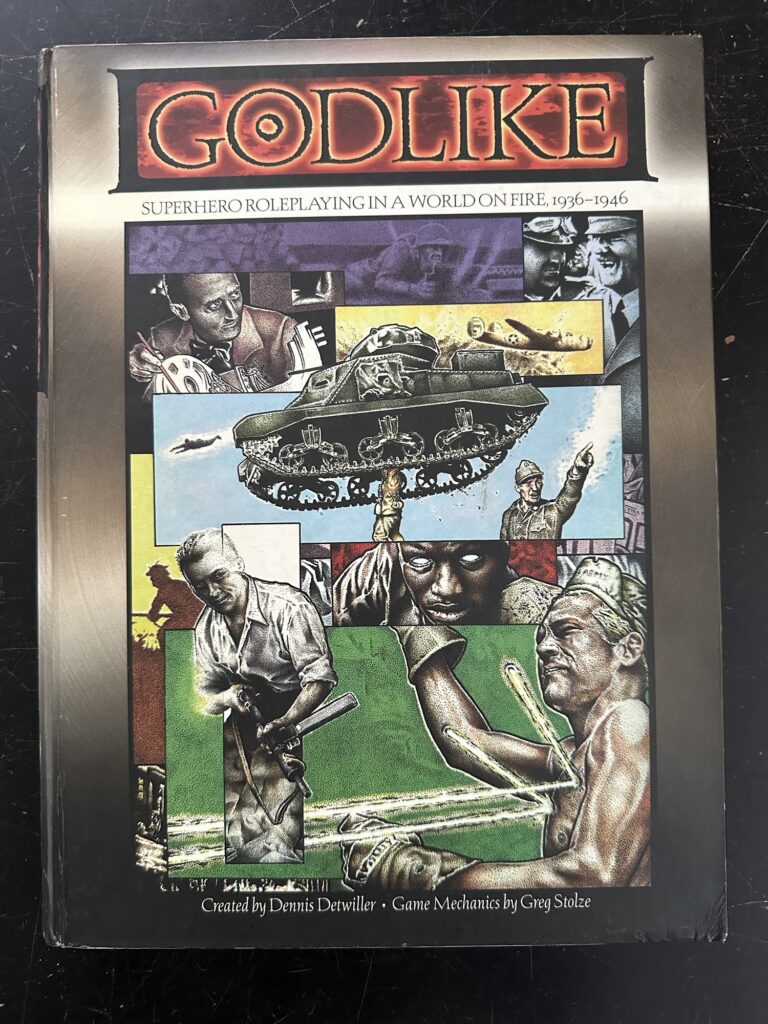
The only other game I can think of with a sort-of Statement of Intent phase is Godlike2. It gives us the obvious tactically relevant solution to this problem: declare actions in increasing Sense stats, and resolve them in decreasing roll width. Now, of course, this all looks like gibberish if you don’t know what the Godlike mechanics are, but let’s just say that in Godlike you declare actions from the less perceptive/aware character to the most, and then resolve from the fastest to the slowest action.
There is no Sense or other “perception” stat in RuneQuest, but we can use other characteristics for that. We could do Statement of Intent by increasing INT, for instance, allowing faster-thinking characters to choose their action based on what they perceive slower characters to start doing. Or, if you can’t be bothered, use the Pendragon rule and only decide whether PCs or NPCs declare first. GM fiat for the win!
Resolution of All the Stuff Happening
The third phase is when players and gamemaster resolve melee combat, missile attacks, and spell casting. It is done in Strike Rank order, explained a few paragraphs later, and most of the mechanics for resolving these things are found in the next chapters. But for some reason, melee combat is half explained here, and half in the next chapter, which requires some page flipping. It is notoriously hard to figure out the order in which to present information3 in a TTRPG rulebook, and we can see here that designers were still figuring that stuff out in the late 1970s.
That said, the melee mechanics are actually quite nice:
- Roll a D100 under your attack skill minus your opponent’s Defense rating. If the opponent parries, they also roll a D100.
- On a successful attack, damage is dealt to the enemy. If they parried successfully, that damage goes to their weapon or shield instead of their body.
- On a failed attack, if the opponent parried successfully, they deal damage back to your weapon. Otherwise nothing happens.
This is pretty straightforward, while also being flavourful and tactical. You get the nice feeling of having a chance to defend against an attack, while D&D tells you to go fuck yourself and take it without complaining. You get a visceral sense of swords clashing against shields, sparks flying, with a chance to break your opponent’s equipment or at least cause some resource attrition, where other games feel more abstract. I get a sense that RuneQuest combat felt a lot grittier, realistic, and heroic when it was released, and that’s probably one of the things that set it apart.
Frankly, the only bit that feels superfluous is having to subtract the Defense rating. As mentioned previously, this Defense rating quickly became annoying even to Greg Stafford, and it was unceremoniously removed in the next edition, never to be brought back4.
Of course, melee combat isn’t quite as simple in practice, as there are a few exceptions such as with “long hafted weapons”, critical hits, impales, and so on. But at least the basic mechanic looks simple at first glance. Compare the simple rules of 1978’s RuneQuest to the utterly demented attack/parry table that we get in 2018’s RuneQuest Glorantha, and you have to wonder what the fuck happened over the years.
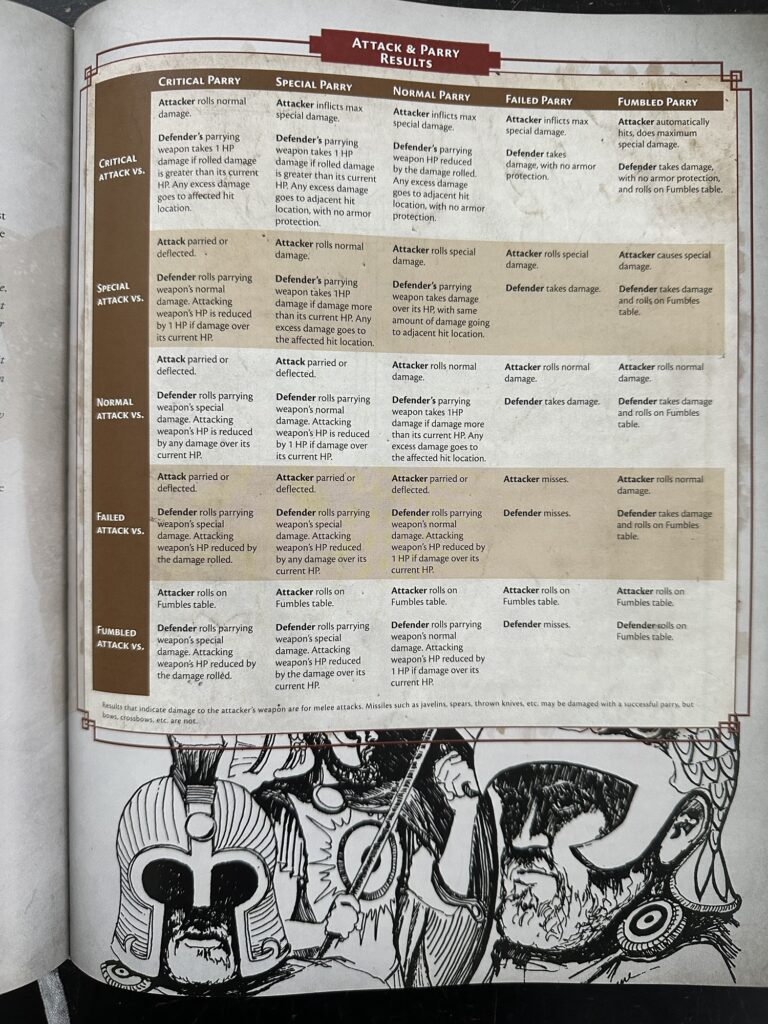
Sure, I appreciate that RQ3 added some type of “overflow damage”, wherein a parrying weapon or shield may not block all of the incoming damage, and you might end up taking the excess. But there is a way to do this in a straightforward manner. That’s not what RQG ended up doing. Instead, not only did it add needless complexity, it also completely messed with the reasoning involved with the combat mechanics. Let me explain.
Looking at the RQ2 rules, what I appreciate most is that you can almost always reason about the attack and parry as separate rolls. If your attack was successful, you deal damage. If their parry was successful, they redirect that damage to their weapon or shield. Attack roll does X. Parry roll does Y. Both players can just look at their own roll without having to compare it to the other’s. The only exceptions I can see5 are:
- The parry roll does something different if the attack failed, as you deal damage back to the attacking weapon.
- If both attack and parry are critical successes, they are both downgraded to normal successes and resolved as such.
The first one is an acceptable exception in my opinion, because it makes sense and sounds cool. The second one, however, is a design mistake as far as I’m concerned: critical vs. critical should lead to something epic, not be downgraded to a mundane result!Let’s house rule it and, for instance, say both pieces of equipment take double damage, which makes it not an exception anymore because that’s what critical hits naturally do. So there, we can reason about each roll separately and simply, with the one and only exception being for parries dealing damage back to a failed attack’s weapon.
In RQG, you can’t do that: you have to compare the rolls. A special or critical attack will do different things depending on whether the parry was a success or a special or whatever. Worse, you can’t even boil the attack/parry table down to a simple “upgrade/downgrade” system, in which, for instance, a critical success attack is “downgraded” to the effects of a special success attack when faced with a special success parry. The two effects are slightly different! So you have to compare the rolls on the attack/parry table. Ugh. What is this, 1992?
In other words, RQG ruined the elegance of RQ2’s melee combat mechanic.
Strike Ranks
Strike Ranks (SRs) are RuneQuest’s other and more famous idiosyncrasy. Their main point is to determine who strikes first in melee combat, based on a whole bunch of factors such as character speed and agility (DEX), arm reach (SIZ), and weapon length (e.g. a dagger compared to a spear), among others.
How Much Is Your Strike Rank
Once you compute the SR for your character’s attack, it can be compared to the SR of their opponent(s) to determine who rolls their attack first (lowest SR goes first). This can be extremely important since a successful attack may hit hard enough to disable an opponent’s arm before they even get a chance to attack. The design goal, I assume, is to make combat initiative “more realistic” and less “random bullshit”, modelling the advantage of, say, pike-wielding hoplites over hatchet-waving barbarians, which I guess is something that SCA-going history buffs think about a lot.
Just as with the ability modifiers of the character creation chapter, here we are given some game designer notes to justify how and why various elements play into a Strike Rank, which is nice. Plus, I guess it helps swallow the table at the bottom of the page that lists them all: we have SR modifiers for DEX, SIZ, and weapon length, of course, but also SR modifiers for being ambushed, having to draw a new arrow or other missile ammo, distance travelled prior to an attack (if you’re running into melee), and POW expenditure for a spell (“bigger” spells take more time to cast).
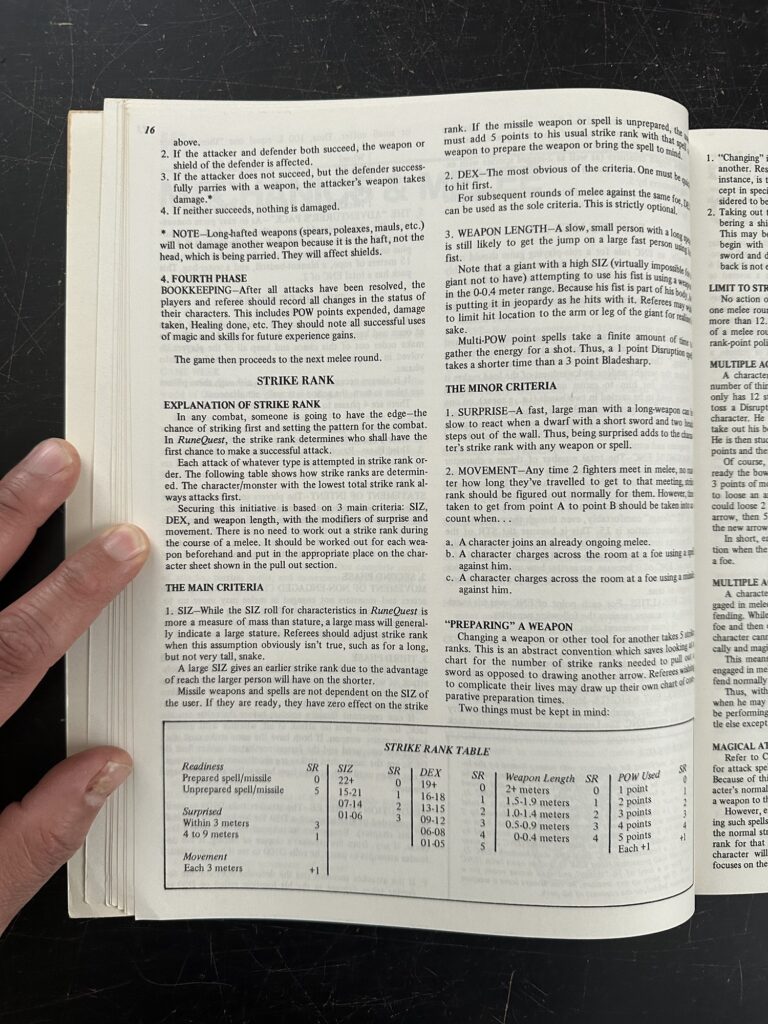
For reference, an average character probably has DEX SR 2 and SIZ SR 2. If they’re wielding a shortsword (SR 3), then an attack would commonly be on SR 7. By comparison, my character Glawyn is quite stiff and/or slow (DEX 8, so DEX SR 4) and very short (SIZ 6, so SIZ SR 3). Wielding a similar shortword, Glawyn’s attacks would commonly be on SR 10! He would often be last to attack! The only way for Glawyn to compensate would be to prefer longer weapons like pikes, but he doesn’t even qualify for the minimum STR required! What a wimp. So the best he can do is use one-handed short spears, or two-handed long spears, which would bring his usual attack SR down to 8 or even 7… barely good enough to attack first, and only against some enemies. So Glawyn is going to have to get good at defence or, you know, stay out of melee as much as possible by specializing in skirmisher weapons like slings and javelins.
First Strike Opportunity
Depending on your opinion on the topic, this is either some cool character optimization driven by the rules, which has meaningful consequences on story, roleplaying, and combat tactics… or it’s a whole bunch of annoying number crunching from SCA nerds obsessed with “first-strike opportunities” or something.
A melee round has 12 SR, so anything that takes “longer” than that cannot be accomplished in that round. The rules don’t explicitly say that, for instance, an action on SR 16 would happen on SR 4 of the next round, but I assume that’s how most people played it in practice, in the rare cases this was needed.
As often with TTRPGs, we have the picture a melee round (about 12 seconds) as a whole bunch of stepping around the opponent, stabbing and jabbing here and there, until an opportunity presents itself. That’s what the Strike Rank and the attack roll are supposed to represent: how your character leverages the best opportunity that presented itself during these 12 seconds. It does not represent a “single attack” in the pure sense of the term6.
Logically, someone with a long pike will see an opportunity for striking someone wielding a small axe much earlier. Sadly, there’s no rule here for “closing the distance”, at least not until RQ3. It’s a bit disappointing, given the effort spent here modelling how deadly a shield wall of Spartan hoplites can be, that the designers drop the ball about how deadly a dozen warriors with shortswords can be in return once they pierce that shield wall and let loose at short range where those pikes are not much better than broomsticks.
Hand-Waving Strike Ranks
The gamemaster may tweak Strike Ranks a bit. For instance, the SIZ SR of a “long, but not very tall, snake” may need to be adjusted, because (I assume, it’s not explained) the snake would have a good reach (lower SR) despite its low SIZ… but frankly, I’m looking at the stat blocks for snakes, later in the Bestiary chapter, and I don’t see much tweaking being done there? Hard to tell, since they only give the attack SR, and not the math behind it. My point being that I don’t think I’ve ever seen a “tweaked” SR in any stat blocks in any published material, so I’m not convinced anybody actually did it.
“Unengaged” characters (i.e. characters not in melee combat) might also benefit from SR adjustments. For instance, we are told that a character running for a while, readying a new arrow on his bow, and then shooting that arrow, may “combine” the first two actions, since they could draw an arrow while running. This means the +3 SR for running 9 meters can be “happening during” the +5 SR of drawing an arrow.
We can quickly see where Strike Ranks can go wrong: they sit in a sort of uncanny valley between initiative system and action point economy. On the one hand we are told they are only meant to determine who strikes first in a melee round, but on the other hand we get very strong vibes that 1 SR equals 1 second, even though we are once again told to not think about it that way. But it’s hard not to think about it that way when we have SR modifiers that are literally for “spending time” on stuff, such as spending time running around, drawing arrows, or focusing magical energies. This slippery slope ended up being impossible to not slide down, and RQ3 started embracing Strike Ranks as action points. That trajectory ended with Mongoose’s RuneQuest, and now Mythras, being basically entirely based on SR as action-points. However, RuneQuest Glorantha went back to RQ2’s ambiguous Strike Ranks.
In practice, this logical tension between initiative system and action-point economy can be ignored, although in some situations it requires having to actively turn off the part of your brain that connects what happens in the rules with what happens in the story. Otherwise it might imply, for instance, that almost nobody ever strikes a melee blow in the first 5 seconds of a combat, which is obviously ridiculous. But that’s kind-of the case if you have unengaged characters doing 5 SRs’ worth of stuff before the gamemaster gets to your melee attack. Hey, as long as you can occasionally plug your ears and go “la la la la la la I’m just acting on SR 6 la la la la” then you’re fine.
This Is Bullshit
Now I know what you’re thinking: I’ve been writing about Strike Ranks for a long while now and I still haven’t said that they’re bullshit yet. What’s up with that?
Let me reassure you: Strike Ranks definitely are bullshit.
But lots of people seem to like this bullshit. I mean, some people still prefer THAC0 for some reason7. Strike Ranks are RuneQuest’s THAC0, in a sense, but unlike D&D, RuneQuest never really outgrew it. When it comes down to it, RuneQuest is “that game with the hit locations and the Strike Ranks”. Part of why it is still that game 40 years later is probably grognards clutching their pearls, but part of it is possibly that it’s simply a core part of RQ’s DNA and identity, like the D100: “It’s not RQ if there aren’t hit locations and Strike Ranks!” is something I’ve definitely heard.
Now, I could argue that there’s a difference between what happens in the game, and how the rules make it happen. What’s important to me is less the hit location and Strike Rank rules, and more the fact that you can get your left leg severed, and that long spears have an advantage over short swords. Basically: we could get similar effects with different rules. This would allow modernizing RuneQuest’s mechanics while retaining its spirit… but, well, see grognards and their pearls. Sometimes, the rules define the game, I guess, and not the other way around. It’s not really Carcassonne if you can’t steal fields and cities, and it’s not really UNO if you can’t scream and cheat your way through. But at least, stealing fields and cheating is fun to me. Strike Ranks aren’t. They feel like a chore to me.
Ultimately, this is a hill I’m happy to surrender to the Strike Rank fans. If they really enjoy this stuff8, they should totally knock themselves out. But after 6 years of GMing RQG on a weekly basis, I was frankly done with Strike Ranks and started heavily house-ruling them away9. I find them to be bullshit because the amount of overhead they bring to the table isn’t worth it for me compared to a much simpler system that covers 75% of the same goals.
A few more notes on Strike Ranks before we move on:
- If Strike Ranks were such a great idea, they would have been stolen and found in other games. But even most Chaosium games ended up, wisely, dropping that mechanic.
- Games not focused on combat, like Call of Cthulhu or Ringworld, did it for obvious reasons.
- Others, like Pendragon, were meant to be streamlined past the point that SRs made any sense.
- Stormbringer’s sword & sorcery arguably matches RuneQuest’s swords & sandals in terms of combat, but Ken St Andre probably talked Steve Perrin down on the matter, using a DEX-based initiative instead (although a paragraph tells us that RQ’s Strike Ranks may be used as an optional rule!)
- Steve himself wisely went with a different mechanic for Superworld, but brought back SRs for Elfquest a couple years later. They kinda stick out like a sore thumb in that game in my opinion, because I can’t think of any moment in the comic-book that SRs ever allowed to emulate.
- Having to recompute resolution order every round is just as annoying as those games who make you re-roll initiative every round. I just don’t have that kind of free time on my hands!
- Unlike initiative, which is generally quickly determined with a dice roll, SRs can make combat scenes very slow. This is because players can micro-optimize their SR to death. This is catnip for tactically-minded munchkins, and I can totally see in their eyes that it takes them to their happy place, but you really need to be OK with a 5-round combat taking an hour and a half to resolve.
Hit Locations and Wounds
Okay, we have one last big and famous bit about RuneQuest to look at: how to get your left leg chopped off!
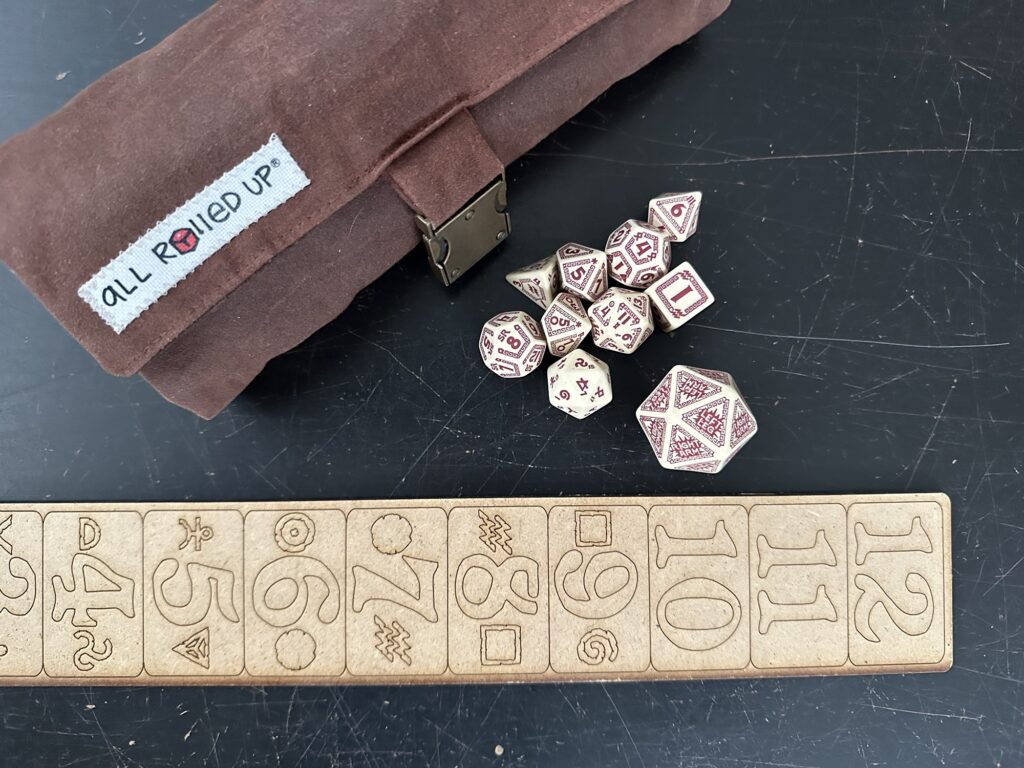
By the way, I’m not sure where the classic RuneQuest joke of “you get hit in the left leg” comes from? I suspect some players got hung up on their D20 rolling 01-04 “seemingly more often” than other results, and then it grew from there on some old 1990s mailing lists or something? I’m definitely open to information on the topic. Funnily enough, the Q-Workshop Hit Location die for RuneQuest Glorantha (pictured above) had a small incorrect production batch featuring an extra side for the left leg. You can’t make this up.
Those Squishy Characters
So yes, RuneQuest has hit locations in its standard rules. Every attack roll is accompanied by a D20 roll to determine which body part is being targeted. I recommend rolling that D20 along with either the attack’s D100 or the damage roll, to make combat a bit less slow than it needs to be.
The humanoid hit location table is obviously the most commonly used, but various non-humanoid tables are available in the Bestiary chapter. Hit locations have their own Hit Points, and taking damage involves subtracting that damage from both the hit location and the character’s “general” HP. I find this quite annoying, and even after years of GMing RQG, I still sometimes forget to do the latter… maybe I’m just getting old?
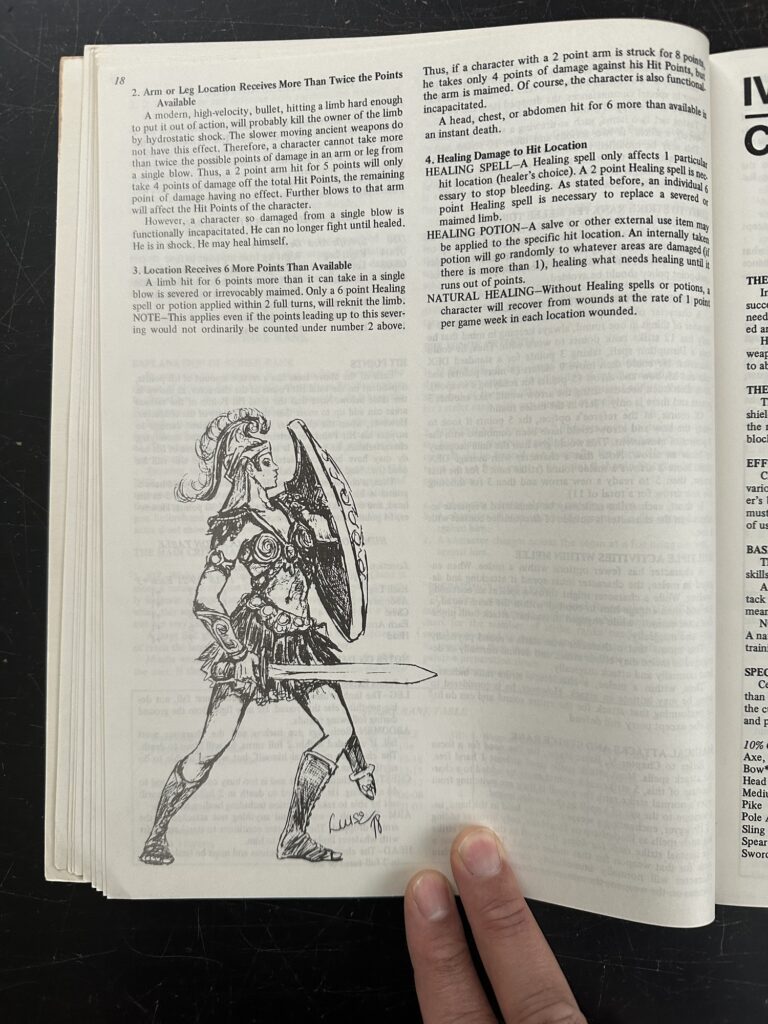
When a hit location reaches 0 HP, the obvious happens: that limb becomes unusable and you might be unable to use your sword or shield, which is bad news. If the hit location was your head or your chest… well, let’s just say I’ve got even worse news. But there are other rules, such as limb damage maxing out to twice that limb’s HP (extra damage just “blows through”), and a threshold for limbs being maimed or severed. That threshold was changed over time, by the way: it is 6 points over that limb’s HP in RQ2, and three times that limb’s HP in RQG. So a 2-point arm was a bit harder to sever in RQ2!
The Rationale for Hit Locations
RuneQuest’s hit locations are often hailed as a great way to make combats feel epic: “I struck his shield arm with a critical hit, disabling it! On the second round, he was unable to block my attack, which pierced his abdomen. He fell to the ground, bleeding out!”. This is definitely true, but I wonder how much of it is still needed 40 years later. Maybe in the late 1970s it showed players how to bring the dice rolls to life, but I’m not convinced we still need these kinds of rules in 2026, when we’ve all learned to do it even with the most minimalist system.
There is a place for hit location rules in games, of course. Among the games I like, GURPS has optional hit location rules, but not per-hit-location HP, and GODLIKE has hit locations and per-hit-location HP by default, but not general HP. RuneQuest is the only game I know that goes the extra crunch mile by having all of it: hit locations by default and per-hit-location HP and general HP.
But RuneQuest has changed a lot since the 1970s. It started as a straightforward dungeon crawler FRP where combat simulation was important enough to justify the crunch. Soon, the early 1980s boxed sets and supplements transformed it into a more general adventuring game, with more diverse gameplay situations. By the time we get to RuneQuest Glorantha, social interactions, politics, and religious matters have almost overshadowed combat, or at least taken equal air time. Countless RQ gamemasters boast online about how their players “avoided combat” by doing such and such. And sure, part of avoiding combat is because it can be deadly10, but that can be achieved without the crunch. So again, I’m not convinced that modern RQ needs to keep the same crunchy hit-location-based combat rules from 1978 when, by all accounts, the game’s core activities have changed dramatically since then11.
If I was making a new edition of RuneQuest, I would strongly consider redesigning hit locations by either streamlining them (such as removing general HP), or (more likely) by turning them into a special effect of critical hits. Just as with the Strike Ranks, I don’t find that the table look-ups, bigger stat-block sizes, and extra bookkeeping of hit locations are worth the trouble. But hey, again just as with Strike Ranks, I’m sure some people love that sweet crunch, and they are already lining up at the top of the hill to defend it. Soooo…. let me wave at them as I stroll by, whistling inconspicuously!

Well, that was a big one! But given how central Strike Ranks and hit locations are to RuneQuest, it was to be expected. Next time, we stay on the topic of combat and head into the “Combat Skills” chapter, where we find something rather… special!
Until then, happy gaming!
- But hey if you have an idea, please send it to me! ↩︎
- A game that I will never not advertise whenever given the chance! ↩︎
- Some people are still, to this day, arguing about whether character creation should come before game mechanics or after. ↩︎
- Instead, we gained the Dodge skill, giving the ability to dodge instead of parrying. ↩︎
- We could consider another exception, in that a weapon or shield parrying a critical hit takes twice as much damage, but this could be reworded as “critical hits ignore all armor and any other protection, and deal double damage to parries”, which lets you think about it without comparing rolls. ↩︎
- Very few games do, but it does happen, for instance with GURPS’ one-second melee round… which isn’t so weird to think about if you’re an RQ3 fan because counting down all those Strike Ranks is basically a weirder and more complicated version of doing one-second rounds! ↩︎
- I have played very little D&D in my life, and it was only 3.5e and 5e, so I have zero opinion or nostalgia about this topic… but frankly, THAC0 does sound like bullshit. ↩︎
- My super hot take is that, frankly, I suspect that many actually don’t… but muscle memory and nostalgia is often stronger than critical sense. Now take THAT with your hot cocoa. ↩︎
- As always, big thanks to my players who went along with it without complaining. ↩︎
- More likely, your players avoided combat because they didn’t want to spend an hour dealing with Strike Ranks! ↩︎
- But hey if your campaign is mostly just a hexcrawl through Dorastor where you fight horrible monsters all the time, then yes, go nuts with hit locations! ↩︎