Reading Classic RuneQuest: What Is Time?
Last time, in my ongoing read of the old RuneQuest 2nd edition, we learned how to make a character. Now, things are becoming serious: we are in the mechanics chapter! Also known as Chapter 3 of the RQ2 rulebook! But wait! Once again I get myself in a rabbit hole of my own creation, and I end up only covering a quarter of a page while ranting for, like, ten times as long!
I swear I’m not doing it on purpose, people. Anyway, let’s gooooo!
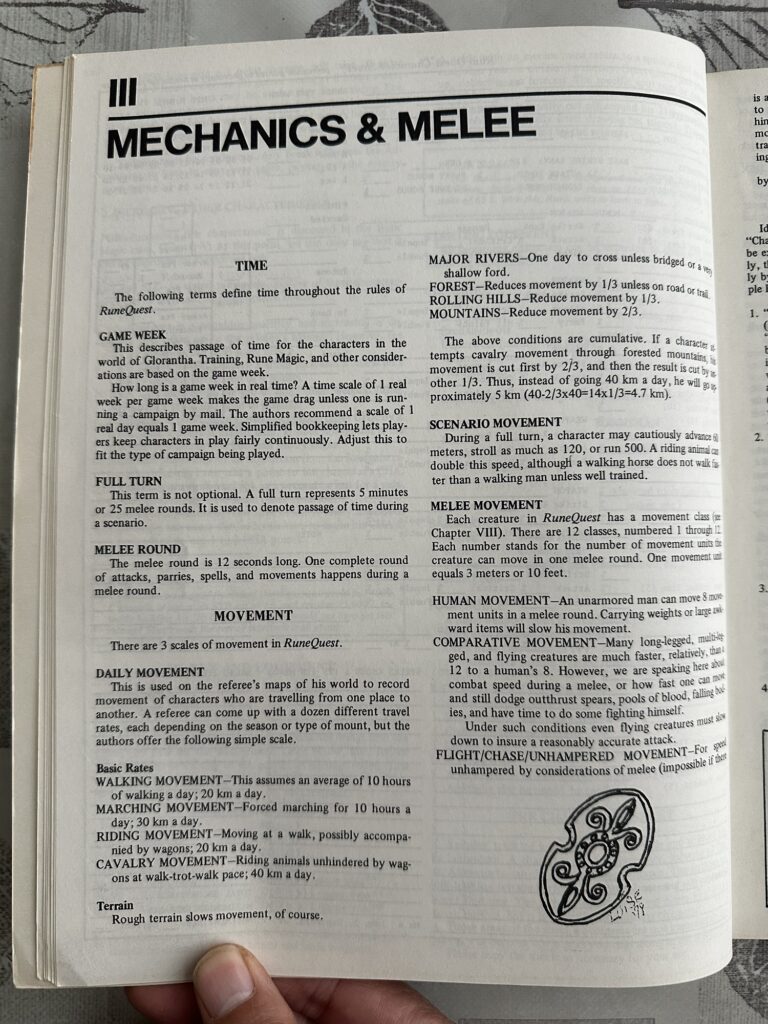
The first section of this chapter introduces different definitions of “time” in RuneQuest: the “Game Week”, the “Full Turn”, and the “Melee Round”.
Melee Round
Let’s start with the Melee Round because that’s pretty straightforward. It’s about 12 seconds long, and it’s used for combat. You might generalize that a bit and say it’s actually for any “action scene”, but either way, we all know how melee rounds work, yay, let’s move on.
Game Week
The “Game Week” is, well, when a week passes inside the game’s world. It sounds evident nowadays that the gamemaster can squeeze and stretch time as the story requires, but I don’t know how well-understood it was in 1978? Case in point: the concept of a “Game Week” is painstakingly explained here over two paragraphs, including how you don’t need to wait a week in the “real” world for a week to pass in the game’s world!
When you consider that 95% of TTRPG gamers came from board games and war games, with their rigid turn-based progression, I suppose it was indeed maybe a bit tricky to explain to them that time passes as fast or as slow as you want.
On the other hand, the text also recommends “a scale of one real day equals one game week” to “simplify bookkeeping”, and I’m wondering, like, what the fuck? How does that work exactly? You play on Tuesday with your friends and fight some trolls, but one of them escapes… but it’s 9pm and your mom tells you to pack up and go to bed. When you resume the game on Wednesday a whole week has passed? Or do they mean “at most a game week”? So on Wednesday you can chase the runaway troll, with a scene set immediately after the combat from Tuesday, but after catching and killing the troll, if you want to have your character train and rest for three weeks, you can’t? You have to play Thursday, Friday, and Saturday for that?
I get that it’s just a recommendation, but I question how good that recommendation is, and how often you can follow it anyway, really? I’m utterly confused, to the point that I wonder if I’m being stupid, or if this “one real day equals one game week” thing is absolutely pointless? I’d love to hear from old grognards what they remember about this kind of stuff in the late 1970s! In the meantime, I’m going to call bullshit.
Full Turn
Last is the Full Turn, defined as 5 minutes of game world time, or 25 melee rounds. The text tells us that it is “used to denote passage of time during a scenario”.
Well, this is another piece of bullshit. The paragraph starts with “this term is not optional”, making us think it’s super important, but it’s not! It’s bullshit! Let’s see where it’s actually used in the rules:
- Scenario Movement: in a Full Turn, a character may “cautiously advance 120 meters, stroll as much as 240, or run 1000”.
- Damage Results: a character bleeds out and dies in two Full Turns if unhealed, or loses a maimed limb.
- Blade Venom: the venom loses its potency after three Full Turns (*).
- Antidotes: you can administer an antidote to a poisoned character up to two Full Turns later (*).
- Swimming: you must make a roll every two Full Turns.
- Shade Attack Table: one of the results is the victim collapsing from fear after 20 minus CON Full Turns.
- Walktapi: they regenerate 1 Hit Point every Full Turn.
- Diseases: the terminal form of a disease causes loss of 1 point of characteristic every Full Turn (*).
So we have Full Turns used in 5 places, plus 3 other places (the ones with an asterisk) where the conversion to minutes is provided, as if the authors knew that people would just reason in terms of natural time anyway! Can you completely remove the “not optional” concept of Full Turns from the rulebook? Yes! You just remove the extraneous text in the 3 places that give you the time in minutes, and you replace the text in the 5 other places!
Even in the Shade Attack Table, where Full Turns are mechanically put to use, is useless too since you can reformulate that result as (20 – CON)×5 minutes… and if any one of you tells me that using Full Turns saves you a multiplication, I will make them eat their RQ2 character sheet because frankly that’s rich for a game where you have to multiply characteristics by 5 all the time!
Is anybody actually using Full Turns in their game? What were the RuneQuest designers really thinking here?
Here is what I think happened.
At the time, D&D had the concept of a “turn”. This was actually a mess, at least judging from the Holmes Basic Set: a “turn” was defined as 10 minutes, with movement tables1 for both characters and monsters defined in “feet per turn”. But also, a “turn” was different in combat, where it was defined as ten combat rounds, or 100 seconds (because Gary Gygax hates you).
Now, D&D’s gameplay is more focused: the point of the game is just to go into dungeons and kill monsters and get loot. It kind of makes sense to try and simplify movement of PCs and monsters in war-game-like “turns”, so that the Dungeon Master can move her pawns every time the players move theirs. At that point, you basically have two types of turn-based gameplay: “exploration” and “combat”, where each turn is, respectively, 10 minutes or… well, 100 seconds, but you probably don’t care because you just drop into 10-seconds combat rounds at that point.
Decades later, games like Old School Essentials and Dragonbane would more clearly explain and leverage this concept. In both these systems, for instance, the “turn” (10 minutes) or “stretch” (15 minutes) define the temporal granularity of dungeoneering, and tie into actual action economies in the rules. Each turn or stretch, the players may move a certain number of squares of corridors, or search a room, or take a rest, or recharge spells, or look for secret passages and traps, or whatever else. Meanwhile, each turn or stretch, the GM rolls on encounter tables or moves monsters according to their speed and so on. The concept has mechanical weight because you can reason in these terms without having to think about how many minutes they represent.
By comparison, RuneQuest’s “Full Turn” is just air. There are no short rests or spell recharges or other such mechanics to give it mechanical weight. The only thing you’re left with are maybe managing PC vs monster movement in dungeons, but it seems obvious that RuneQuest was never just about that. The rulebook gives encounter tables for towns, cultivated lands, countryside, forests, mountains, and more. The word “dungeon” only occurs once, in the referee advice chapter, which then immediately recommends not limiting yourself to big-ass dungeons full of random monsters because they “will quickly pall into boredom”!
With its different and more free-form mechanics and gameplay, RuneQuest renders the D&D concept of an “exploration turn” mostly useless, and for this, I declare the “Full Turn” a pile of bullshit2.
All You Need Is Narrative Time
Nobody asked me, but I think we just need Melee Rounds and Narrative Time.
- Melee Rounds are 12 seconds and explained in the combat section.
- Narrative Time is the time that passes in the game world based on what the gamemaster and players narrate. Sometimes it’s very close to the real world’s time, such as when roleplaying a conversation, and sometimes it’s much faster, such as when the gamemaster describes a day-long journey in a few sentences, or fast forwards over a week of rest or training. It might even be slower, such as when the gamemaster stretches a few dramatic seconds into a couple minutes of suspenseful descriptions and dice rolling.
That’s it! That’s all you need!
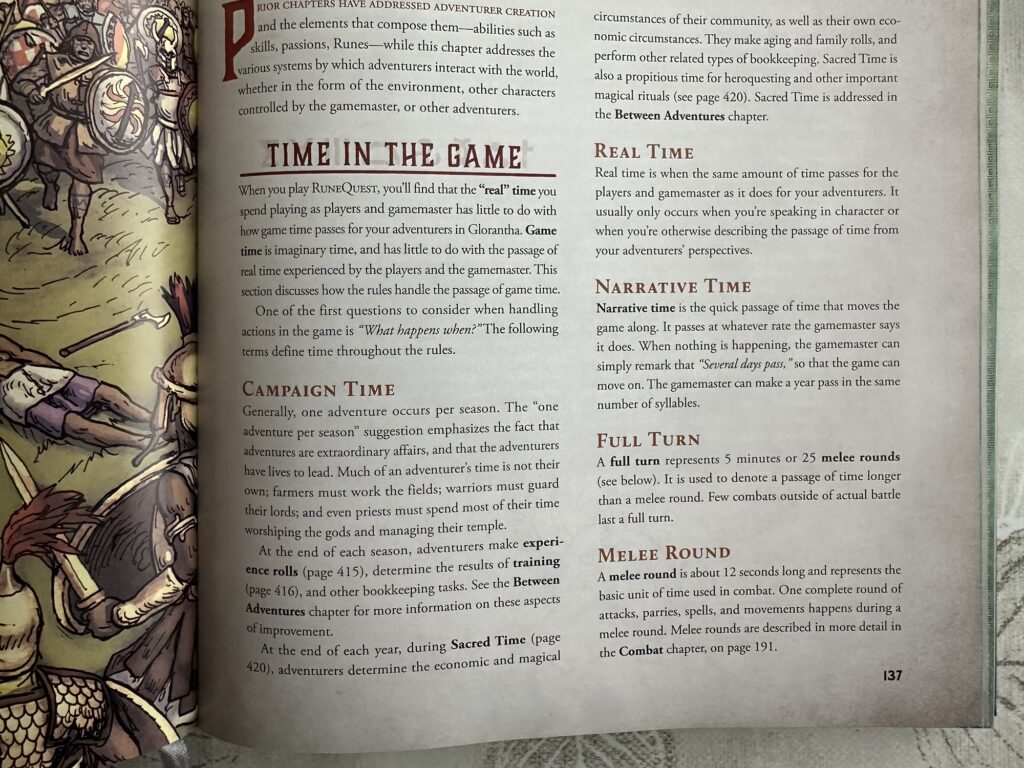
Note that the latest edition of RuneQuest almost had it right, by indeed introducing Narrative Time… and then blew it! As is often the case with RQG, the authors thought that “more is more”, or something, and so they introduce not only “Narrative Time”, but also “Campaign Time” and “Real Time”, all while keeping “Full Turns”! Uggggh. Whyyyy.
About Real Time
If you allow me more ranting on the topic3, the concept of “Real Time” is bullshit too, by the way.
Real Time is supposedly when time passes in the same way between the players and their characters. In theory that might happen for instance when you’re speaking to an NPC: you and the gamemaster might roleplay out the dialogue in the same manner as you would witness in the game world.
But this isn’t quite correct: sooner or later, someone starts hesitating, searching for their words in a way their well-spoken thief with a high Fast Talk skill would not. Or they start adding descriptions, such as “the inn-keeper suddenly frowns” or “I hide my tribe’s tattoo as I realize he’s from the Greydog clan” or “I wink towards Grunda to move behind him stealthily”. Or they simply grab some snacks from across the table or something. Very quickly, the two time scales diverge. The three minutes you spent talking to the inn-keeper was actually two minutes in game. But does it matter? No! Because “Real Time” is a bullshit concept.
Am I totally nitpicking here? Of course I am! (Have you met me?) But frankly, RQG is the one who started nitpicking first, by trying to define a bunch of time concepts that didn’t really need to be defined at all! Yes, my defence is “he started it!”

So there you have it: time in RuneQuest is two-thirds bullshit. And once again, I ended up ranting way longer than expected on a small detail, and sadly next time won’t be any better: I originally planned this article to cover the first couple pages of chapter 3, up to the melee combat rules, and then I realized that not only was I ranting way too long on “Time”, but also on “Movement”! So expect that to drop soon, with just as much opinionated ramblings! Yay!
In the meantime, happy gaming!
- By the way, those tables are completely fucked, I have no idea what Gygax and Holmes were smoking. Apparently, a non-encumbered person, moving normally without being careful or mapping a dungeon or whatever, would cover 480 feet per turn, or 150 meters in 10 minutes. What the fuck?! ↩︎
- I’m ready to die on this hill so if you try to counter argue, you better be equipped with some good armour and shield! ↩︎
- Yes I know, this article is once again unnecessary long, sorry! ↩︎