Reading Classic RuneQuest: Movement and Encumbrance
I warned you last time that I would have more ramblings about the beginning of chapter 3, “Mechanics and Melee”, and that we would not actually get to, you know, reading the mechanics and melee rules yet. Well, this is it! These are the other ramblings! Let’s talk about movement in RuneQuest! (With a side of encumbrance)
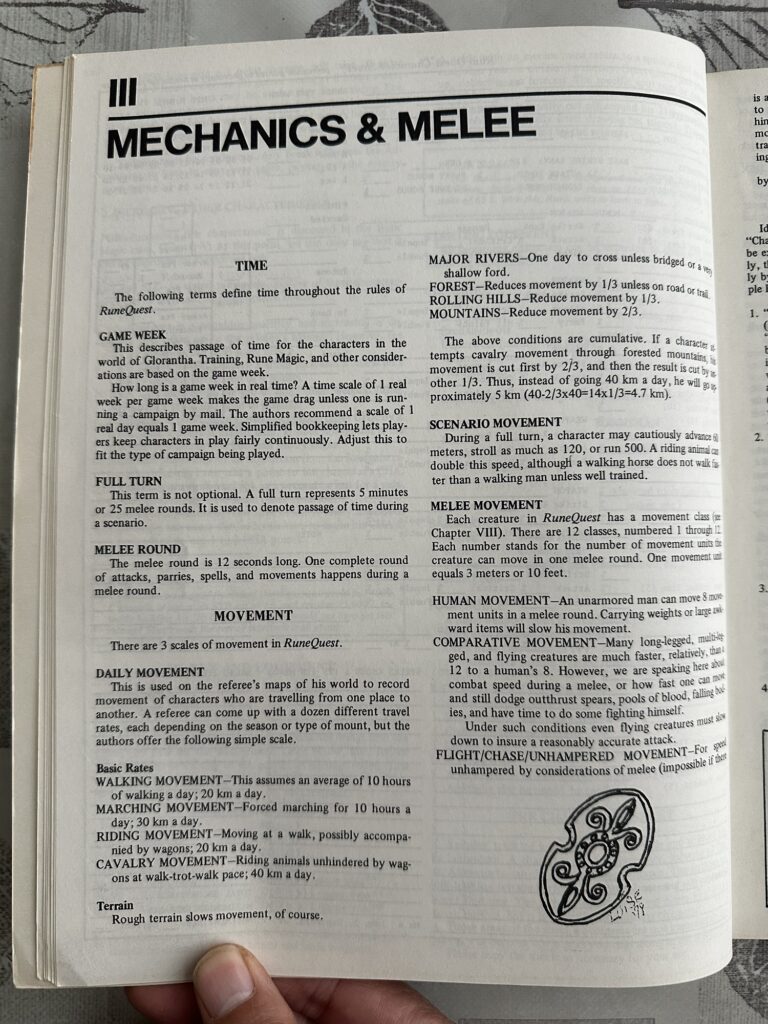
Daily movement speeds seem OK. Plus, it’s worth noting that riding animals was baked into the game’s design from the start, since we are given movement speeds for both people on foot and on mounts. Plus wagons. Neat! I wonder how much of a selling point that was for RuneQuest when compared to other FRPs of the time? “Tired of walking everywhere in D&D? Try riding a bison or antelope with RuneQuest, the game for truly wealthy adventurers!”1
Melee movement, however, seems weird to me because it’s defined by a “movement class” from 1 to 12. That corresponds to the number of “movement units” a character or creature can move in a melee round, with one “movement unit” being equal to 3 meters or 10 feet.
One More Useless Game Unit
I have no idea why the authors decided on these units: most battlemaps use a resolution of 1 or 2 meters per square or hex2, right? Does anybody use a 3-meter scale? I’ve never heard of this.
When GMing RQG, I use a mix of pre-made maps from various sources (such as 2-Minute Tabletop and Dyson Logos), and maps I draw myself, including drawing them on the fly as I improvise something, which is actually quite often. I find it so much more natural to draw at 1 or 2 meters scale. But doing this then requires using meters during play, since you can’t just use “RuneQuest units” and reason entirely in MOV points. Either that, or you need to re-scale your maps3.
In the end, just as last time with RQ’s useless “Full Turn”, RQ also has useless 3-meter distance units.
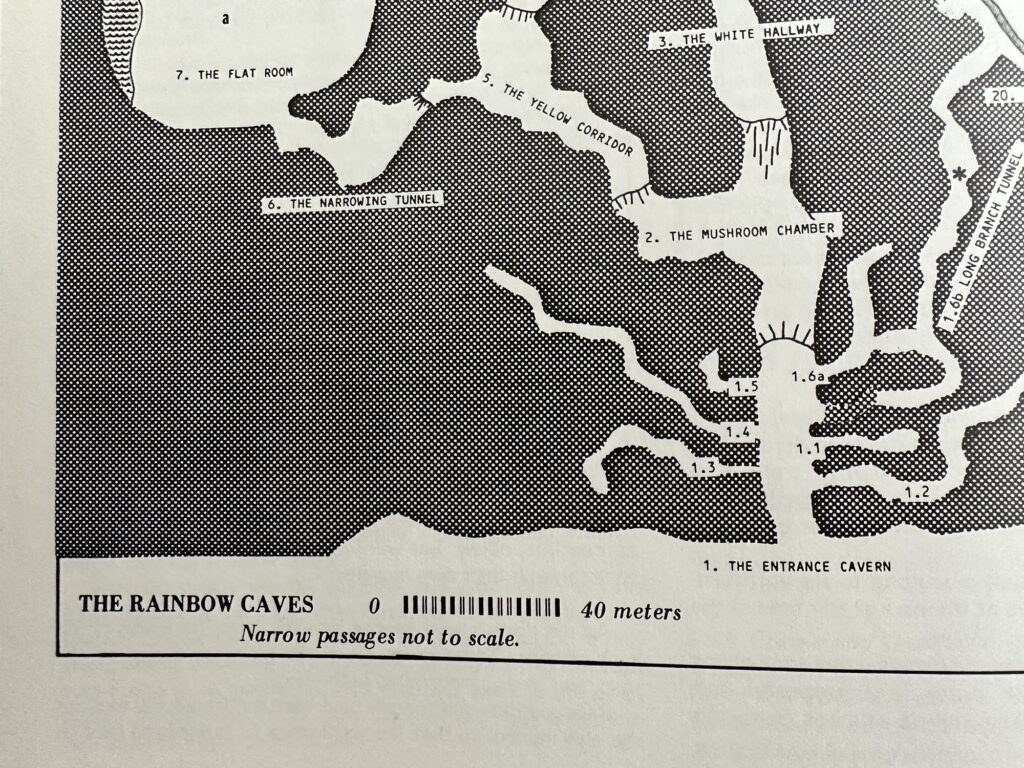
Looking at the first published scenarios, the scales are all over the place anyway. The scale in SP1’s “Balastor’s Barracks” is 15 meters, which is divisible by 3 so it might be usable with RQ’s movement units, but the map doesn’t give you those increments so you have to measure them yourself. SP2’s “Gringle’s Pawnshop” uses 8 meters, and “The Rainbow Mounds” is… well, I’m not even sure what that scale is (see image above). I think each increment is 2.5 meters? What kind of madness is this?
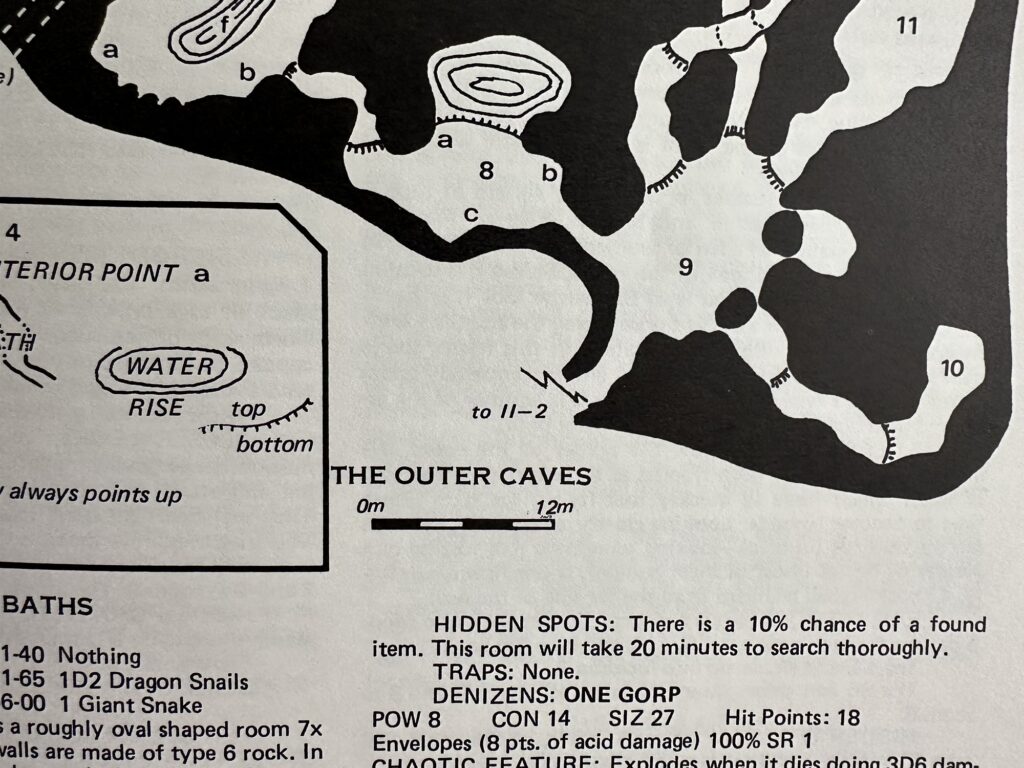
Thankfully, SP6’s “Snakepipe Hollow” features a 3-meter scale on its cave maps! Yay! But there’s no grid on the map, so you have to measure by hand! Booo!
Regardless, the authors immediately forget that their game system uses 3-meter movement units, and most of the subsequent publications feature wildly different scales. Granted, these publications also feature wildly different scenarios and adventure sites anyway, from large religious temples to sprawling cities and entire nation states. So that’s cool. As Steve and Greg said elsewhere in the rulebook, dungeons get boring pretty quickly anyway. But I guess GMs often ended up drawing their own maps for the actual combat scenes, and we’re back to square one4.
Where’s My Movement Crunch?
When compared with the rest of the RuneQuest system, it seems weird to me that adventurers have a simple, fixed movement rate. Humans’ MOV is 8. That’s it. Coming from a game where your characteristics provide modifiers to your skill scores and your damage bonus, for instance, you have to wonder where is the table that says that, I don’t know, a big-enough DEX and SIZ can give you MOV +1 or something?
But then again, movement is generally an afterthought in RuneQuest. I wonder how much of this comes from Steve Perrin’s and his friends’ experience as members of the Society of Creative Anachronism (SCA). We know that this is where they had “practical” experience with melee combat (or at least an approximation of it), and how it had a big influence on the way they designed the combat rules.
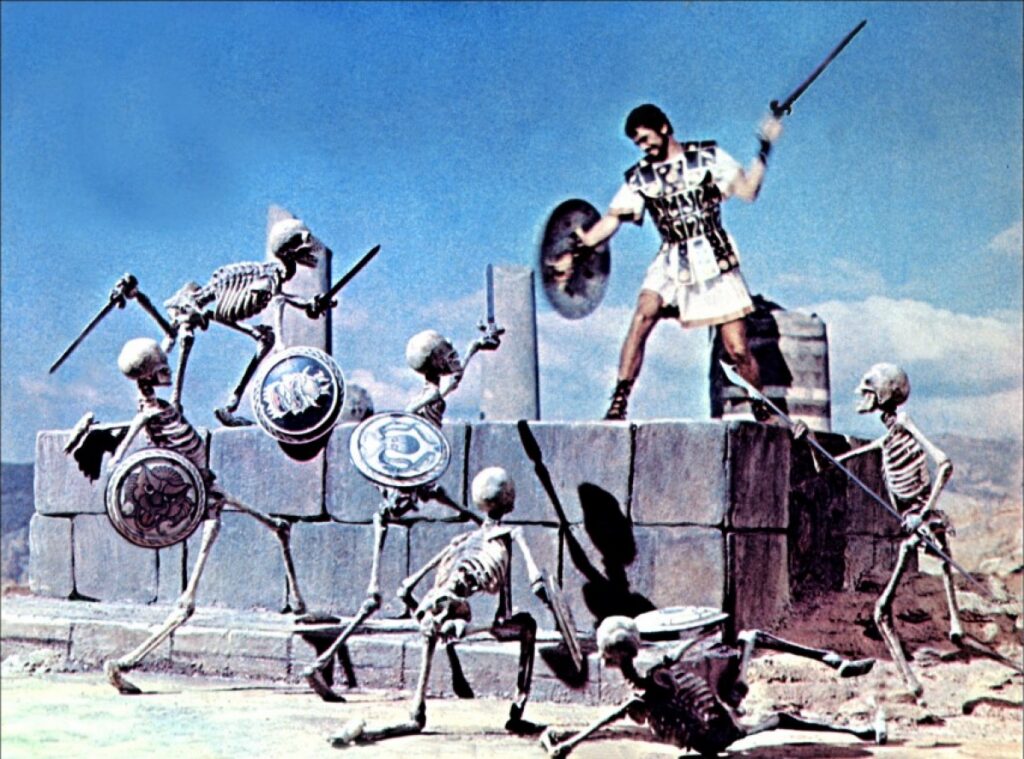
I’m peeking ahead a bit into the next page, here, but let’s just say that RuneQuest’s melee combat is very static. When you’re in melee, you just don’t move. RuneQuest doesn’t model combats where the participants push their enemies into a corner or the edge of a cliff, gain the higher ground, or cede it in a desperate defensive move.
Even “Jason and the Argonauts”, more that 15 years before RuneQuest, and despite the technical limitations of stop-motion VFX, features Jason and his buddies jump up and down short stone walls, advancing and retreating, all while engaged in melee against a bunch of skeletons. In RuneQuest, you’d have to “disengage from melee” and then “re-engage”, which… actually isn’t even possible in RQ2? But I guess I’m getting ahead of myself a bit, and we’ll get to that later.
My point is: I wonder how much of these SCA combats were basically two white guys standing on a mat or in the middle of a municipal park, hitting each other with foam weapons until a referee called the winner. I’m sure some SCA-people will yell at me online, telling me how awesome and dynamic their combats are, and I’m totally sure they are! I’ve done a bit of LARP’ing myself in my youth and I know there’s a lot of footwork and running around! But I wonder how Steve Perrin’s SCA chapter, specifically, in the 1970s, specifically, was. That would surely explain why RuneQuest melee combat often feels… exactly like two white guys standing in place and hitting each other until it’s over.
Unhampered Movement
One other thing caught my eye in this section: the bit about “comparative movement” and “flight/chase/unhampered movement”.
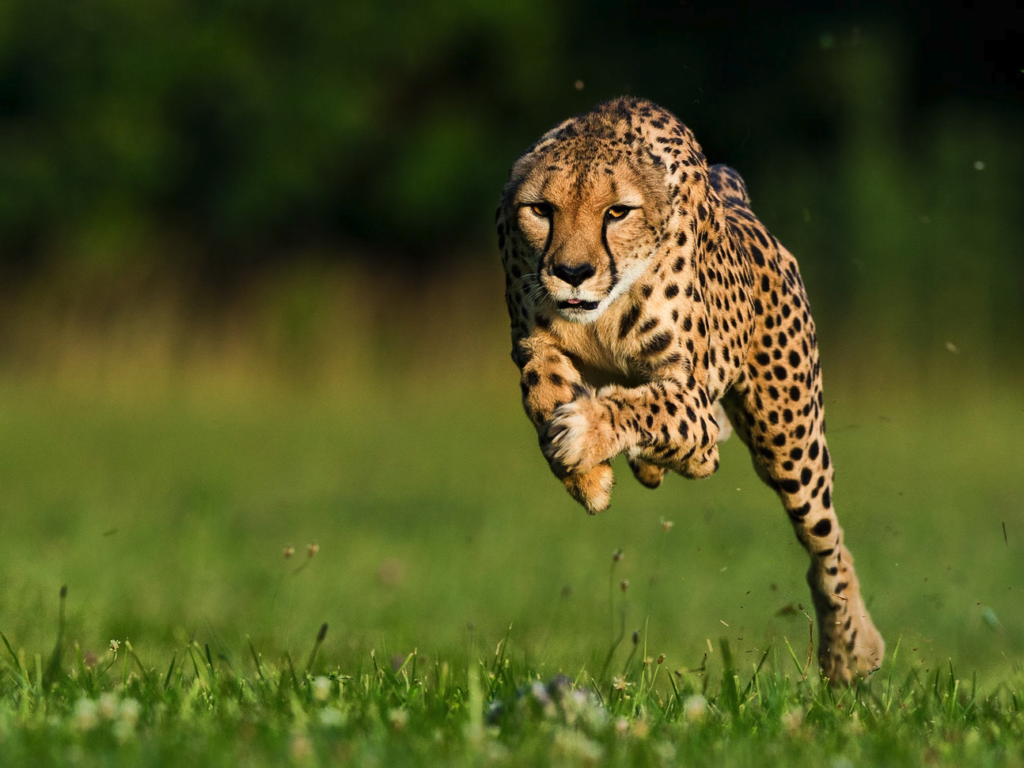
With humans at MOV 8 and the maximum MOV at 12, we might think that nothing can be more than one-and-a-half times faster than a human… which is obviously wrong if you’ve ever seen, like, a horse or a lion or something. The authors are aware of this, so they tell us that MOV is only meant for use around melee combat. They argue that even a fast creature, like a cheetah or peregrine falcon, would have to slow down to attack! I don’t quite agree with this, but sure, let’s go with that.
Still, the rules allow for fast creatures to actually be fast in other situations, at the GM’s discretion. If a character or creature is “unhampered by considerations of melee”, it can move at double MOV if 2-legged, triple MOV if 4-legged or more, and 5 times its MOV if flying. This certainly helps people and creatures on the periphery of the action run around much faster! But I’m not sure that this actually checks out.
At MOV 8, an unhampered human can run up to 48 meters in a round, or about 14km/h. That’s actually below the human average for sprinting (about 20km/h), and of course way below Usain Bolt’s 2009 record (about 44km/h) but hey, let’s assume that the average RQ character involved in a combat scene is busy doing other things than just running in a straight line for fun, I guess. Well, except for the javelin-throwing skirmishers at the top of the hill, who do routinely run in straight lines to change positions or retreat, but who’s counting.
It gets a bit wonkier with animals and monsters. At MOV 12, an unhampered quadruped can move up to 108 meters in a round, or about 32km/h. That’s… way too low? According to some quick research, a domestic cat can reach 40km/h, a horse 50km/h, a greyhound 70km/h, and cheetahs over 90km/h. Maybe they’re also too busy in RuneQuest to reach their top speed for… reasons.
I think GMs can pretty safely increase unhampered movement rates, with humans being able to sprint for a round or two at three times their MOV. Similarly, GMs should be able to bump the multipliers by one or two for various creatures.
The Missing Rule
One interesting bit about the latest RuneQuest Glorantha is that, unless I missed it somehow, it does not support unhampered movement.
I looked at both the RQG rulebook and bestiary, and none seem to mention anything about it. No multipliers to MOV for multi-legged or flying creatures, and nothing about different movement rates in some situations. In RQG, the top speed is just MOV 12, also know as 10km/h, and that’s it.
Did the RQG authors just forget to add that paragraph in the rules? Did they think we don’t need it? Hard to say. Usually, when they didn’t take something from RQ2, they took it from RQ3, but RQ3 handles movement completely differently.
In RQ3, instead of MOV 8, humans have Move 3, which means that they can move 3 meters for every Strike Rank5, starting after their DEX SR. Since there are 12 SRs in a round, and a human usually has DEX SR 3, that means they can move up to 10 SRs, or 30 meters in a round. That’s more than MOV 8 (which was 24 meters) but less than the unhampered MOV 8 (which was 48 meters). On the plus side, creatures’ movement ratings could go much higher, since they weren’t technically limited to MOV 12. For instance, in RQ3, a horse has Move 11, which means it can move 11 meters per SR, or about 110 meters per round. Oh wait, never mind, RQ2 had quadrupeds at 108 meters per round, so we didn’t gain much here… but in theory they could go faster!
Anyway, I always felt that monsters were slow in RQG, and now I know why!
A Side of Encumbrance
I really want to get to the mechanics and melee next time, so let’s quickly get through the section on everybody’s favourite rules6: encumbrance! I had a good chuckle at the authors’ introduction:
Ideally, an ENC rule for a role-playing game should read, “Characters may not carry more than they could reasonably be expected to carry under normal conditions.” Unfortunately, the reasonableness of various loads is interpreted differently by different players, so the authors offer the following simple ENC system.
Hahaha. Slow clap. Good job, Steve.
The rules are almost narrative. They say that you can carry as many “things” as the average of your STR and CON, limited by STR7. It then defines a “thing” as something you can hold in one hand (“a sword, a rock, an axe, a rope, etc.”) And so things that take two hands to hold, like a spear or a bow and quiver, have ENC 2. It sounds simple and great! But in practice, the system can’t help itself and goes into simulationism, with a few things you can hold with two hands ending up having ENC 3 because they’re “realistically” heavier, such as the pole axe, the two-handed flail, or the crossbow. Ironically, the large shield, which by definition you carry with one arm, is also ENC 3, although probably more for gamist reasons than simulationism. Gotta make it worth it to pick medium or small shields, right?
The penalties for being over-encumbered are pretty steep: not only are you slower and less able to defend yourself, you also get penalties to all your skills! And no, not just physical skills! The penalties apply to all skills! So being over-encumbered hinders your ability to speak a foreign language or spot hidden items! I wonder if this ever ended up in Steve Jackson’s long-running Murphy’s Rules comics?

Anyway, that’s it for movement and encumbrance, thank you for humouring me and my rants! Especially big thanks to the few people who always send thoughtful comments and corrections on Discord or social media, this is what makes writing this series so fun!
I’m excited that next time we will be looking at the actual combat rules from 1978! Expect lots of ranting!
In the meantime, happy gaming!
- Hey Chaosium, I’m available for time-travelling marketing work! ↩︎
- Give or take the conversion from those stupid units that I am contractually obligated to say bad things about because I’m French. ↩︎
- Granted, this is pretty easy to do in a VTT if you play online. ↩︎
- That square is 3-meters-long on each side, of course. ↩︎
- We haven’t gotten to Strike Ranks yet but rest assured I will conclude that they’re bullshit. ↩︎
- Grappling comes in second place. ↩︎
- Gotta add that extra bit of crunch! ↩︎