Runic Rants: This 800-Pages, 5.7-Kilos Slipcase Set Is A Great Source For A Light Gloranthan Setting
The Guide to Glorantha is a wonderful beast, and I figured I should write about it. It weighs over 5.7 kilos1, it’s over 800 pages long2, it has thick glossy paper, it’s full of glorious cartography, it won the prestigious Diana Jones award in 2015, and somehow it was how I was successfully introduced3 to Greg Stafford’s mythical world of Glorantha.
It’s also a great source for your next light little campaign setting! Does that makes zero sense? Of course not! Let’s crack this monster open.
Look At My Huge Volumes
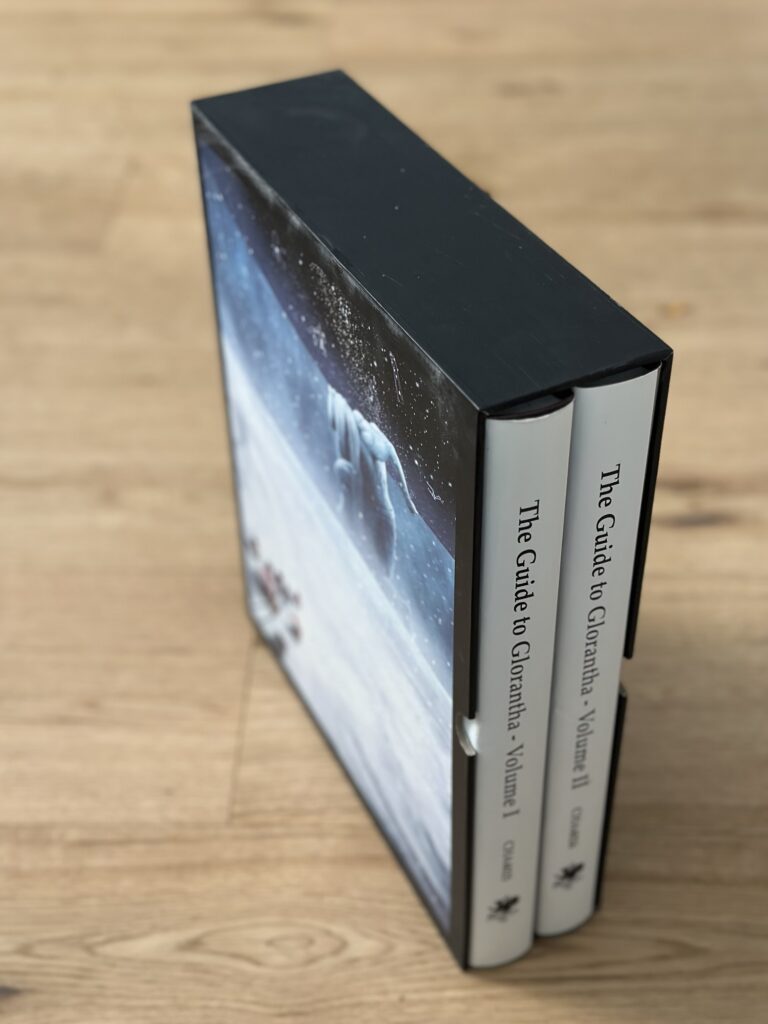
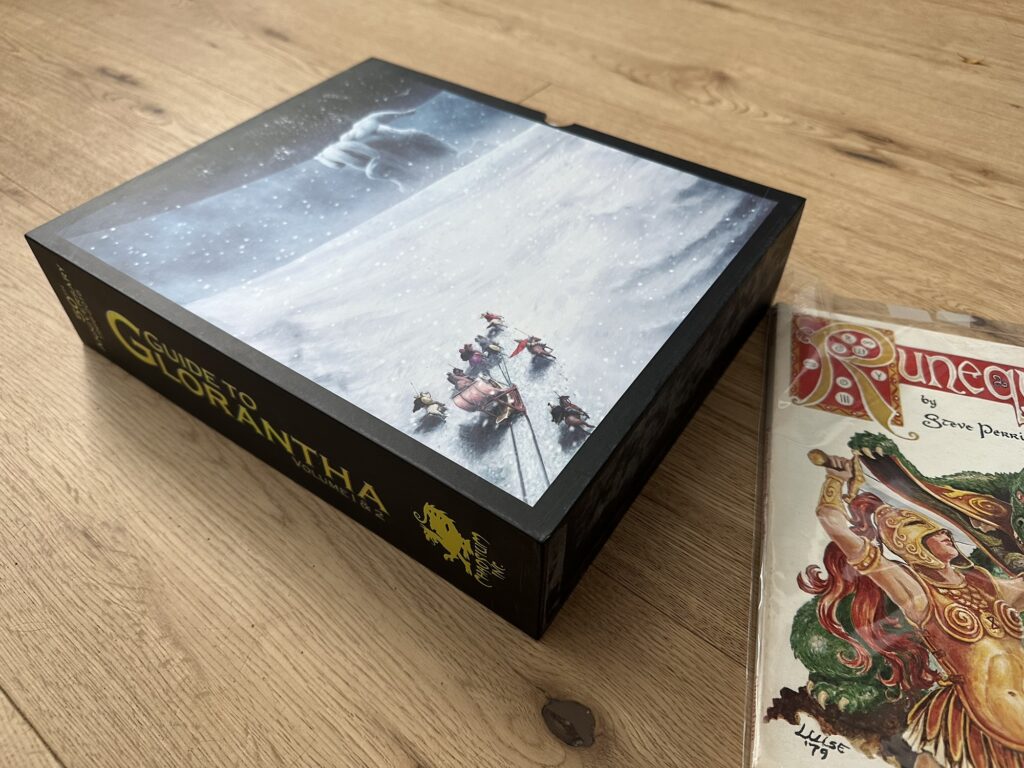
First, let’s stop and marvel at this slipcase, which screams at you to be prominently placed in your living room, if only because its coffee-table size ensures it won’t fit on the normal-sized Ikea bookshelves in your office or basement or whatever. It’s biiiiiiig. The two books inside are biiiiig. You can use them to fight off home invaders. You can use them to stop bullets. You can use them in your fitness routine4. You get the idea.
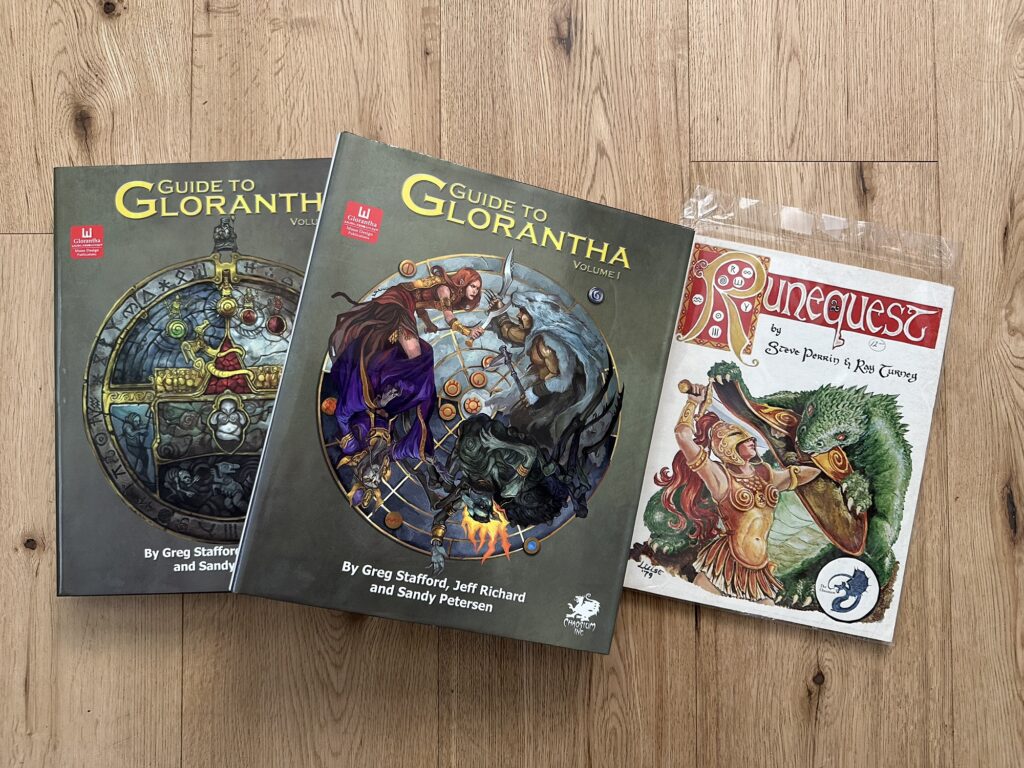
Here they are, next to the RuneQuest 2nd edition rulebook, which I’ve been reading lately.
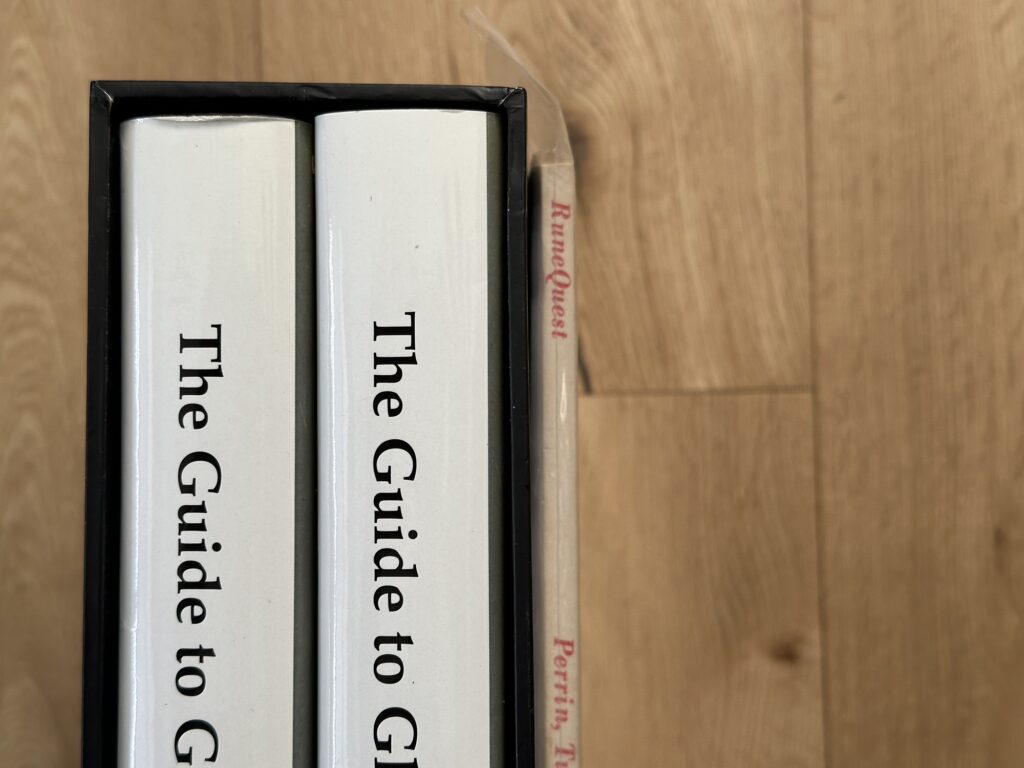
That doesn’t look so big? Oh, wait, my bad. Let me show them to you from the side. There. The RuneQuest rulebook is barely thicker than the thickness of the slipcase. Yeah. Believe me, now?
Also Look At My Goodies
The Guide to Glorantha was the subject of a successful Kickstarter campaign that ended in late 2012, and shipped in mid-2014. It wasn’t even a Chaosium product back then: it was from Moon Design Publications, although most of the people involved in that company eventually took over Chaosium in 2015.
The two-volume set came with a variety of extra rewards, too. I wasn’t into Glorantha at the time so I definitely wasn’t aware (or interested) in this Kickstarter, but I managed to grab a couple of those goodies a few years later, before they ran out of stock.
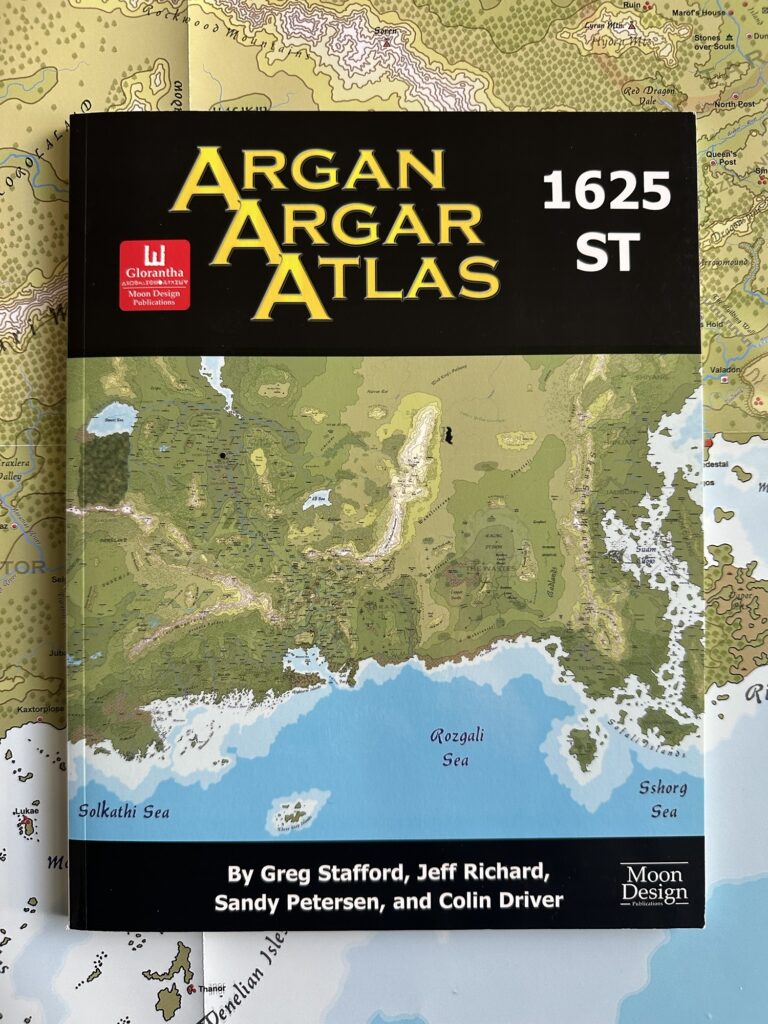
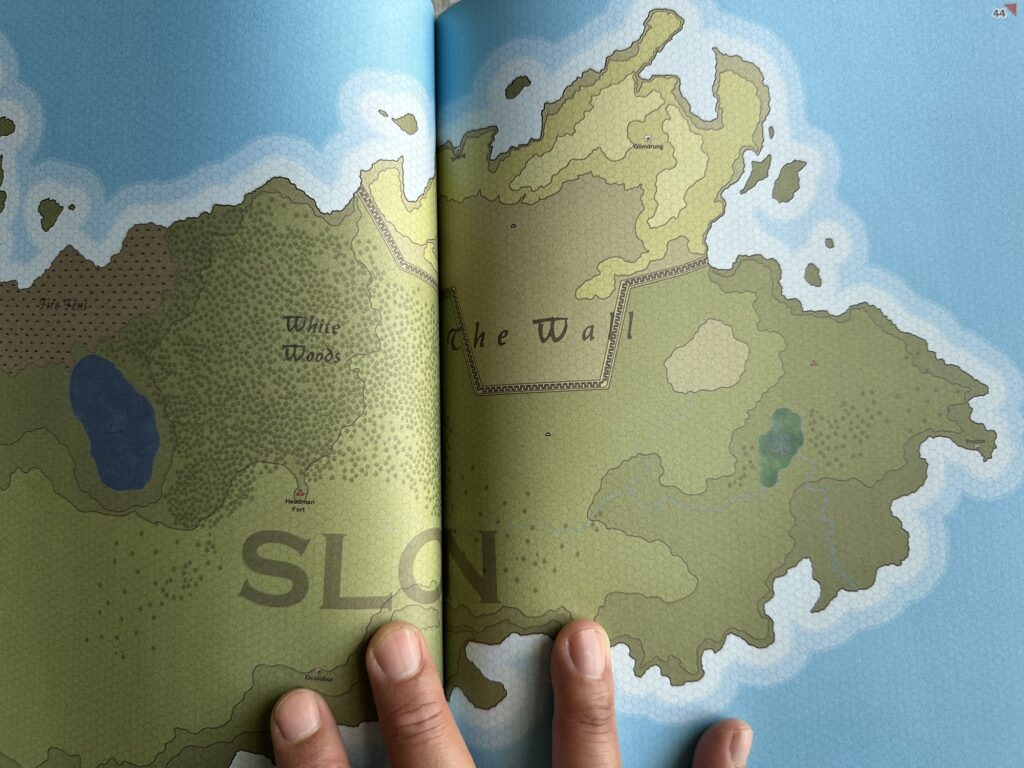
The first common goodie was the Argan Argar Atlas, a road-atlas-style book5 that covers the entirety of Glorantha, using the same maps as those found in the Guide, and printed with… ahem, debatable quality6:
The other common goodie was two sets of somewhat-flimsy poster panels that feature the same Gloranthan map. One covers the whole Glorantha, while the other is limited to the northern continent of Genertela, but at a higher scale.
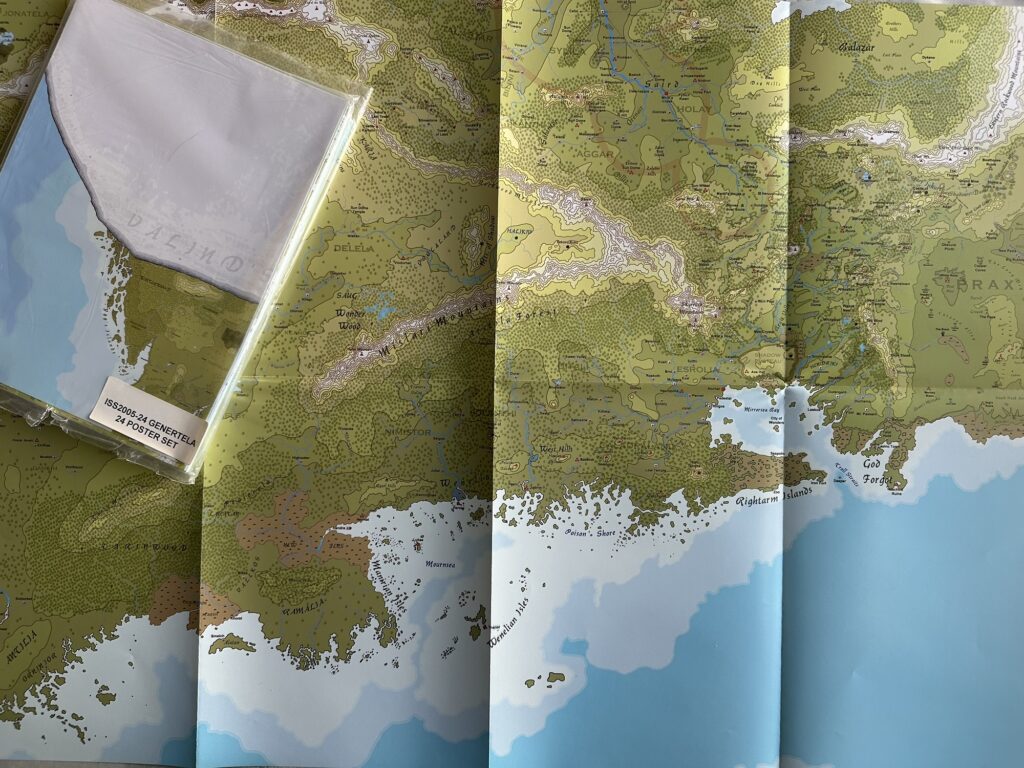
Why am I wasting your time with all of this, by the way? Well…. to show off, mostly. I mean, this is my blog so I get to show off my stuff… where else would I be able to do that? And also we’re talking about maps, here. I can’t NOT post photos of maps, can I? But yes, yes, you’re right, let’s go back to our main topic.
Magic In A Box
The Guide to Glorantha is, basically, an encyclopedia. After the usual credits and forewords, you have a series of pretty standard-looking chapters: cultures, history, geography, appendices, etc.
But even though that sounds like 800 pages of tedious lore, it is actually wonderful. Somehow, it delights me and captures my imagination every single time I crack it open. As far as I’m concerned, this is magic in a book. Why? Hard to say… probably a mix of the initial “wow!” factor, plus a bunch of little things. And of course the maps!
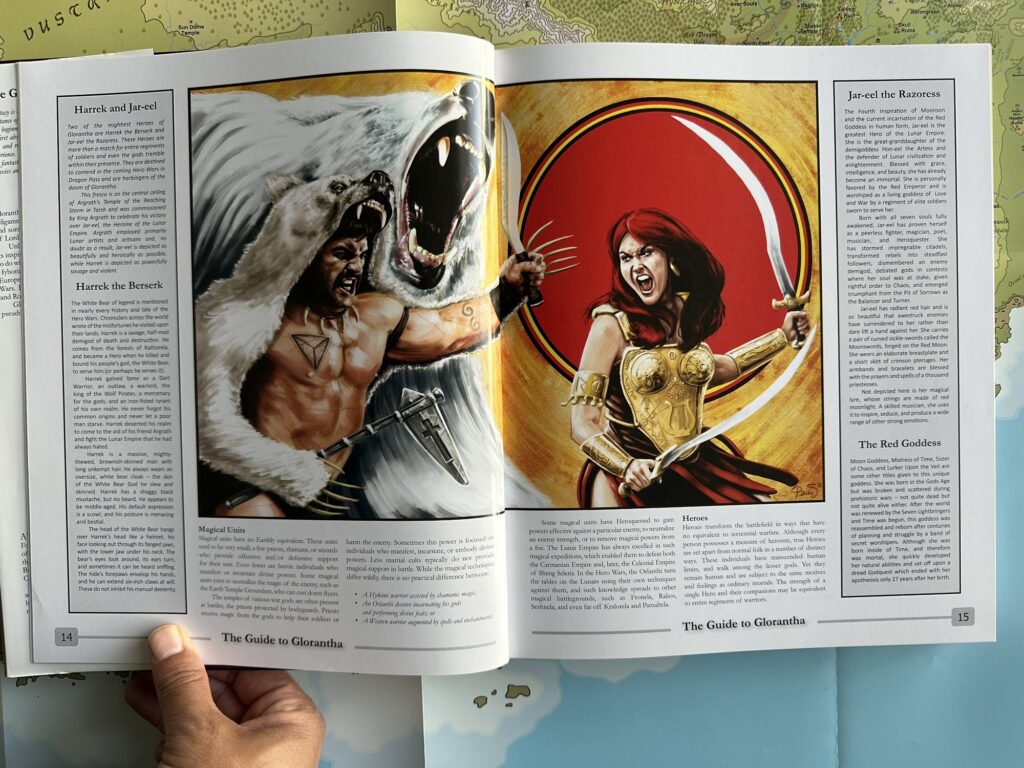
OK, let’s try and list everything that’s great about the Guide to Glorantha!
A Bigger World
First, the Guide to Glorantha describes a much bigger and richer world than, say, the RuneQuest Glorantha books. This is of course because it deals with the whole of Glorantha, instead of focusing on just one area like Dragon Pass or Prax (which totally makes sense for a game like RuneQuest, by the way!)
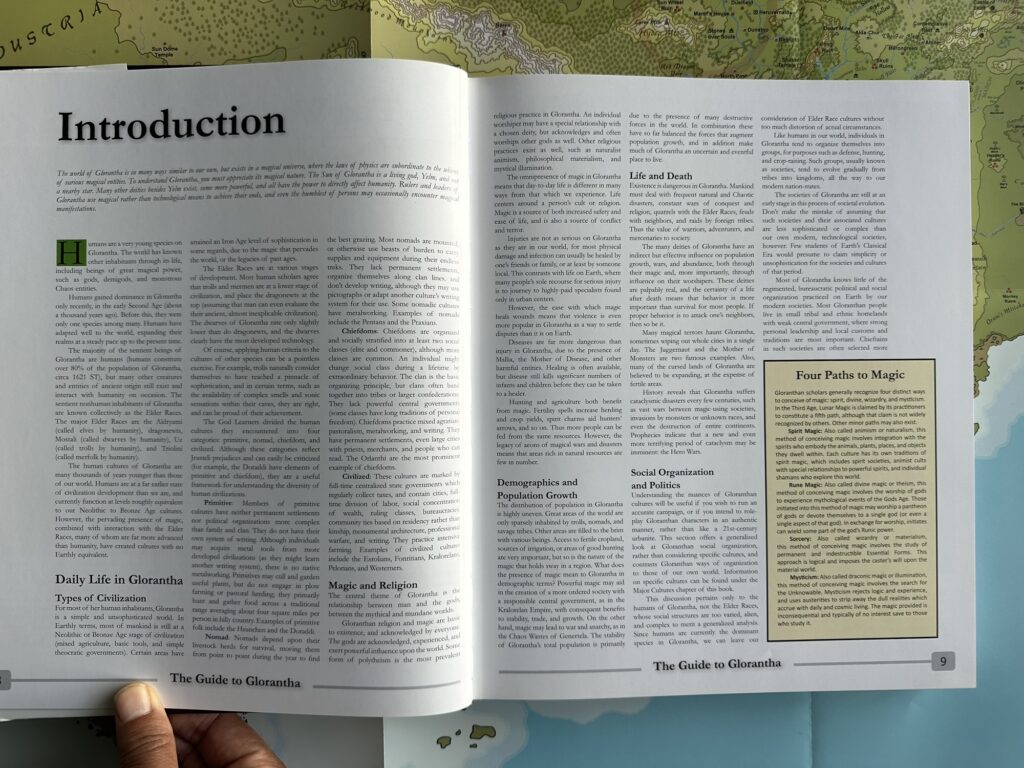
For instance we are not just introduced to Spirit and Rune Magic, but also to Sorcery and Mysticism as alternate paths to magic. When political structures are mentioned, we don’t hear about the Lunar Empire first, we are told about Kralorela as the most centralized government system around. When city states are mentioned, we don’t hear about Sartar, but about the more populous Janube River States. When magical “terrors” are mentioned, we don’t hear about the Crimson Bat, we are told about the even scarier and weirder Juggernaut7 and Mother of Monsters.
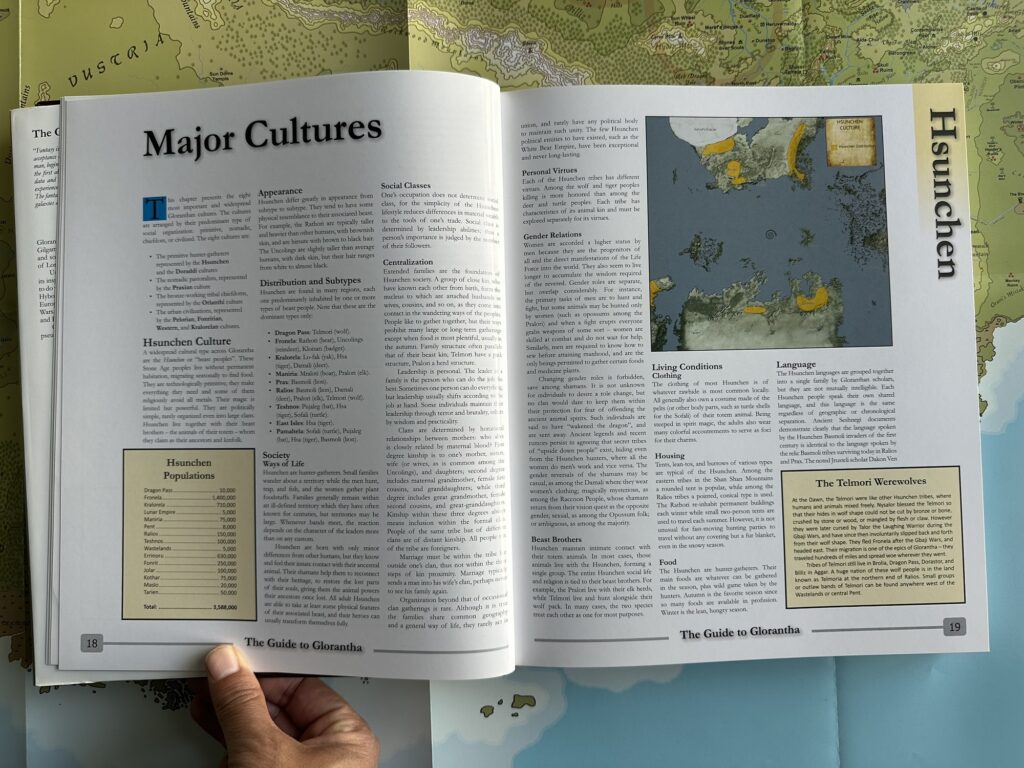
The same goes for many other topics. For instance, the Guide presents eight major “human cultures”. But if you know Glorantha only through RuneQuest, there’s a good chance you only know two of them, the Orlanthi and Praxian cultures, and have vaguely heard of maybe another one, like the Pelorian culture (which is the culture of the Lunar Empire).
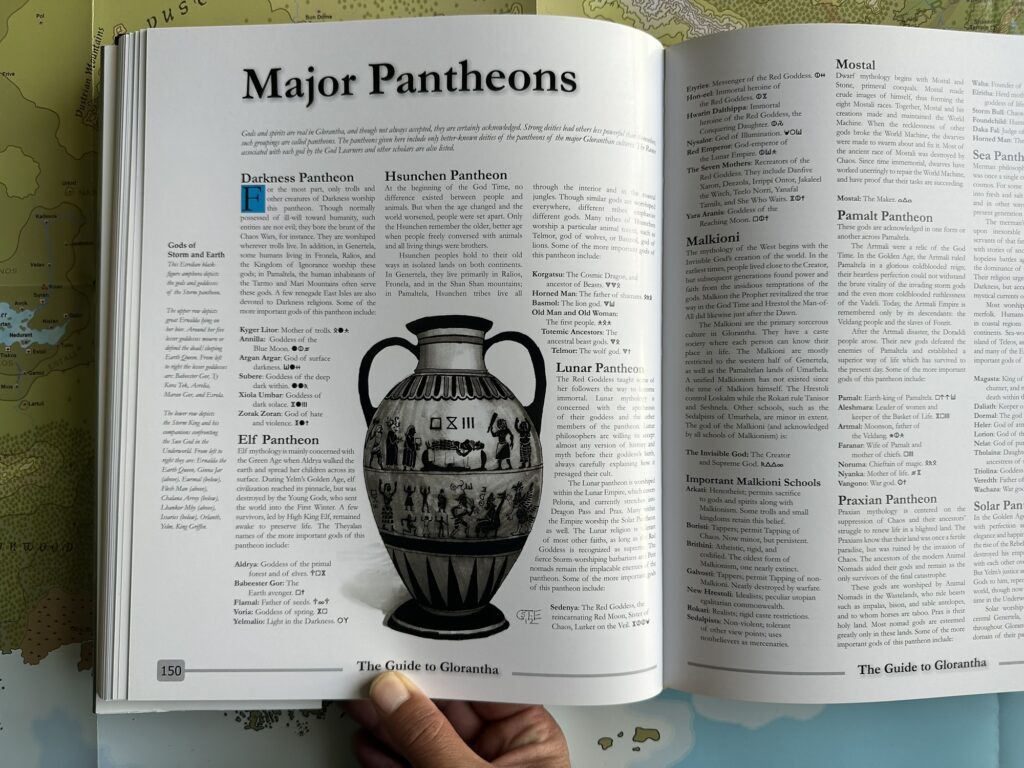
Even the Elder Races, which have been covered by one RuneQuest book after another in the past, feel a bit grander in the Guide. You can recognize portions of identical or similar text between the Guide and the RuneQuest books, but for example the Guide’s Aldryami have a slightly expanded mythology and history, extra information on their internal politics, and slightly longer descriptions of their sub-types. That’s what you get when you don’t need the space for stat blocks! We also get short write-ups of the most notable “Great Woods” of the Aldryami, found in the Elder Wilds, Fronela, and the Errinoru Jungle, which we can then look-up in the geographical sections of the books. And this is where it gets cool, because, well, did you ever think of tropical elves before? I frankly didn’t, not until I saw this mention of the Errinoru Jungle, which directed me to the Pamaltela chapter!
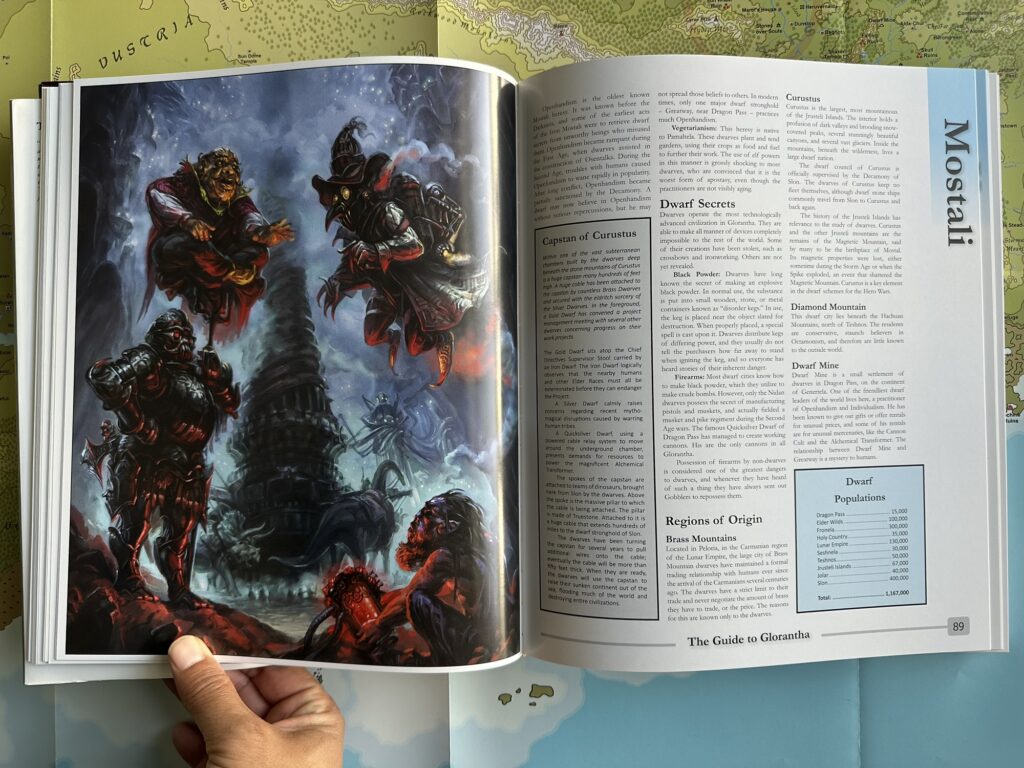
Still about the Elder Races, we get a lot more information on the ones that make no sense on the Dragon Pass-focused RuneQuest books. The Triolini (also known as Merfolk) are probably the ones getting the most extra coverage, with many of their sub-types being described here. My favourites are probably the Ouori, also known as the “walrus-folk”!
There are even extra Lesser Elder Races described here, like the weird Jelmre. They can produce “emotion crystals”, which might be a lot of fun to bring in your campaign via some trader from Nochet or something! Look it up!
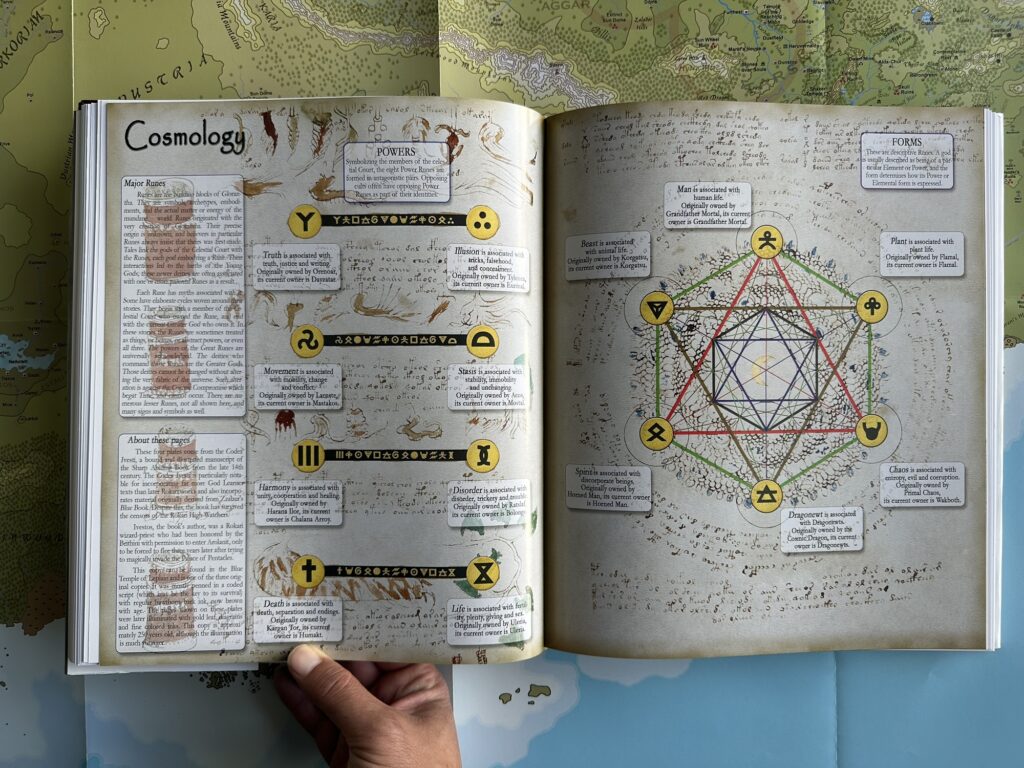
Even the chapter on the Runes of Glorantha contains a few more Runes than what we are used to via RuneQuest’s rules. For instance, we get some information about the Chaos Rune potentially being both a Form and a Condition (something I used in my Chaos chapter in A Short Detour), we see an odd but interesting categorization of the Moon Rune, we learn who the current “owner” of each Rune is, and we get a few extra ones like Power, Eternal Battle, Unlife, etc.
Some people might tell you that some of these Runes aren’t quite “canon” anymore, by the way, but the fun thing is that the Cosmology chapter is presented as being from a manuscript called “Codex Ivesti”, which mixes Rokari, God Learner, and original Zzaburi material! So you can say it’s biased and not completely correct! Which leads me to…
More In-World Texts
Did you like the “Travels of Biturian Varosh” in Cults of Prax, the “Portions of the Jonstown Compendium” in the RuneQuest Companion, or “Vasana’s Saga” in RuneQuest Glorantha? Of course you did. These sidebars of “in-world texts” really help transport us into Glorantha… but they have been mostly abandoned in recent years. Even the “Cults of RuneQuest” series sadly broke with the tradition of RQ2’s cult books, which contained them.
But that’s fine! The Guide has your back! It doesn’t have a winding linear narrative like “Biturian Varosh” or “Paulis Longvale”, but it does includes many “in-world documents” to add some narrative flavour. They are scattered across the whole book.
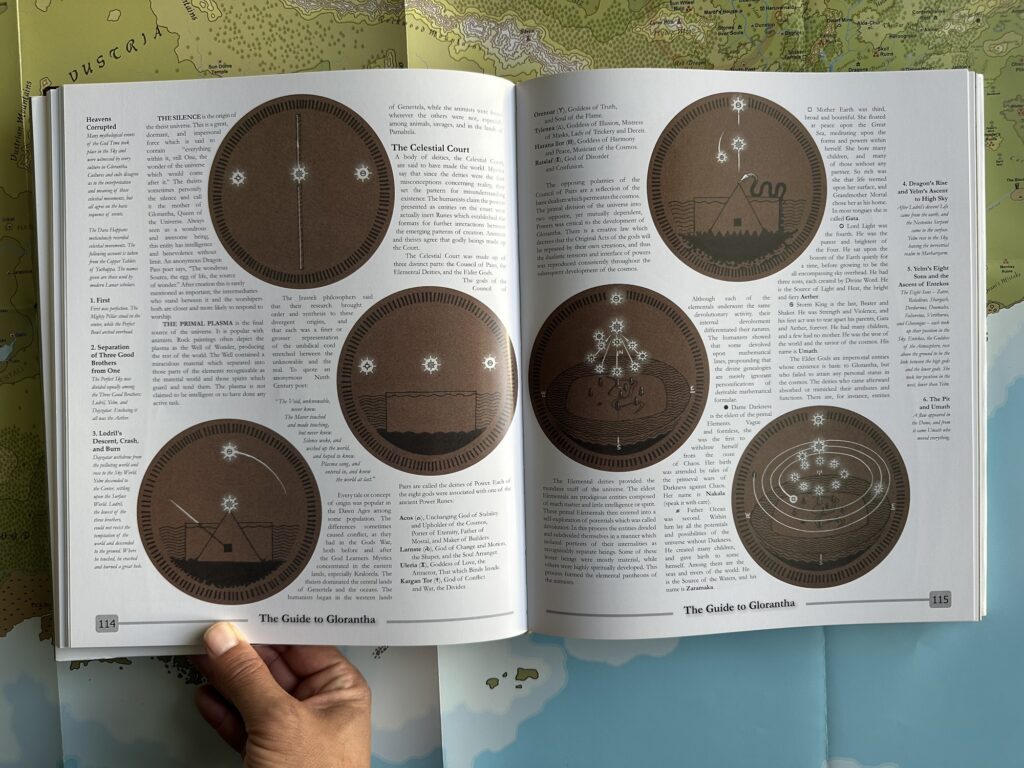
For example, in the Aldryami chapter, we have “Recollections of a Pamaltelan Trader”, and “An Aldryami Shaman’s Grove”, which provide “lived” anecdotes about what some elves are like. The pages explaining the creation of Glorantha feature the Ten Copper Plates of Yuthuppa, for a Dara-Happan take on the whole thing. In the chapter on the Holy Country, we are shown a pair of silver panels depicting the return of the Lightbringers from the Underworld, with annotations that read like some popular archaeology book. In the chapter on Ralios, we have three “tracts” on different aspects of Arkat, as distributed to people in the streets of Tortun. And so on.
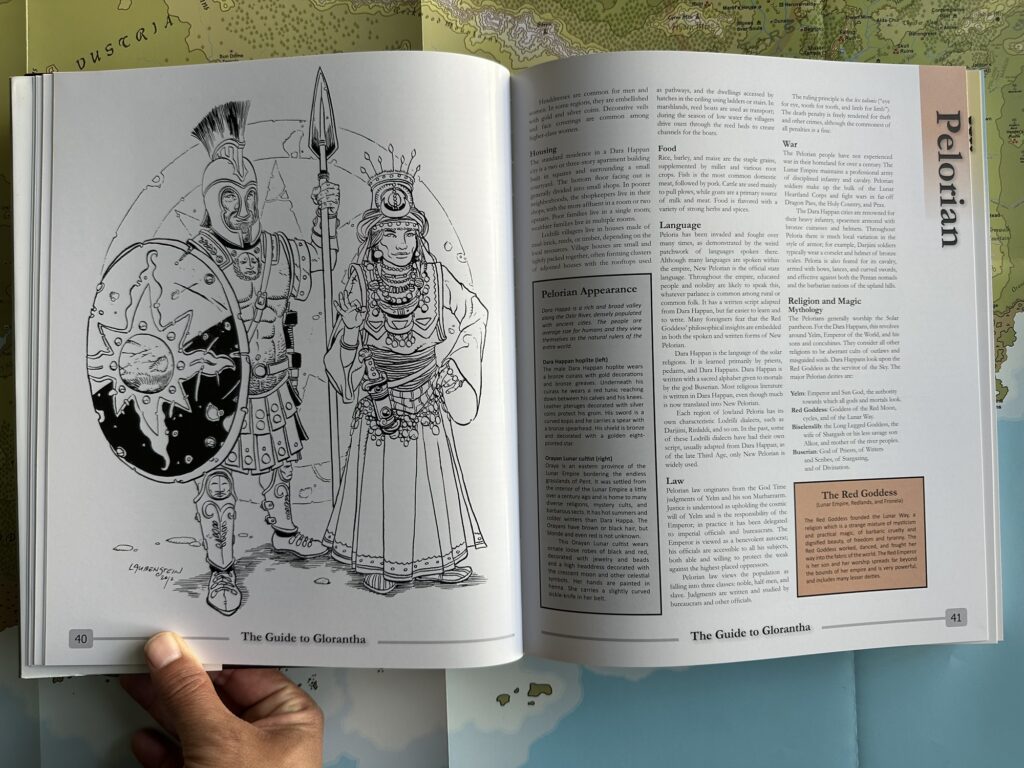
The authors did something similar with many illustrations, too: they treat them like the pictures you’d find in a Gloranthan version of a National Geographic magazine or mainstream history book. For instance, an illustration of a couple of Pelorian people is described on the opposite page, explaining who they are, what they wear, and what they’re doing. A painting of Kallyr Starbrow and Hofstaring Treeleaper surrendering to Fazzur Wideread and the Feathered Horse Queen is captioned like an illustration of Vercingetorix’s defeat from my old French school’s history book. A drawing of three Kralorelan astronomers is captioned as if it was a journalistic photograph.
It all walks a fine line between making Glorantha feel like a existing place from the past, and a real place in the present.
Open-Ended Metaplot
While the latest RuneQuest Glorantha line sets its in-world starting date to 1625, just after the event known as the Dragonrise, the Guide is written based on the earlier 1621 date, which was more aligned with previous Gloranthan games. But the Guide also gives a glimpse of what’s to come, not only related to the Dragonrise, but elsewhere and beyond!
Glorantha always had a “meta-plot” baked into the setting, but it is only known to hard-core fans because it is laid out partially in the Glorantha Sourcebook, and completely but rather obscurely in King of Sartar. These are two game-agnostic books you should only look into if you’re very very much into Glorantha, especially the second one. RuneQuest Glorantha wisely avoids including any of this into its product line, but if you’re curious, Chaosium’s Well of Daliath has a high-level timeline of Dragon Pass that goes all the way into the 1800s. The Guide also has an Appendix that recounts this possible course of events, although it mostly avoids stamping any specific event to any specific date.
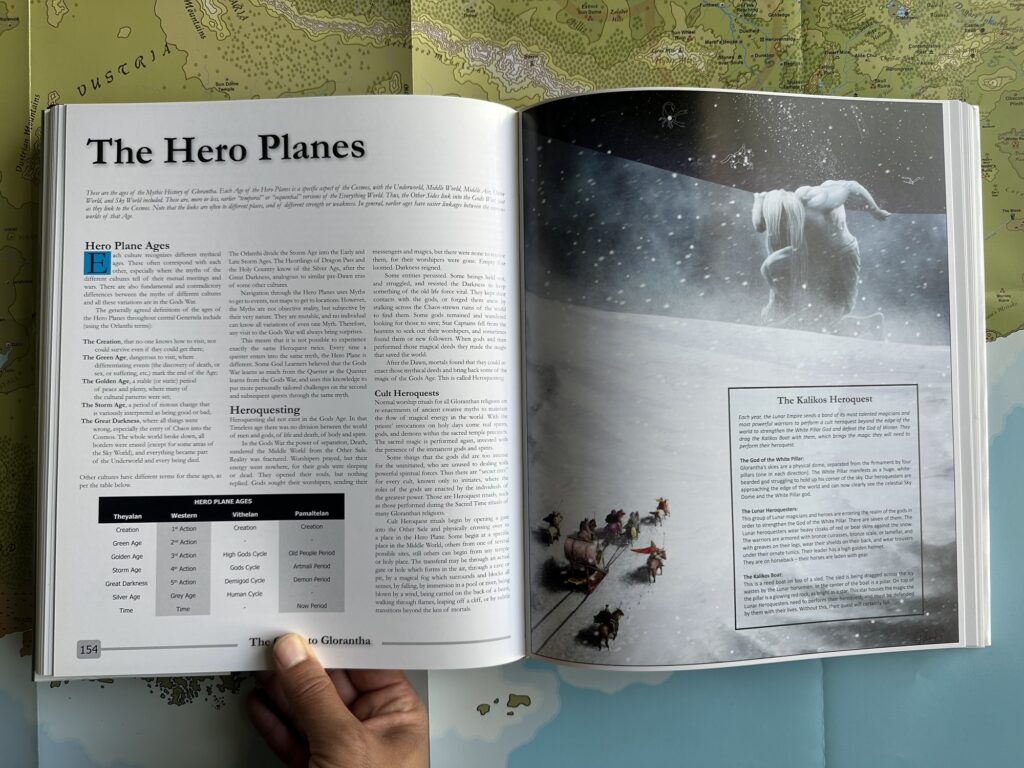
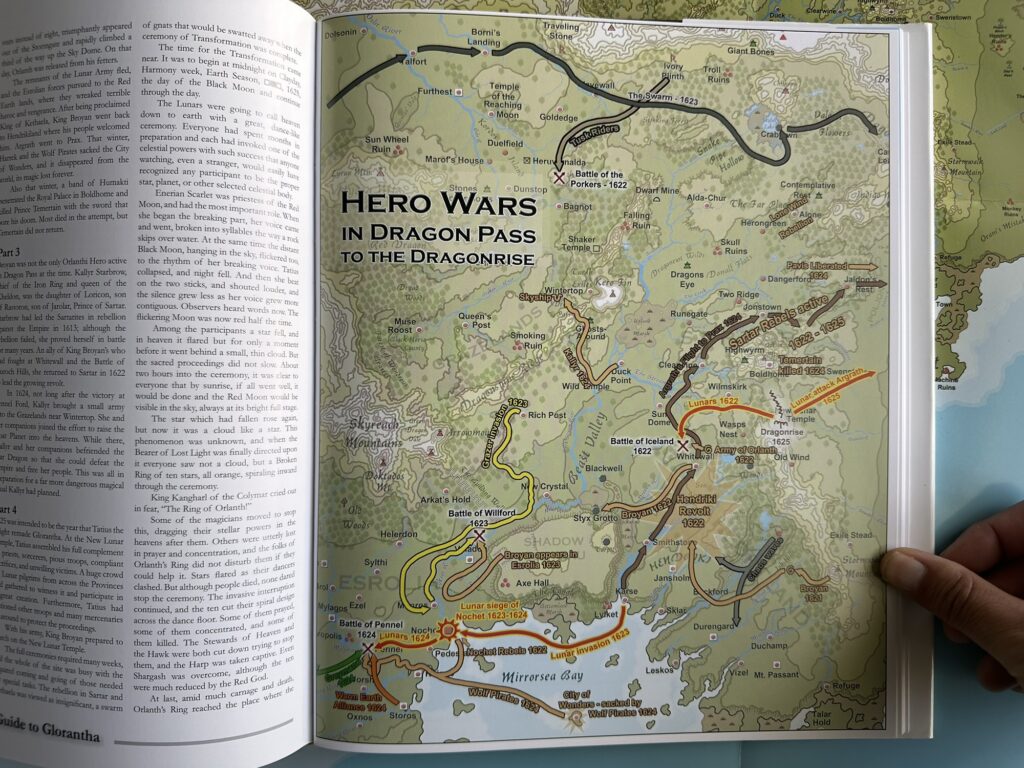
The Gloranthan meta-plot is centred around the concept of the “Hero Wars”, which are made of numerous world-shaking conflicts that will “end” the Third Age. People often only talk about Argrath’s war against the Lunar Empire, but there’s much more to it, and the Guide puts this to good use.
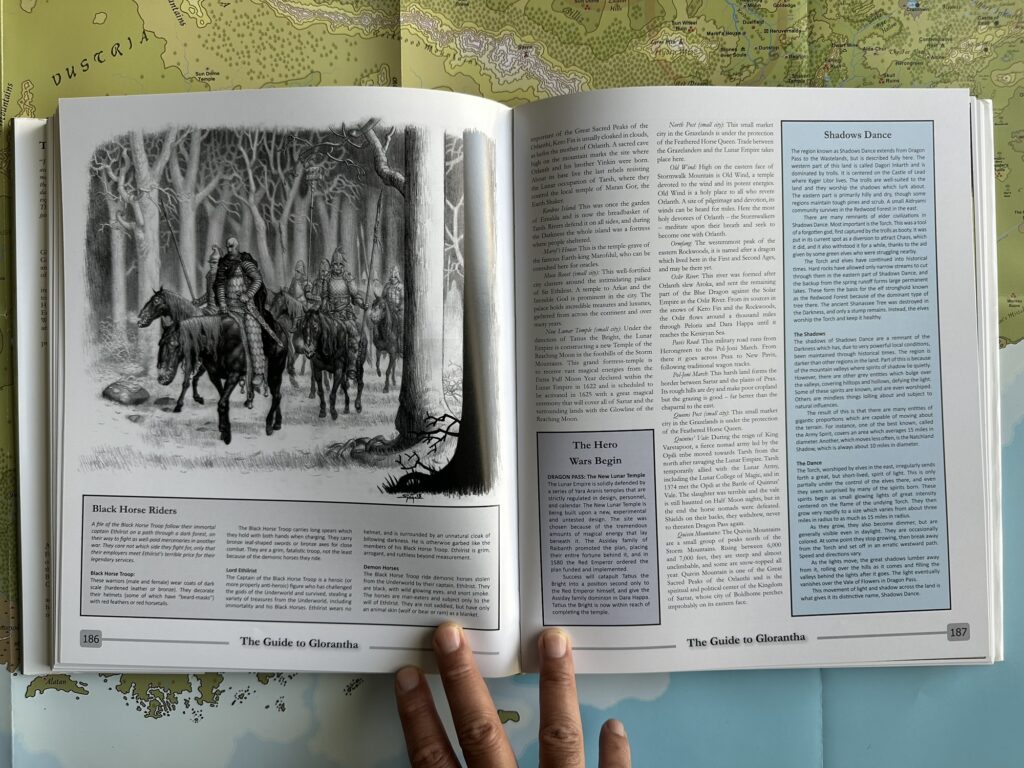
A recurring series of sidebars called “The Hero Wars Begin” give us a variety of plot-lines and agendas that we can use in our games, and they tend to be more interesting than the “Fantasy Alexander The Great” that Argrath’s story often boils down to. Here are a few teasers:
- The Aldryami are planting magical seeds in secret across Fronela, Maniria, and Peloria, as part of a great “reforestation” project that sees large magical forests sprout up in only a few years.
- The Mostali are working to reshape a southwestern mountain into a cube, and raise some of their old God Time kingdoms back into the world, destroying whatever is there currently.
- The giant Gonn Orta is looking for a specific member of the duck tribe, and many people fear what kind of prophecy will happen when he finds it.
- Ice trolls, with some help from cold-water merfolk, have been working on Valind’s Glacier, far in the north, to soon cause a gigantic icebreak that will cover and devastate half of the continent.
- In Kralorela, a cabal of governors/mystics are working to awaken all the True Dragons of the world.
- In East Ralios, a new Chaos faction emerges from Dorastor, who worship a previously unknown goddess.
- In Seshenela, the Waertagi Dragon City Ships return in search of Brithos, with some nefarious methods and plans in mind.
There’s a lot of fun and crazy stuff to discover in those sidebars! Which leads me to…
Lots of Really Fun and Crazy Stuff
I just said that, but it applies to the entire setting! Sure, it’s fun to explore the anthropological aspects of the Orlanthi culture, the political ramifications of ancient theocratic societies, the mythical underpinnings of harvest festivals, or whatever… but it’s also fun to grab one of the many whimsical, ridiculous, outlandish, or over-the-top ideas that have been compiled in the Guide from Glorantha’s long gaming history!
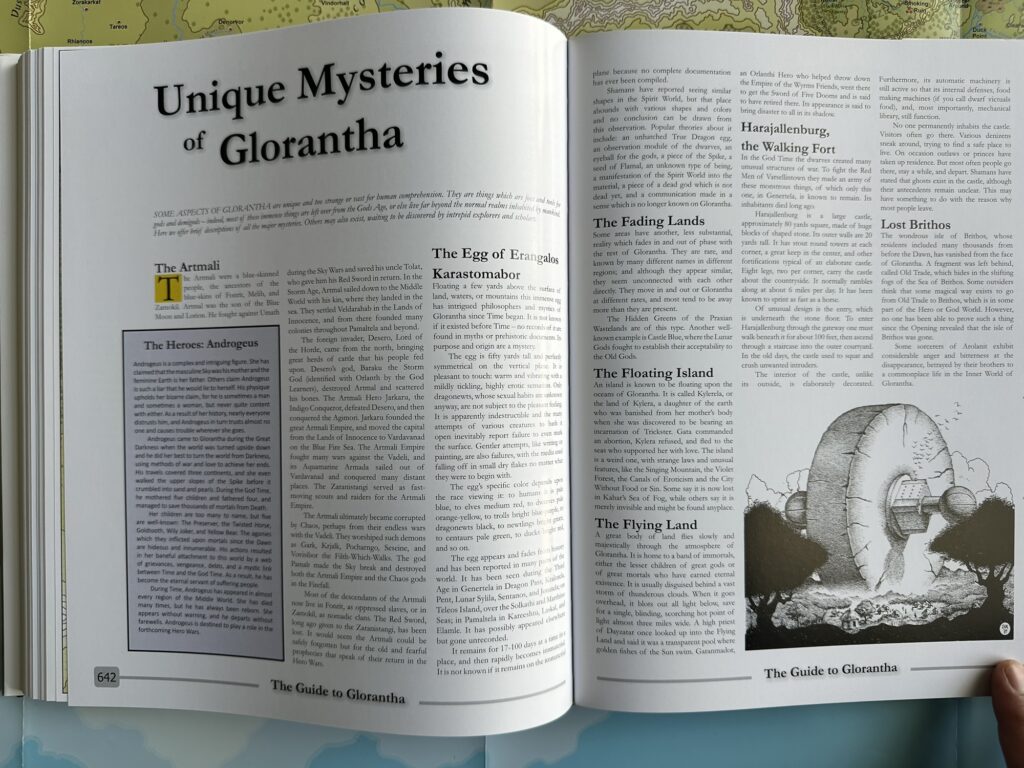
In my opinion, Glorantha is about walking a fine line between ancient history geekery, and throwing wacky eccentric ideas (preferably with puns) at the wall. Many people think Glorantha’s oddities start with the ducks and end with, what, the Morokanths? But think again, there’s a lot more weirdness in there! And the Guide delivers!
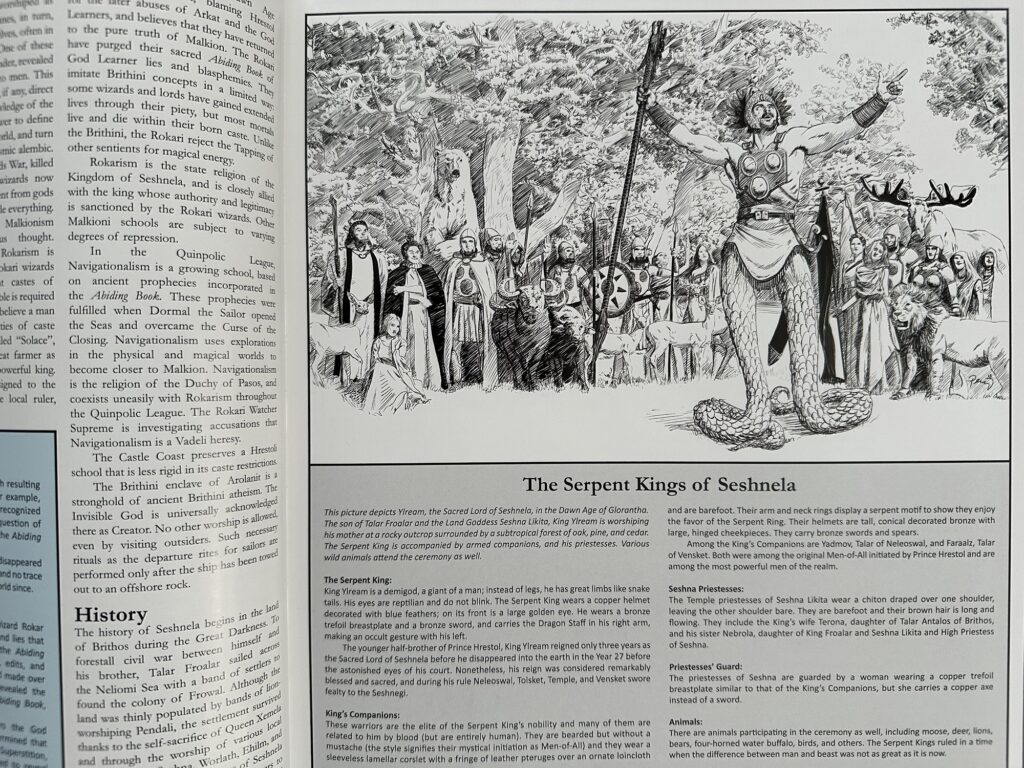
We’ve got kingdoms trapped for centuries in a magical fog, randomly re-emerging into the world with whatever weird, idiosyncratic thing they came up with during their isolation! We’ve got Kings with snakes for legs! We’ve got caste-based societies led by sorcerers who extract magic from the gods instead of worshipping them! We’ve got magical “Fish Roads”! We’ve got City Ships made from the corpses of True Dragons! We’ve got an isolationist totalitarian nation led by immortals who can’t let strangers “corrupt” their conservative ways! We’ve got the Deep Ones from H.P. Lovecraft worshipping a giant walktapus on an isolated island with weird geometry! We’ve got an ocean current made of boiling water, with weird creatures living in it! We’ve got a Ghibli-esque walking Mostali castle! We’ve got a floating island that hovers across Glorantha because its land goddess was banished from the Earth! We’ve got a Phantom Zone-style magical prison for mad barbarians and demons, with the occasional escapees that must then be stopped! We’ve got a miles-wide hell-hole that’s so deep you’ll probably die of starvation before you hit the bottom, if you fall into it! We have demi-god sailors who take their ships to the edge of the world, and maybe beyond! We have an iron city inside of a giant whirlpool in the middle of the ocean, whose mysterious inhabitants do not want to talk to you! And more!
It’s a wild world out there.
Appendices Galore
The Guide has more appendices than some walktapus conjoint-twins. Among things we have multiple cultural calendars, weather patterns, a treatise on Chaos, a view of central Genertela at the Dawn, a treatise on Nyslaor and Arkat, and more!
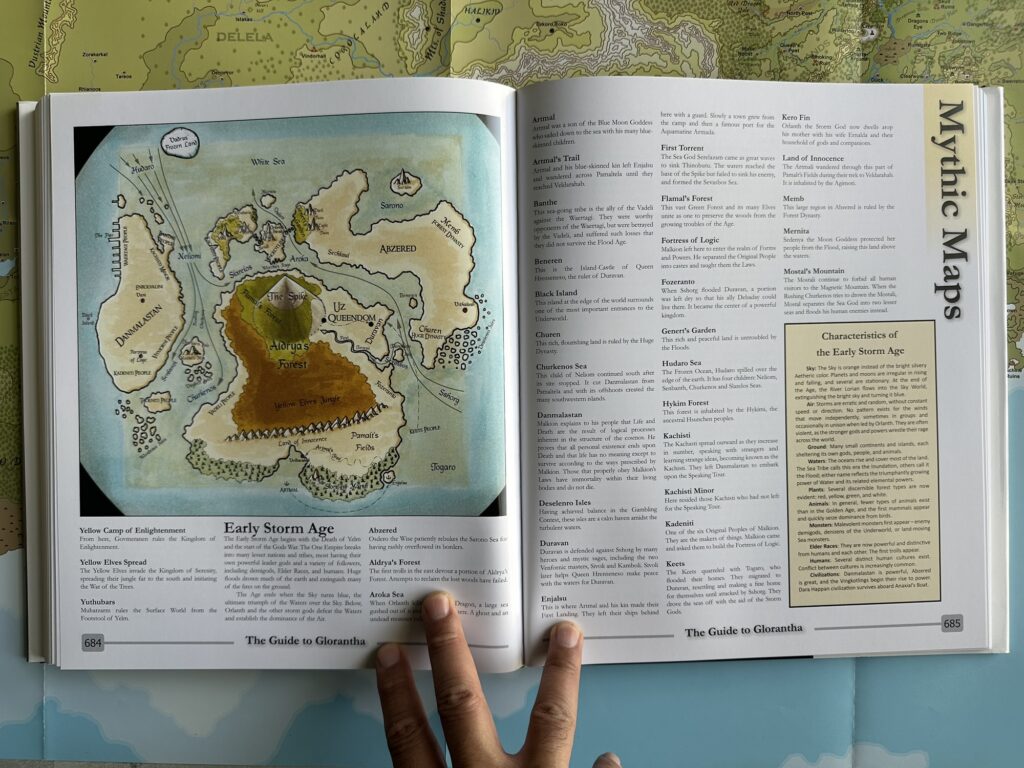
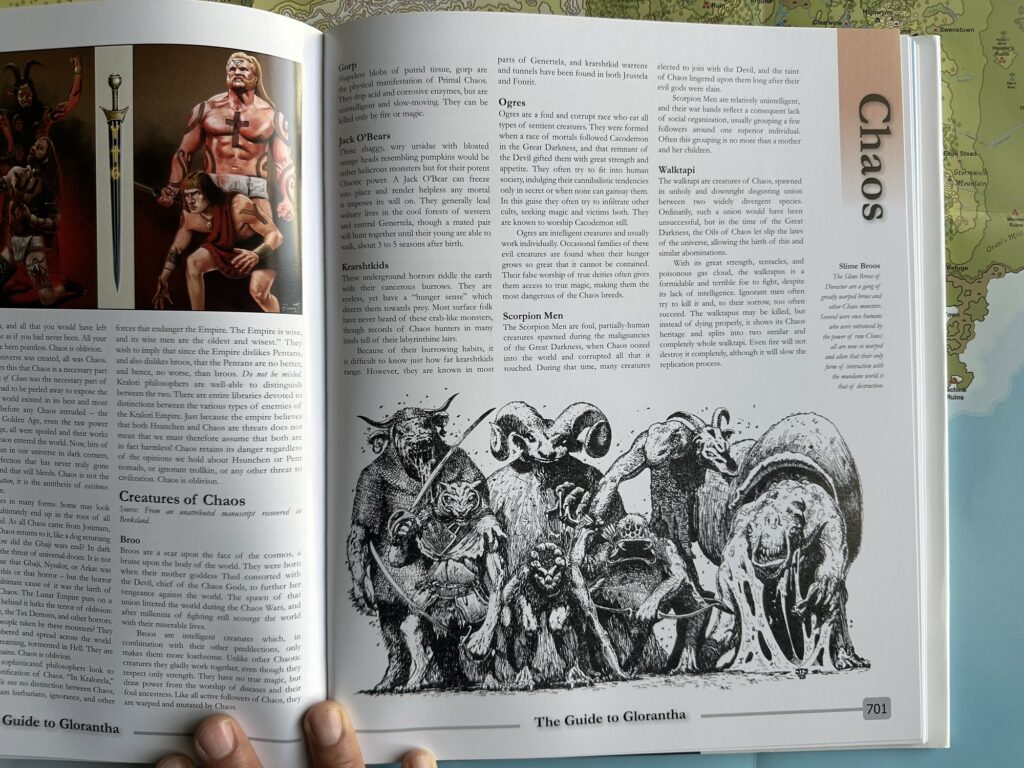
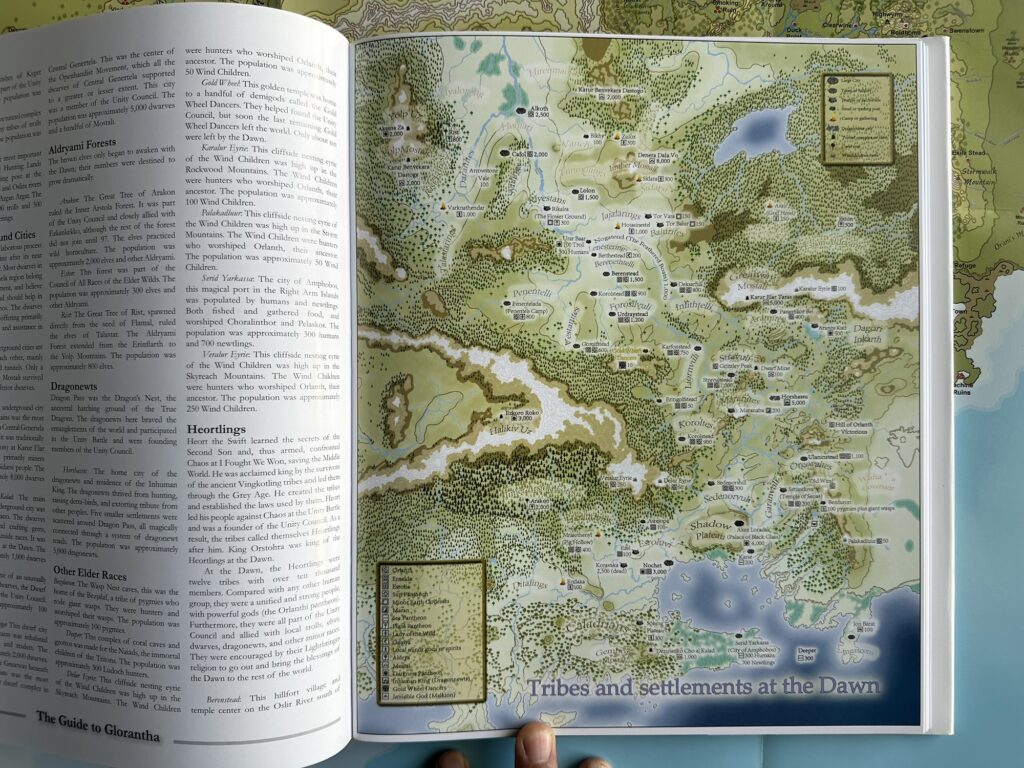
These appendices often get very nerdy and I love them.
Maps and Tables
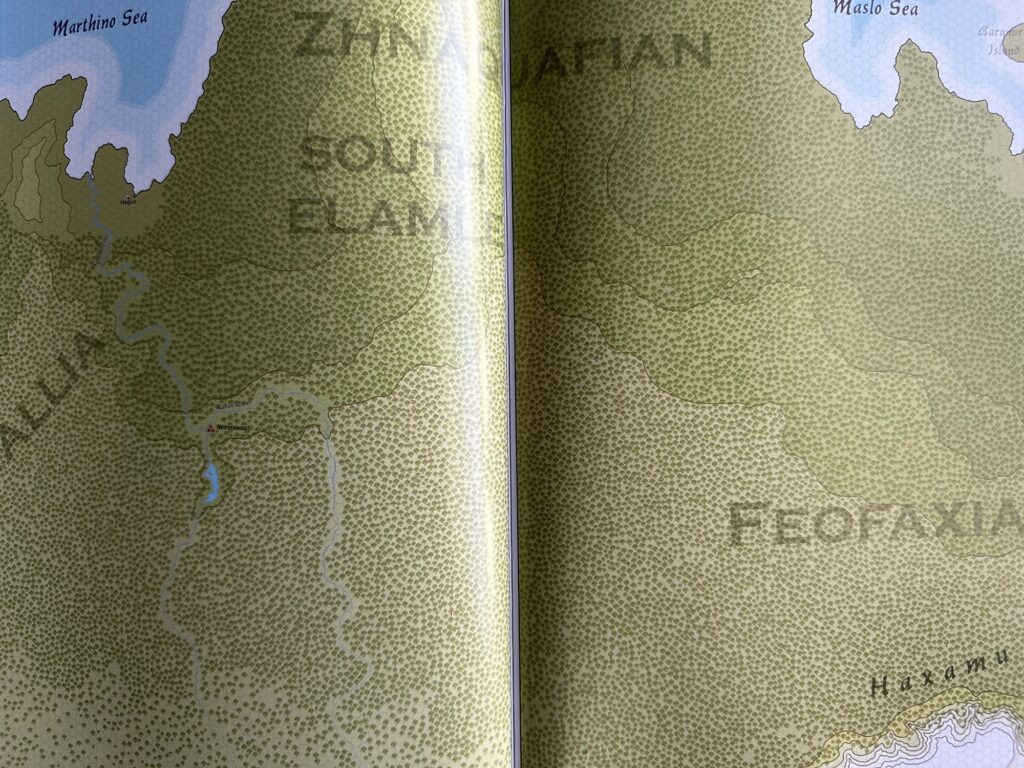
The most awesome thing about the Guide for me personally is the omnipresence of maps and tables of all types throughout the two volumes. This is where the Guide talks directly to my soul.
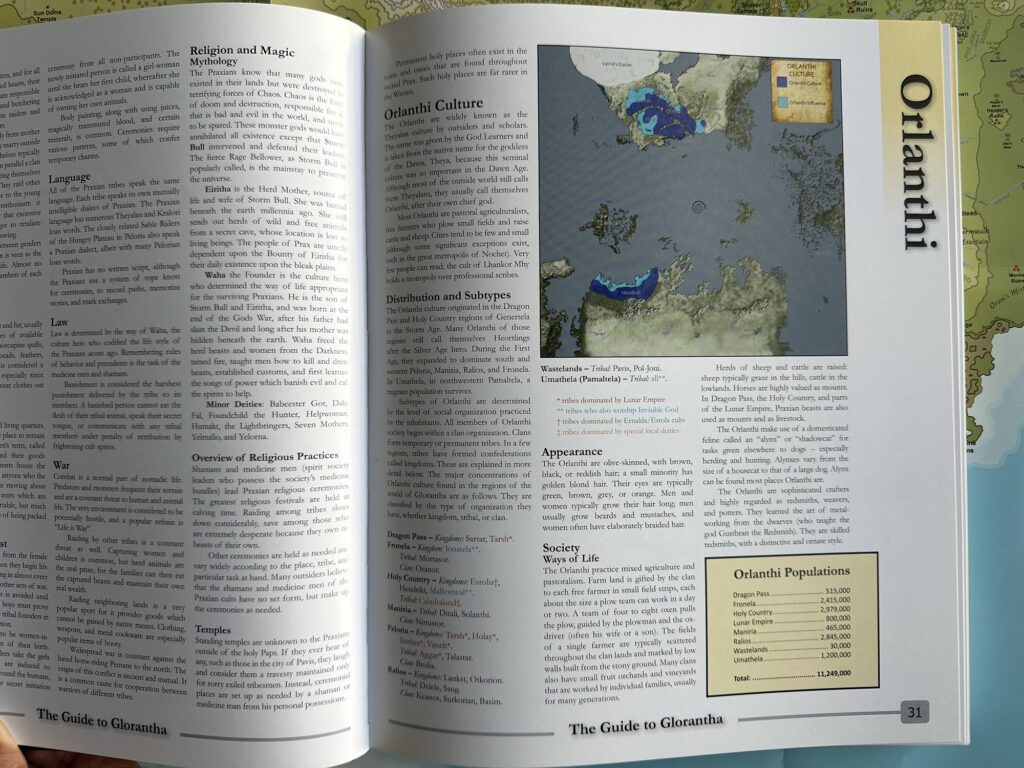
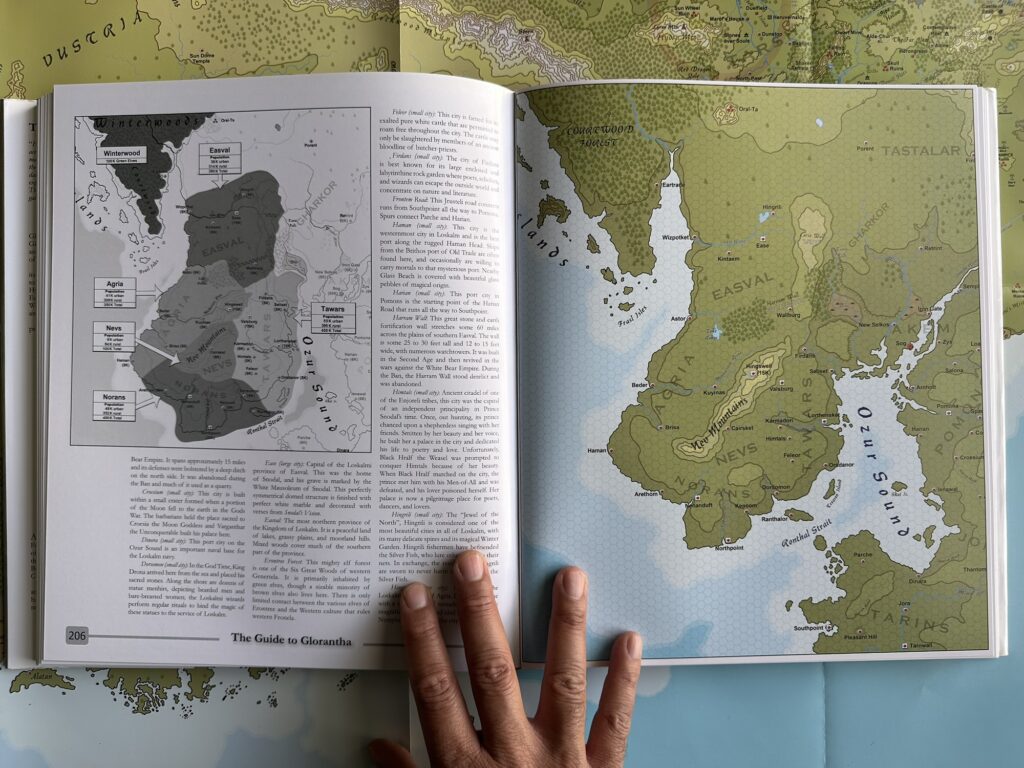
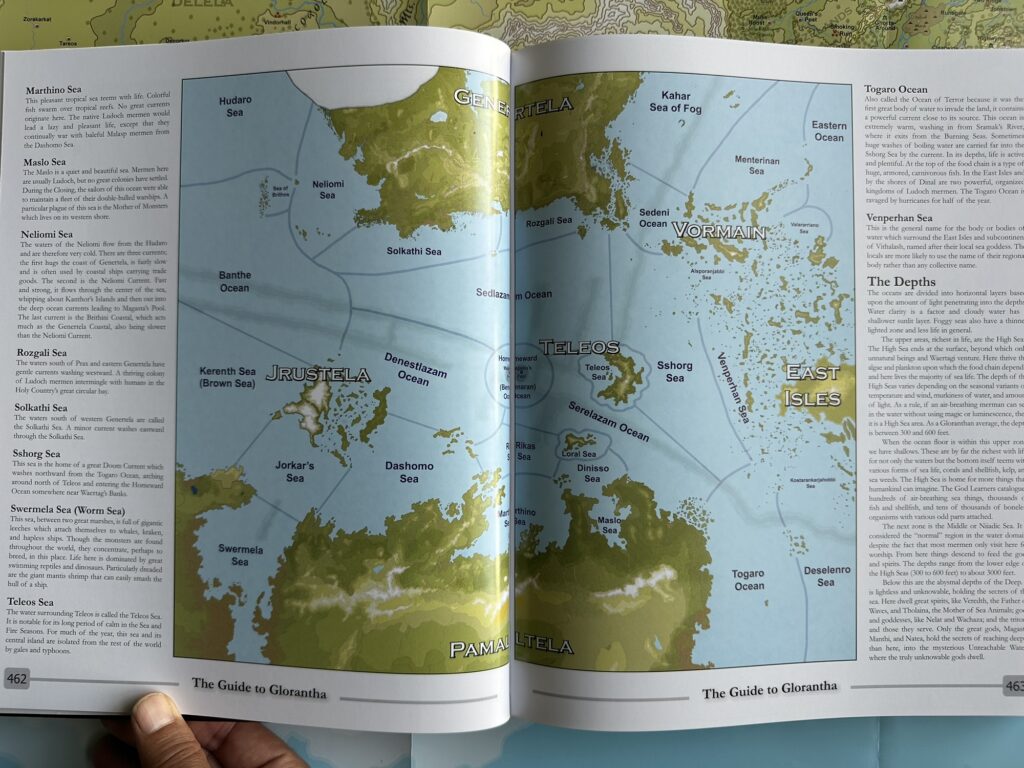
I mean, hats off to the cartographers, who possibly went mad placing all the trees on the maps (I think Colin Driver is the one to thank for that in particular!)
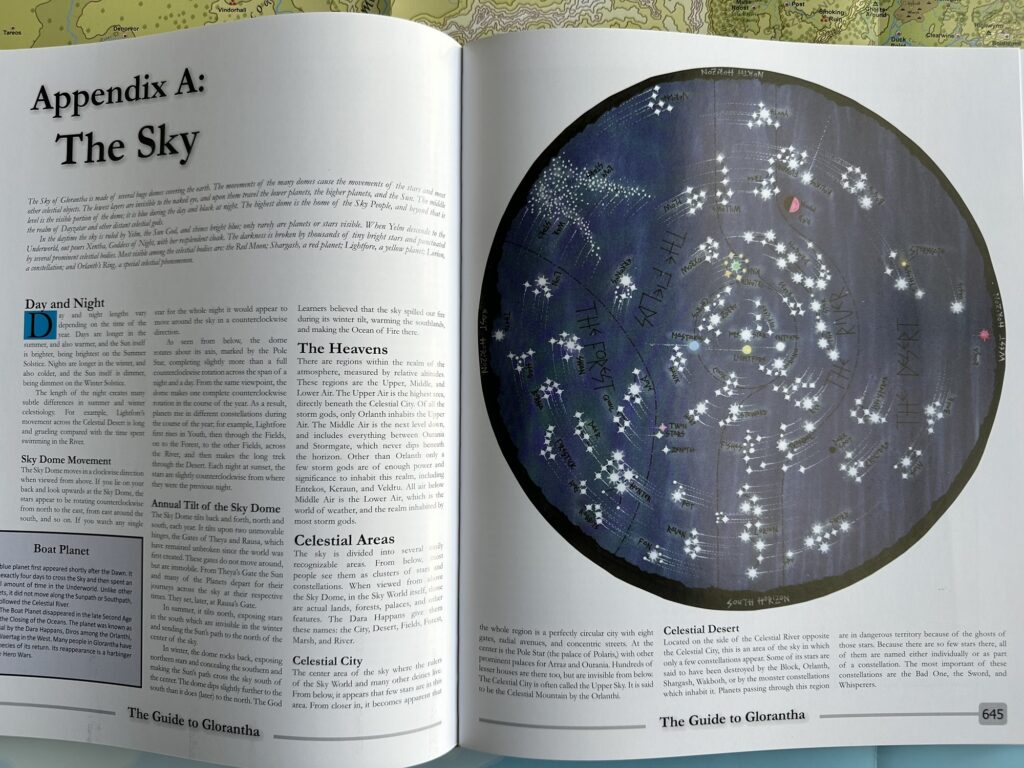
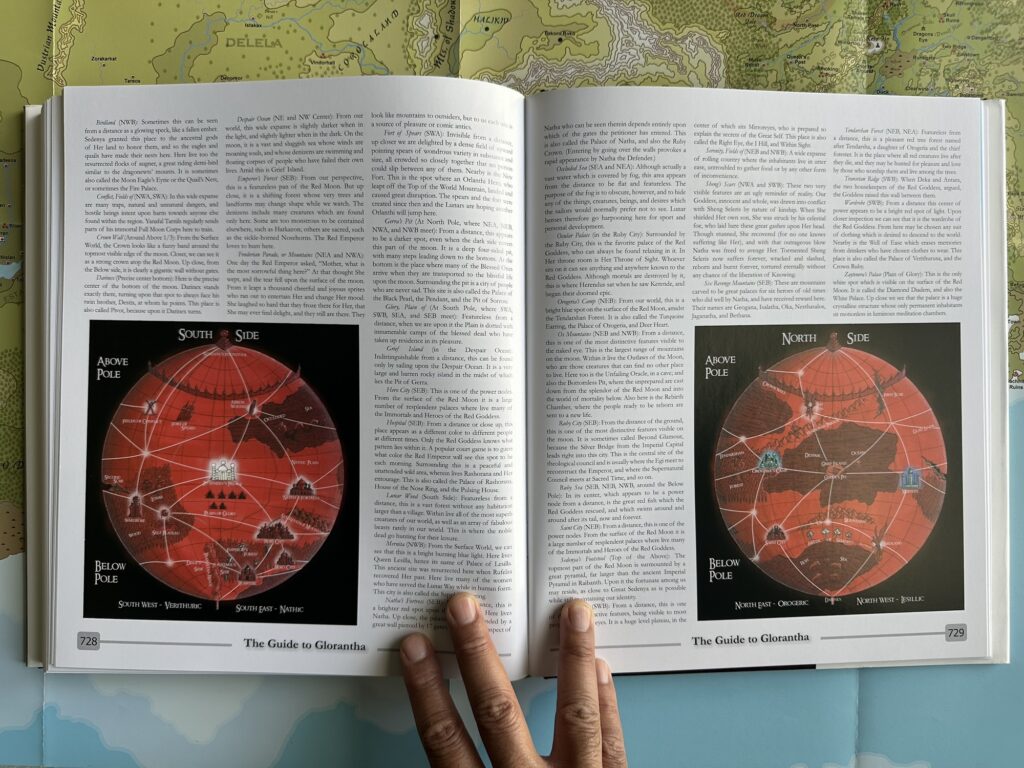
We have distribution maps of the various human cultures and Elder Races, political maps for various eras of Glorantha’s history, and mythic maps of the God Time (which you can find with a new look in the more recent Cults of RuneQuest: Mythology book). We’ve got weather maps and magical maps. We’ve got maps of the skies, and maps of the Red Moon (which you can also find with a new look in the more recent Cults of RuneQuest: God of Fire and Sky and The Lunar Way).
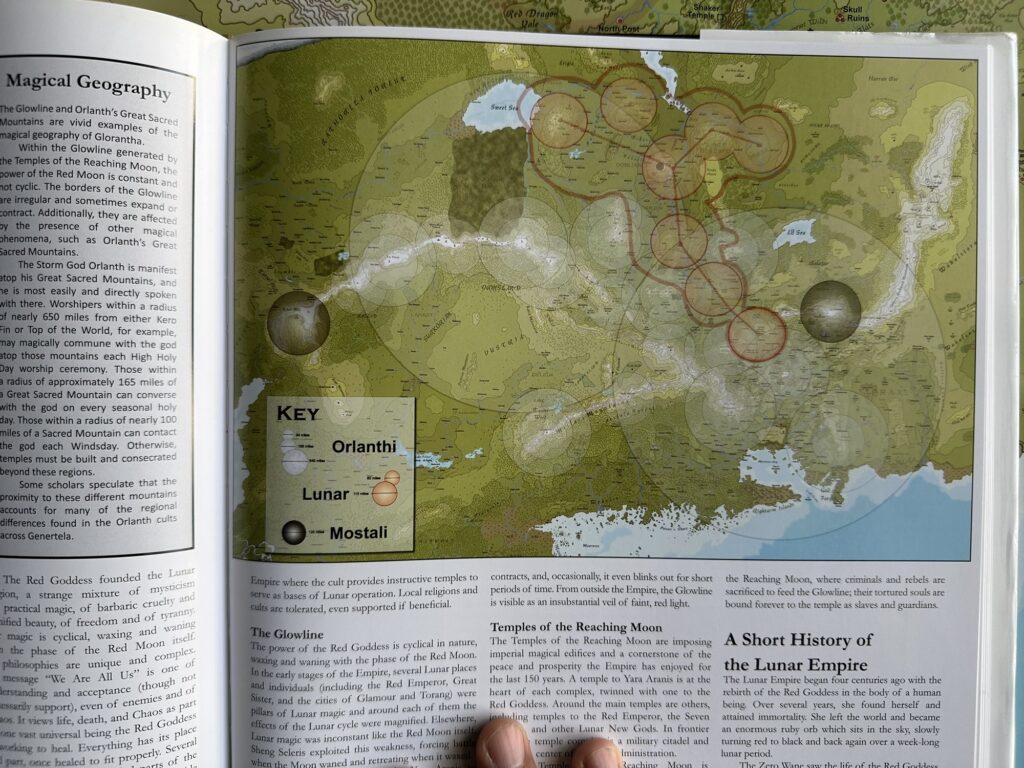
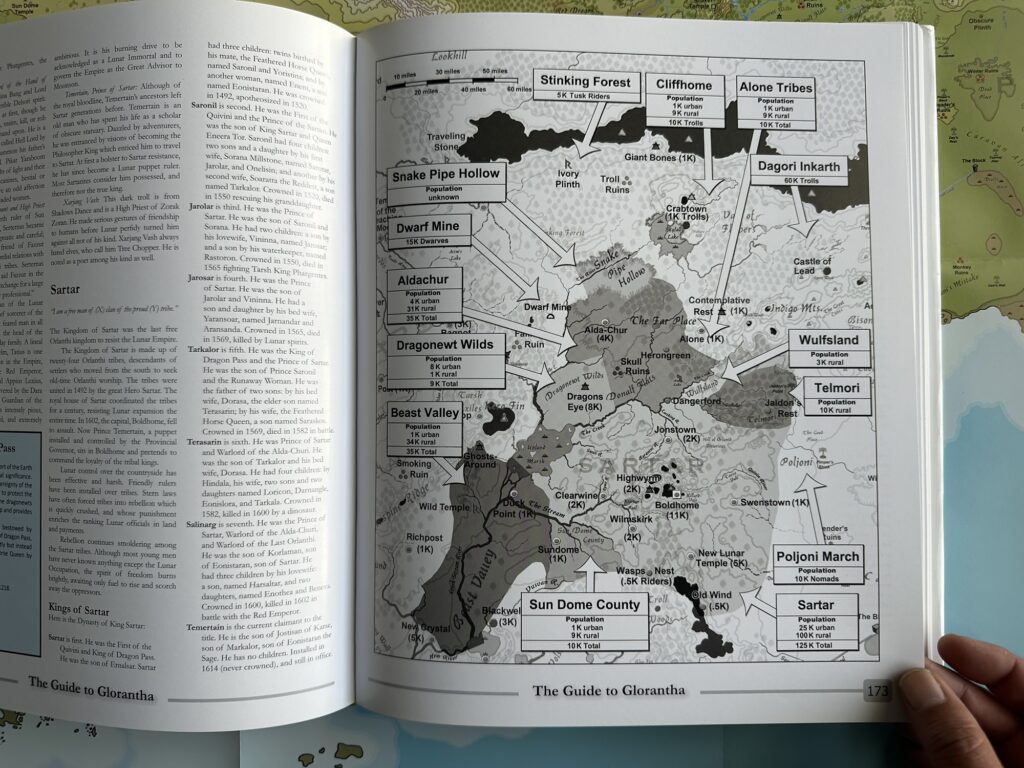
Of course, we also have a ton of geographic and demographic maps! The bulk of the Guide to Glorantha is a description of the world region by region, and each of these regions features both a standard map showing you the lay of the land, and some smaller maps showing the population numbers. In fact, population numbers are also summarized and tallied through tables across the books too. This is great!
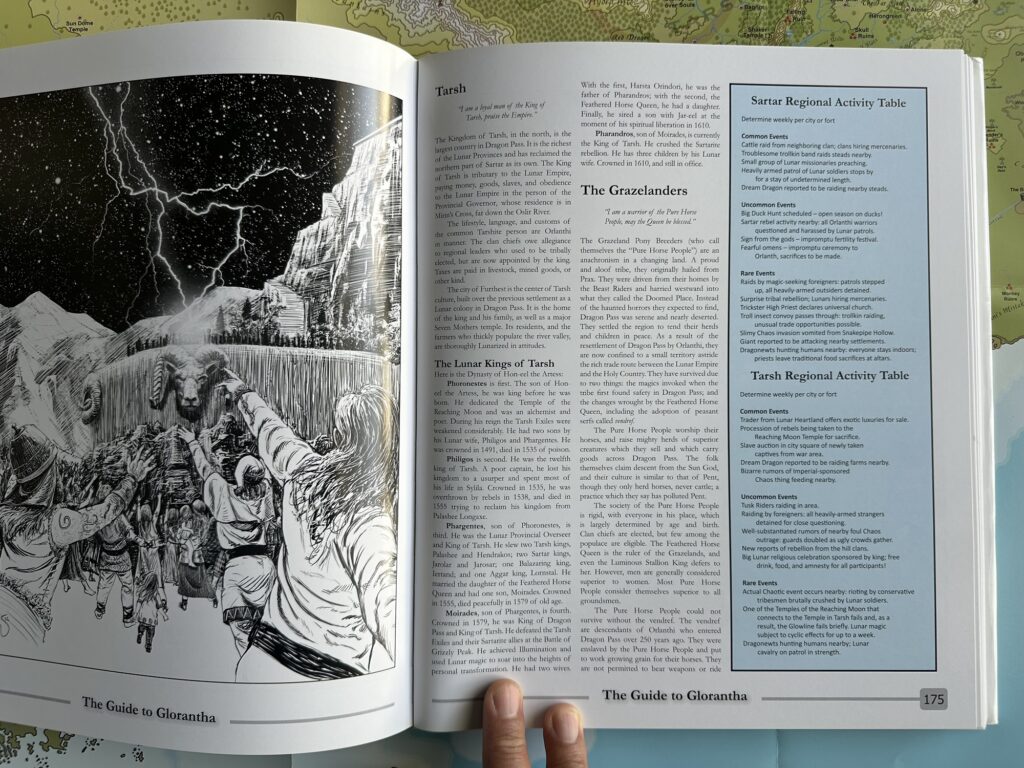
In terms of tables, one of the recurring ones are the “Activity Tables” of each region. They are not “random event tables” per se, but it’s very easy to turn them into that. They list a number of encounters, happenings, or scenario seeds, split between “common”, “uncommon” and “rare” occurrences. It really gives you a good idea of what to expect when you go there8… or what to throw at your players if you’re the gamemaster.
Let’s Play Somewhere!
Okay, so this is a long article, and I’m sorry, but I really love the Guide to Glorantha and I wanted to show it off. Now, I promised that you can use it for some “light Glorathan settings”, right?
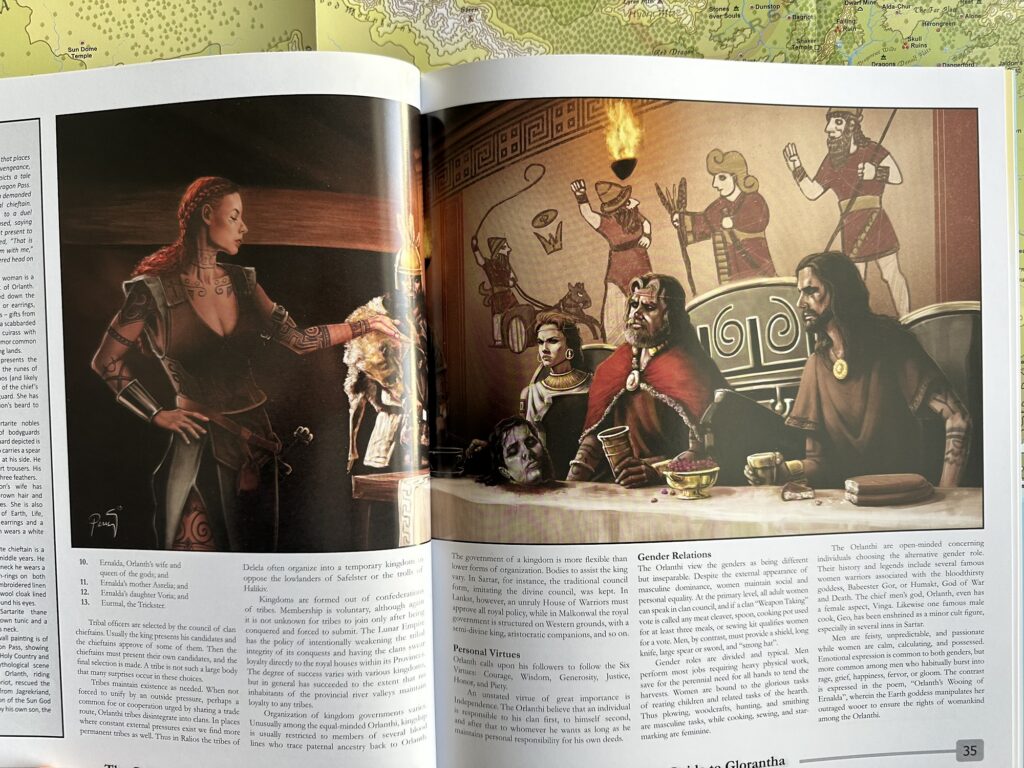
Let’s imagine you are completely mad, and the Guide to Glorantha is your first book about the setting. You’re told that playing in Sartar is one of the default ways to experience Glorantha, and so you read that chapter. The description of Sartar itself is barely 2 pages, but you figure you’ll read the whole chapter on Dragon Pass (about 21 pages), because the general topics at the beginning, the gazetteer, and some of the sidebars and such, are relevant. Let’s add the chapter on Orlanthi culture (7 pages), because the Dragon Pass chapter says that’s the dominant culture. And also, you probably read the Introduction (10 pages) because it lays down some good foundations.
Well, I can guarantee that you’ll have some really good grasp on playing in Sartar and Dragon Pass in general, in less than 40 pages9! It’s got everything you need to get started! The landmarks and the ongoing conflicts, the cities and neighbouring powers, how the people live and how they worship, the political structures and the history, and more! Only, you know, mostly just the cool interesting bits, in a digestible number of pages.
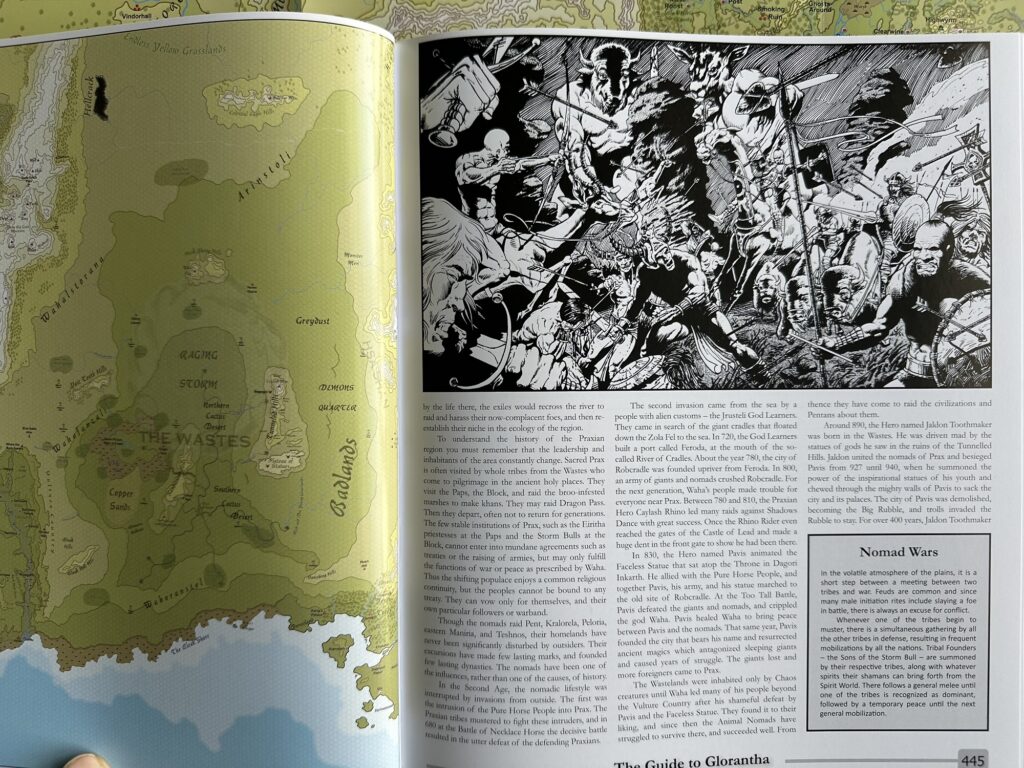
Okay so what about Prax, the other most common Gloranthan campaign setting? Same idea. The chapter on the Wastelands (20 pages) gives you not just Prax but the entire psychedelic Mad-Max area beyond it. Add the Praxian culture (5 pages) and a few other references to track down, and you’re ready to go, again, in under 40 pages.
Frankly, it’s not surprising. If you look at the old RQ2 settings like Big Rubble or Griffin Mountain, they gave you at most 50 pages of lore, before moving on to NPCs, encounters, scenarios, and adventure sites for the campaign. What you get from the Guide, here, is basically equivalent to the “lore” section of these books, and then you go write your own adventures… which is what many people did.
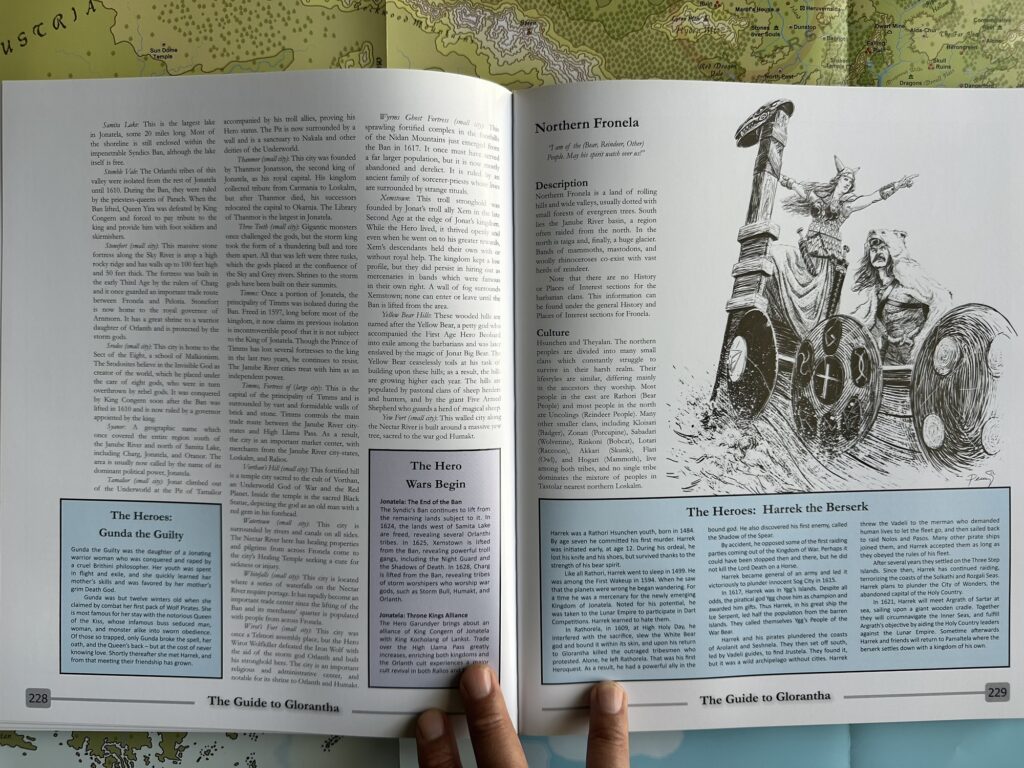
For instance, how about playing in Imther? Imther’s description is only half a page! You might have to read a chunk of the broader Lunar Empire chapter it has been slotted into (and that’s one of the longest regions in the book, at about 58 pages!), but you can skip more than half of it. In that half-a-page description of Imther, you have everything you need to get started! Namely: they are two named tribes of Orlanthi, they herd goats and make nice cheese. The Imther King has a succession crisis on his hands. There are some interesting cultural, political, and economic dynamics with both the ruling (but mostly hands-off in this case) Lunar Provincial Government, and the nearby Mostali mine-town. There’s some nefarious agenda coming from the neighbouring Lunar Provinces, based on some past history. And there’s a Sun Dome temple with a cool hero worship. What else do you need, really? You can develop all this stuff further as you play, but that’s enough to get started!
Oh, you need at least 250 pages of lore and stuff before starting? Sure! Harald Smith has written a book about Imther for you! (And we interviewed him about it!) By the way, he actually came up with most of that stuff before the Guide to Glorantha, so he started with even less! You can do it. I believe in you. But also, I guess, buy Harald’s book?10
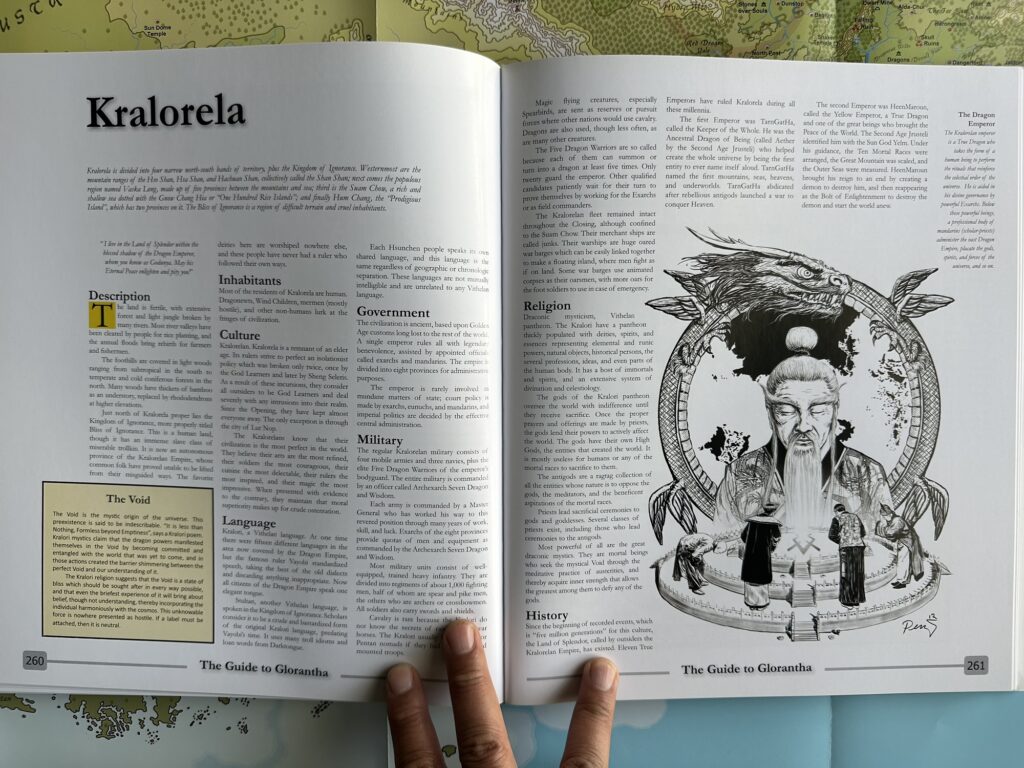
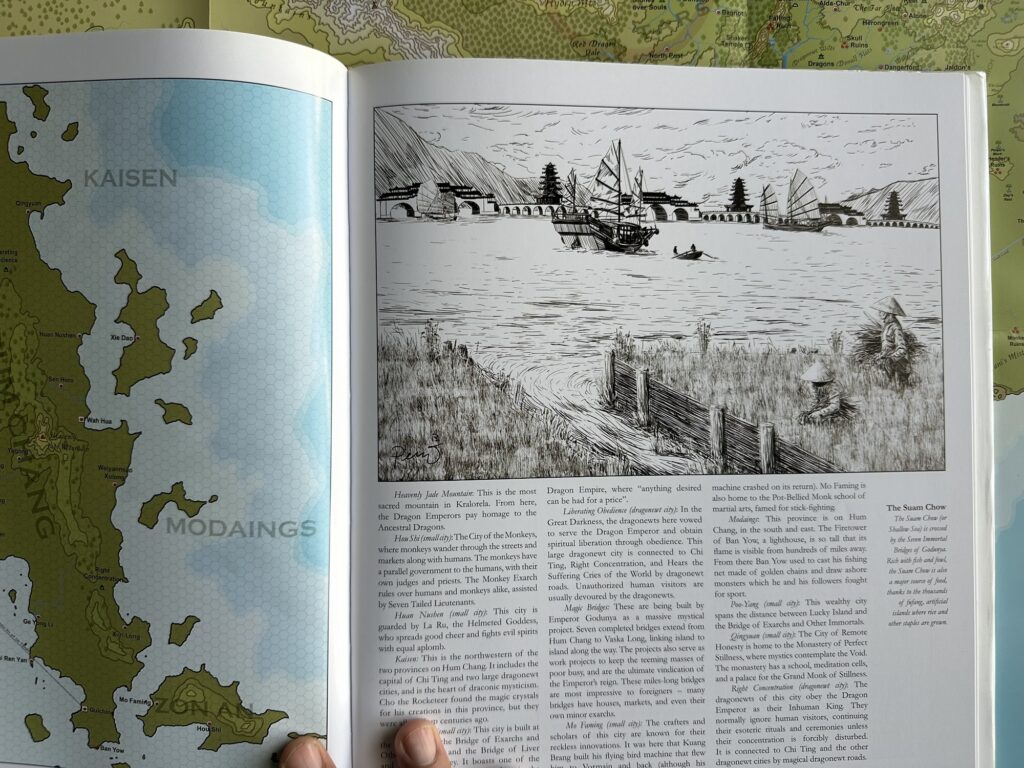
Let’s go to more exotic places! Gianni Vacca and David Millians have each been running campaigns in Kralorela for a while. You can also do that, of course, with the Kralorela chapter (32 pages) and the Kralori culture (5 pages). Easy peasy! Get going and make up the rest as you go! Ask Gianni and David for advice if you need some!
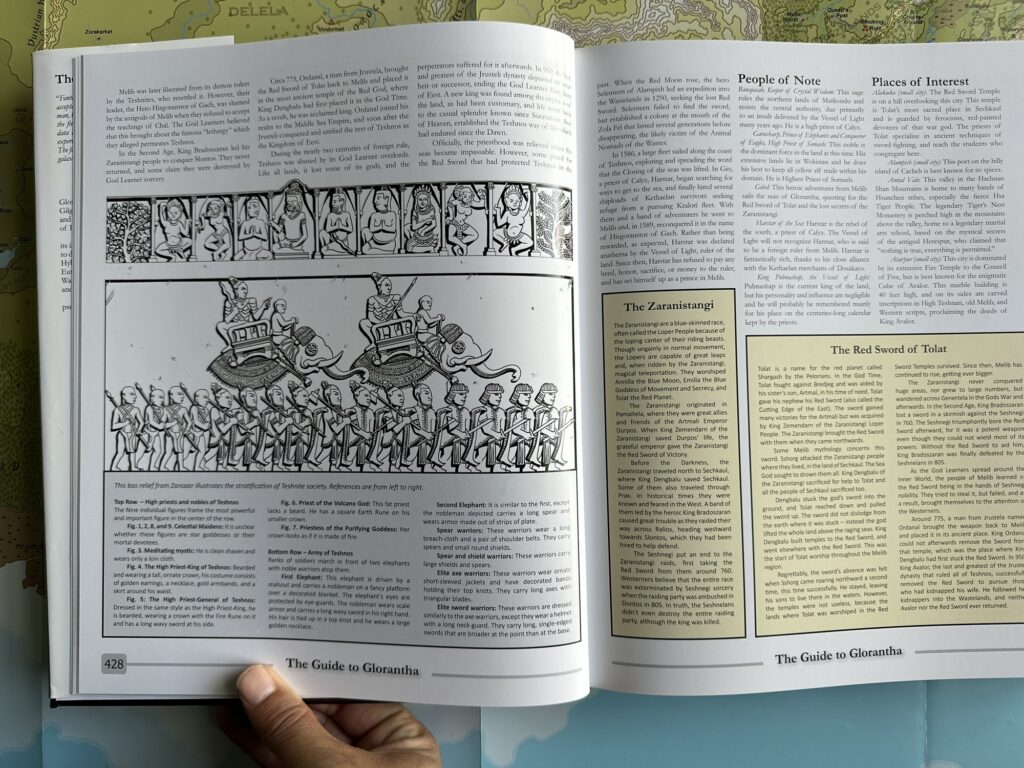
You want somewhere more exotic? How about the East Isles? The chapter is 28 pages-long, but each island is pretty independent so you don’t even have to read the common chapters on human cultures and Elder Races and so on, because they don’t really apply there! So just pick a couple islands and get started! How about Opi, an island Sacred to Veldru the Typhoon God, whose winds can almost rival those of Orlanth? And the island’s patron god does martial arts? And the nearest island is sacred to the Keets, the sentient bird race of the archipelagos, who have an important recurring ritual to do there? Sounds fun! I’m sure if I started thinking about it, I could whip up some campaign.
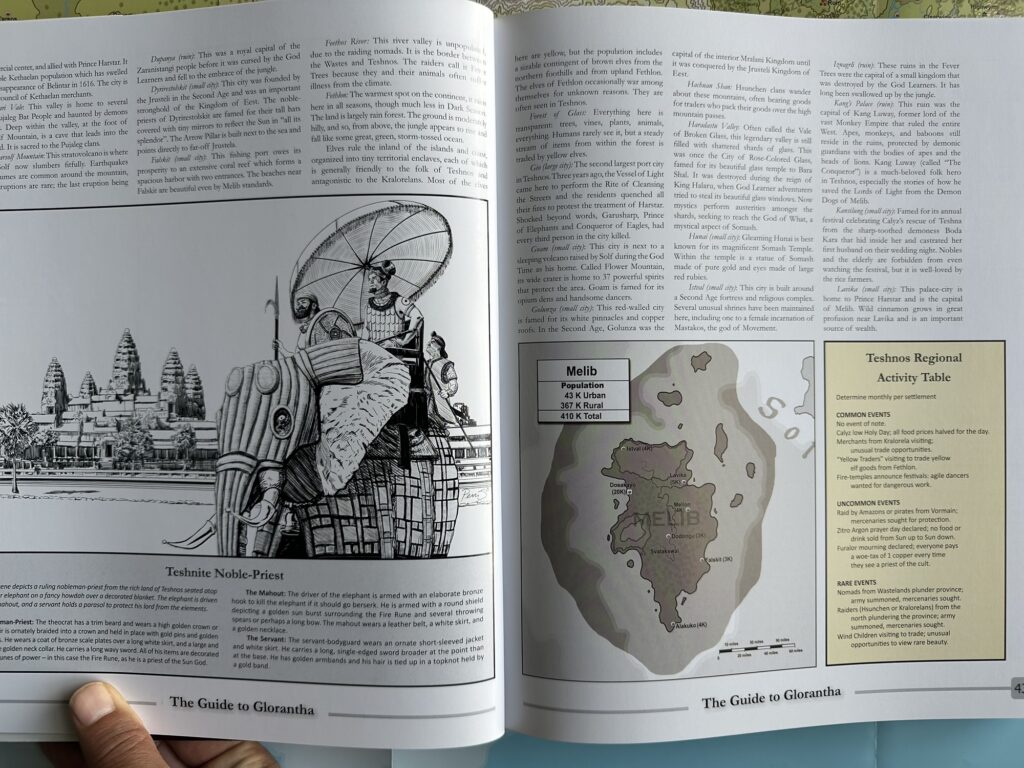
Do you want something exotic but with an easy equivalence to Earth? Sure! Go to Teshnos, Glorantha’s version of tropical India, with a Sri-Lanka-esque island to the south and a mini-Indonesia to the east as an extra treat. It’s got jungles, war elephants, Tiger and Bat People, stratified societies, opium, tantric sex, magical tsunamis, curved swords, snake festivals, a pantheon made of Fire Gods, and almost three times as many people as the entirety of Dragon Pass. The chapter is 14 pages long. Have fun!
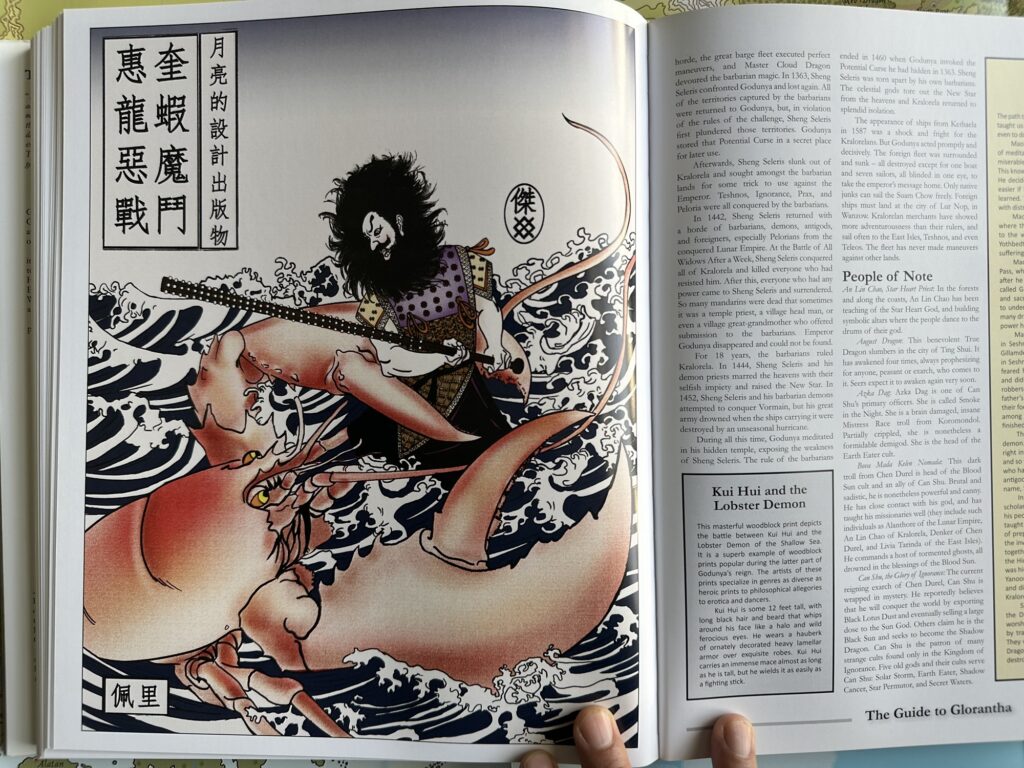
Still not sure? Want something a bit easier to develop and run? How about Vormain, Glorantha’s version of feudal Japan? It’s geographically similar, and it has all the tropes you already know: an Emperor God at the top, peasants at the bottom, and aristocrats and samurai in the middle. Plus: a big-ass snow-topped sacred mountain, cherry blossoms and orchids, and feuding martial arts schools. Just like Japan, there’s an ongoing anti-foreigner isolationist policy that makes it easy to start a campaign there! Plus: an island with weird magical health effects, a local hero called “Golden Boy”, and not one but two different cults that obtain magical powers through ritual suicide and resurrection! This is all in just 10 pages! Have fun!
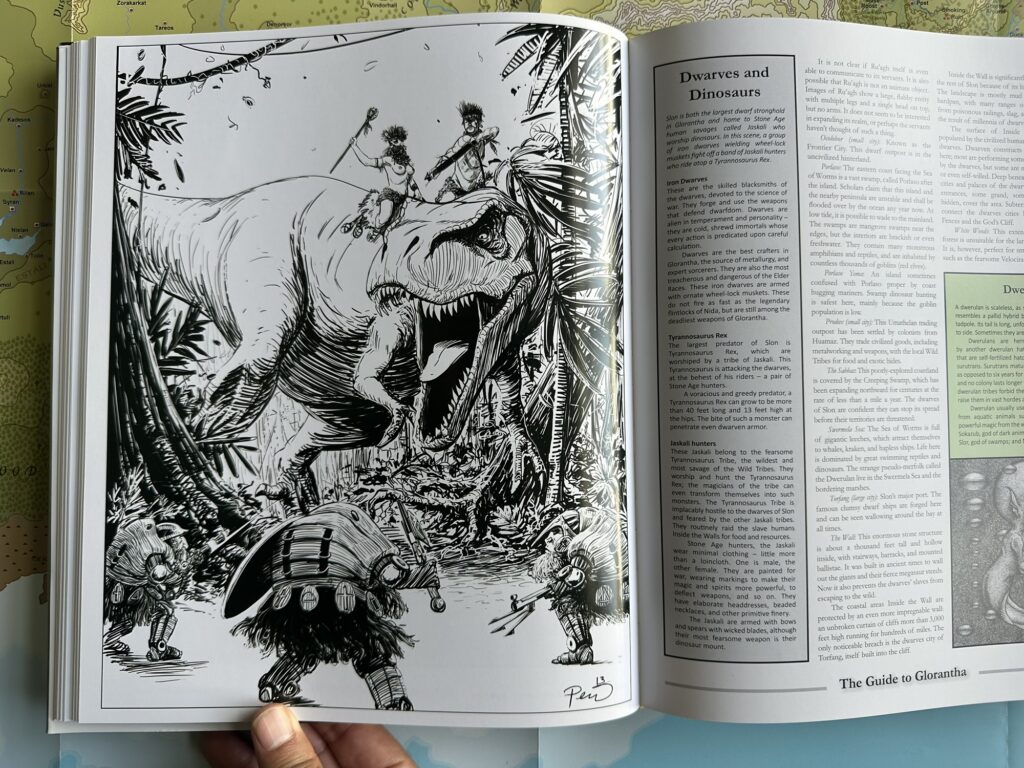
Oh, sorry, you want something more crazy? How about Slon, in the southwest corner of Glorantha? I’m currently preparing a short campaign or long one-shot there, actually. There’s a Mostali stronghold surrounded by a 300-meter-high wall. Inside the Wall, the Decamony of Slon manages a series of underground dwarven cities, connected by tunnel networks, while human slaves work on the surface. Outside of the Wall, aboriginal human tribes ride dinosaurs and fight runaway Mostali automatons. The land is surrounded by the Sea of Worms, where gigantic leeches attack ships, and a unique type of merfolk worships dark mollusk deities. The edge of the world is nearby, past a series of mangrove swamps inhabited by reptilian monsters and Aldryami goblins. It all fits in 6 pages, including an awesome drawing of Iron Dwarves fighting warriors of the Tyrannosaurus Tribe! Have fun!
And that’s only scratching the surface! Whatever floats your boat, the Guide to Glorantha has something for you, with everything you like about Glorantha in it11, and every time consistently under 40 pages, if not 20 pages or less. So like I said: it’s perfect for your next light Gloranthan setting! Are you convinced?
Sure, Where Do I Get This Marvellous Guide?
OK, so this is where you’re going to hate me.
It’s been out of stock for a couple years… Chaosium only sells the PDFs at the moment…
BUT IT SHOULD BE BACK!
Sure, I understand why Chaosium isn’t in a hurry to print more of it. When the Kickstarter opened in 2012, the reward for the two hardcover books was a measly USD $80. When I bought it in 201712, it was around USD $160. Given the state of printing and shipping these days, and the niche and luxurious nature of the Guide (which prevents reducing costs with large print runs13), there’s a good chance it would have to be sold at around USD $250 or something.
But in my opinion, it would be worth it. This is one of Chaosium’s flagship books, for one of their flagship settings. In fact, I will argue that this is one of Chaosium’s most prestigious books. They have received a lot of awards over the years, most of them ENnies or Origins Awards. But the Diana Jones award feels, somehow, above the rest to me. And Chaosium has been excellent enough to receive this award twice: once for the Great Pendragon Campaign14, and once for the Guide to Glorantha.
It would really be a shame if newcomers to Glorantha could not experience the amazing, ridiculous, overwhelming, stunning beast that is the Guide to Glorantha, in its fully realized form: the big honkin’ book set.

I really hope Chaosium brings the Guide to Glorantha back eventually. In the meantime, grab the PDFs! The good news is that they make it easier to jump from one reference to the next!
Have fun!
- That’s over 12 pounds for those of you in antiquated countries, or 0.8 stones for those of you in the posh parts of antiquated countries. ↩︎
- I don’t know how that translates in Imperial units but it’s probably something like “1183 flippers wide” or something. ↩︎
- I go over it in detail in this episode of the God Learners. ↩︎
- And dislodge a spinal disc. ↩︎
- If you’re going to ask what a “road atlas” is, well, fuck you for reminding me I’m old! ↩︎
- Or maybe I got scammed and my copy is someone’s POD from the PDFs, I don’t know… it was a cheap find on eBay and I always wondered… ↩︎
- One of the most bonkers things you can throw at your players. In a good way. ↩︎
- Although, to be honest, a few of the less developed countries feature activity tables that show how the authors ran out of time and ideas! ↩︎
- Unless you’re one of those people who can’t run a game without 500 pages of lore, in which case, well you can grab four RuneQuest Glorantha books on the subject… but I can tell you that you’ll still have questions even after reading them all, so you better get used to finding your own answers. ↩︎
- Yes, sorry, I’m giving mixed signals here. Let’s move on. ↩︎
- Well, except for a few underwritten places where the authors visibly ran out of ideas. ↩︎
- This was technically my second ever English-language Gloranthan purchase, after backing the RQ2 Classic rulebook on Kickstarter. But I received it before the RQ2 Classic fulfillment happened, so it was my first English-language Gloranthan book. Years prior, I had bought the French version of Hero Wars, which I bounced right off and never really read. ↩︎
- This could maybe be alleviated with regular crowdfunding campaigns, to just print what’s needed. ↩︎
- Although this is stretching things a bit… the Diana Jones award for the GPC was given to Greg Stafford, while he wasn’t working at Chaosium, and the GPC was being published by Nocturnal/White Wolf. ↩︎