Some Notes on Brindlewood Bay
When Brindlewood Bay came out it seemed to become an immediate darling of my TTRPG circles. Being a fan of both the Cthulhu Mythos and TV series like Murder She Wrote, Columbo, Scarecrow and Mrs. King, and more, I figured that “old ladies investigating murders that lead into cosmic horror” sounded totally like my jam! Plus, there was some promise of a “novel take” on investigation games! So, as is tradition, I backed some Kickstarter, and waited to receive the books.
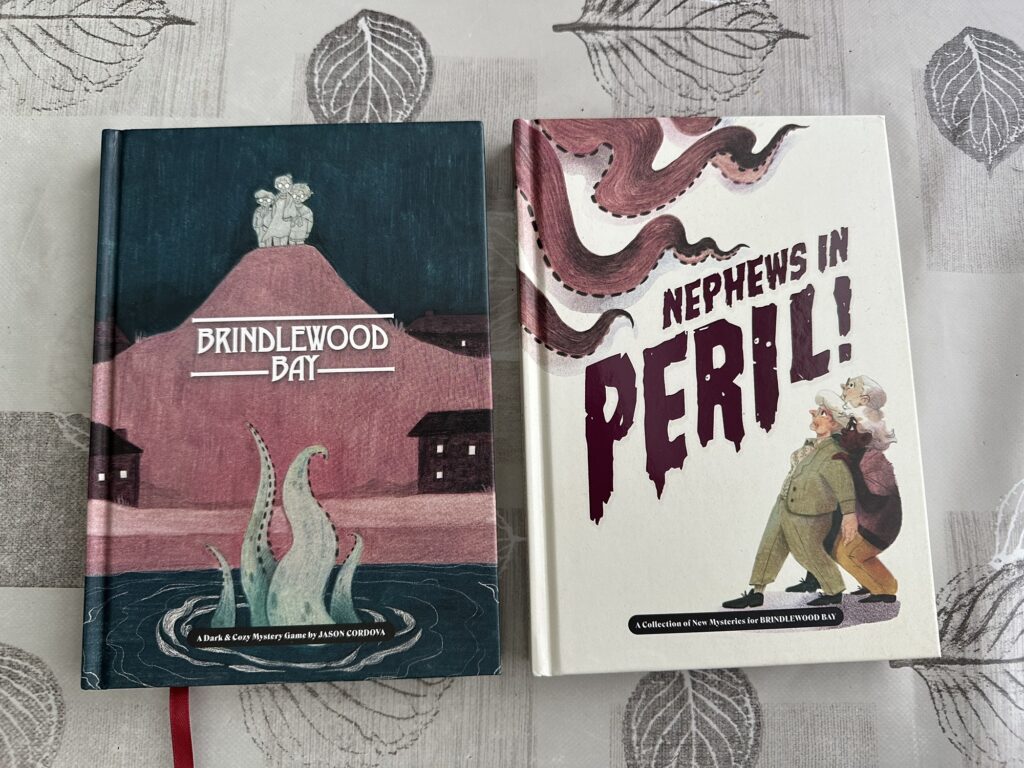
That’s how, back in 2024, I ran my Friday group through a handful of cozy mysteries from both the basic Brindlewood Bay book and the Nephews In Peril supplement. Here are some notes about how that went!
Sitting Down For Some Tea and Biscuits
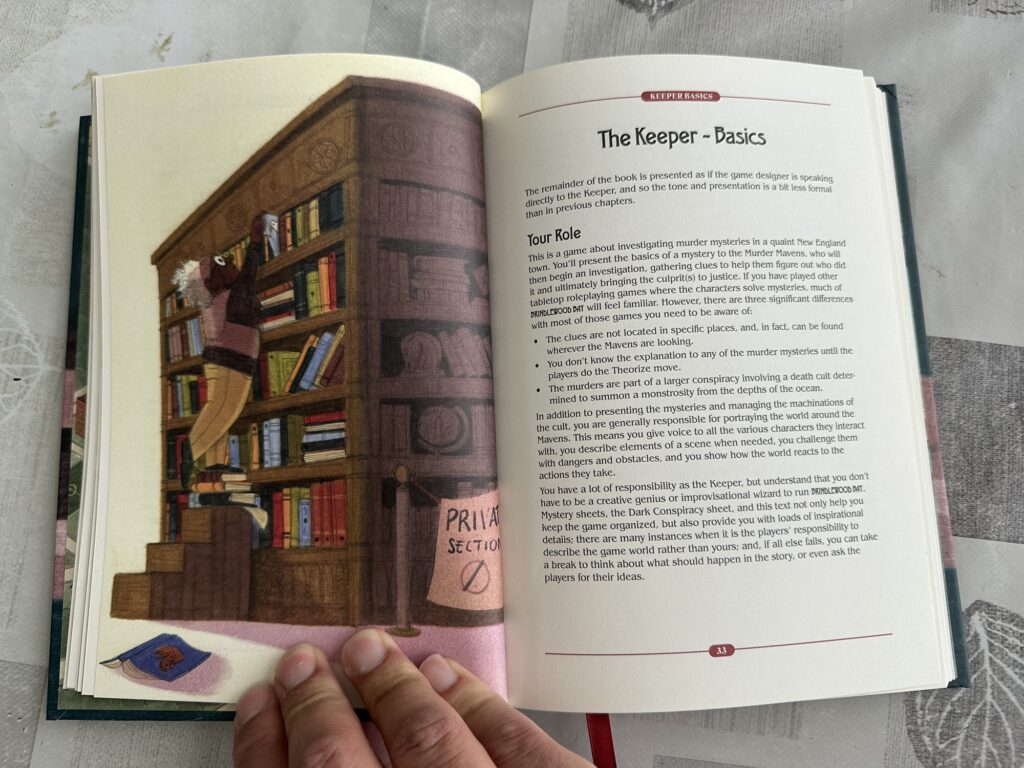
At first glance, Bindlewood Bay looks really good. The book is small, looks nice, and reads well. The illustrations give a sort of cozy, cartoonish Nancy Drew vibe.
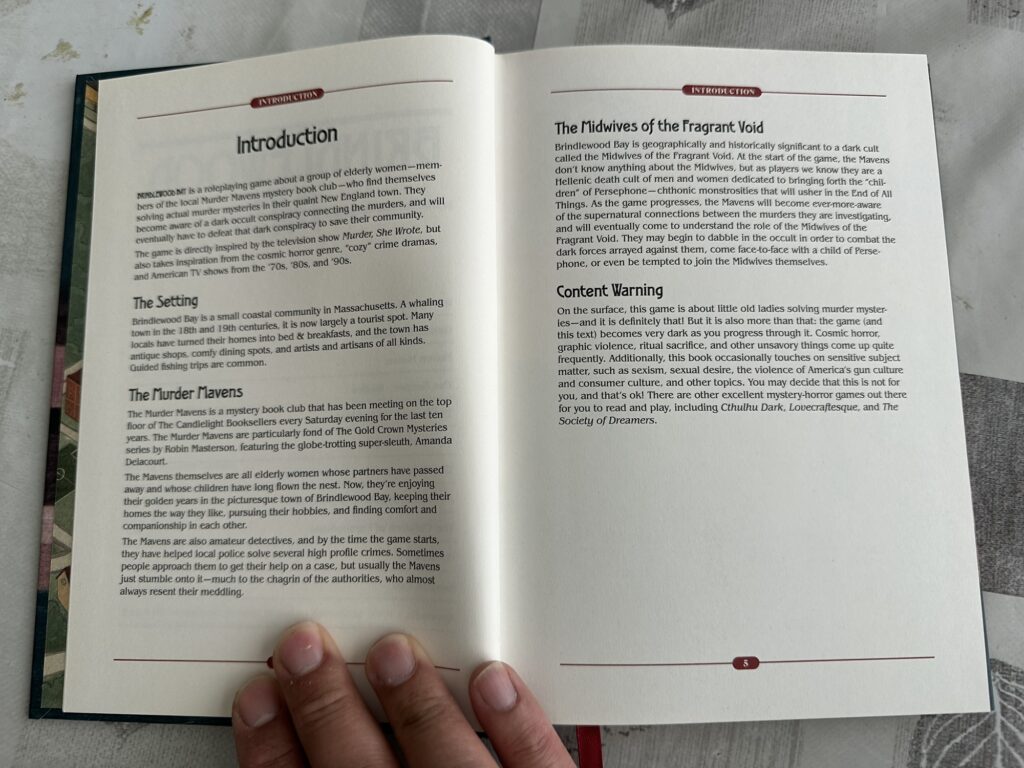
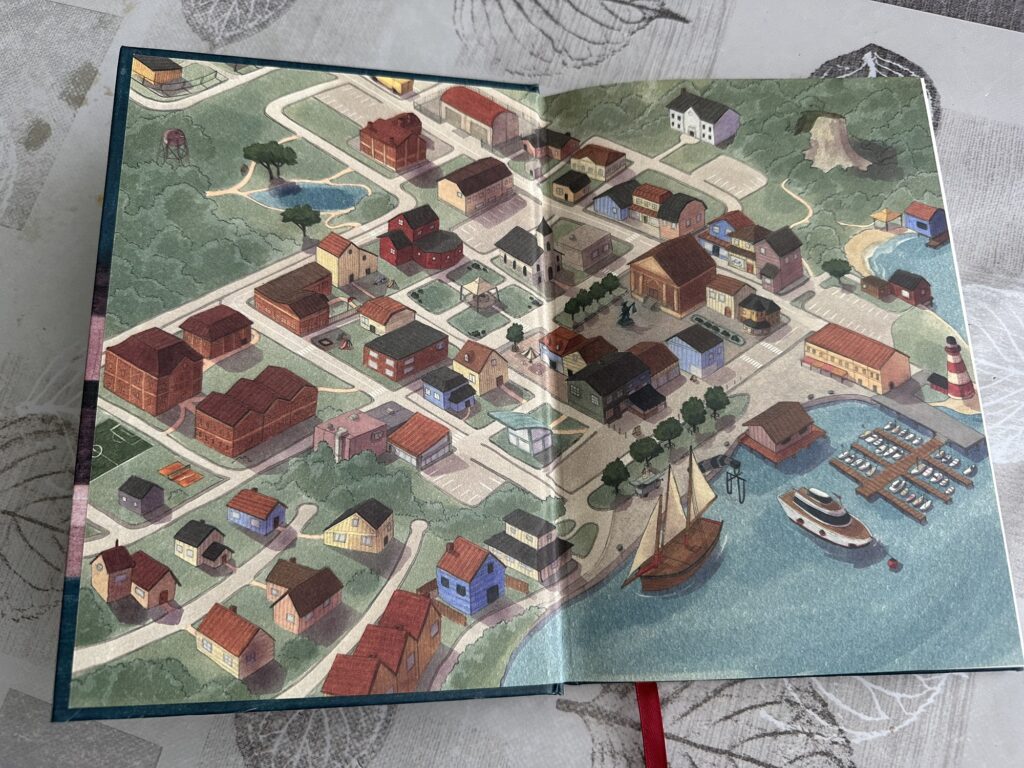
You play as the members of the “Murder Mavens”, a book club of murder-mystery-loving retired ladies, in the titular small town of Brindlewood Bay. And just as in Murder She Wrote, this little seemingly peaceful community is soon to become the murder-capital of the country.
The game’s system is based on the then-ultra-popular Powered-by-the-Apocalypse system. Let’s start right away with some hot take: I’m not a fan of PbtA. I understand why it’s so popular, but it’s not my thing. In my experience, PbtA games are often so obsessed with emulating some TV show or movie that they use restrictive mechanics that force you into stereotyped characters and scenes, resulting in, well, the intended goal, I guess, but in a rather bland and contrived way, full of clichés as far as I’m concerned. PbtA games have “moves” instead of “skills”, and I find that it’s ironically aptly named, as it seems to make you “go through the motions” more than anything.
Luckily, Brindlewood Bay avoids at least some of these pitfalls. For instance, there are no stereotypical character classes (or “playbooks” as PbtA calls them) to choose from. You can freely create your Murder Maven lady, although it’s pretty limited: a name, a style (personality, fashion, etc.), a favourite cozy activity, a single point to spend in one of the five abilities, and a special “move”.
Here we get my first complaint: the ability scores end up being extremely uniform. With only one point to spend, there’s barely any difference between the characters. The basic mechanic is 2D6 plus a relevant ability, trying to get 7+ (for a “success at a cost”) or 10+ (for a normal success)… so sure, mathematically speaking, a +1 is not negligible, as it might give you around +14% to +17%. But in the grand scheme of things, it’s not much. You don’t really have one character who’s super good with Composure, and another with great Presence or Reason. It’s just… a bunch of mostly mechanically interchangeable old ladies.
My players therefore quickly realized it didn’t matter too much who should roll for something, contrary to other games with more specialized characters. On the plus side, it meant we just went where the roleplay led us: the players would just do whatever, without trying to “optimize” which character should do one thing vs another thing. Maybe that was one of the design goals? I don’t know. Either way, this was only a silver lining, and I think my players were sad to not have more differentiation between their characters.
I think if we played Brindlewood Bay again, we might tweak how characters are created. Maybe all abilities would start at 0, and players would get, say, 4 points to spend in them, with the possibility to go negative in one ability to get extra points in another? Something like that. Note that, as the campaign progresses, the Mavens get XP, which they may spend on abilities, but it’s quite slow and quite limited.
Old Ladies By Night
The meat of the system are the “moves”, which are PbtA’s fancy term for skills and feats and so on. The main differences are that moves are more prescriptive, and often have a narrative bend to them compared to the simulationist approach of most “classic” games.
The main moves are pretty straightforward. For instance, the Day Move and Night Move are for doing something risky, like sneaking around. The difference is that one is done by day and the other by night. Doing things at night is riskier than by day, and the gamemaster is supposed to come up with harsher consequences for failing the roll.
In practice, we almost never used the Night Move. There were three reasons for that.
- First, my players totally embraced the idea of role-playing old ladies, and they were all happy to be in bed with a nice cup of herbal tea by 8pm or something. There is some gamemaster advice that tells you that you can use the Night Move even when it’s not “technically” night though, such as a poorly lit warehouse, or a dark basement. I should have used that more, and I encourage you to lean into this. Generally speaking, don’t skip on the gamemaster advice in this book, it’s quite good and very informative.
- Second, there aren’t many mysteries or situations that press the players for time, so they often just waited for the next day to do something. After I realized the problem, a couple of adventures in, I did try to add some time pressures, and I’d recommend you do the same whenever the opportunity presents itself!
- The third reason is… well, we need to talk about the Meddling Move first.
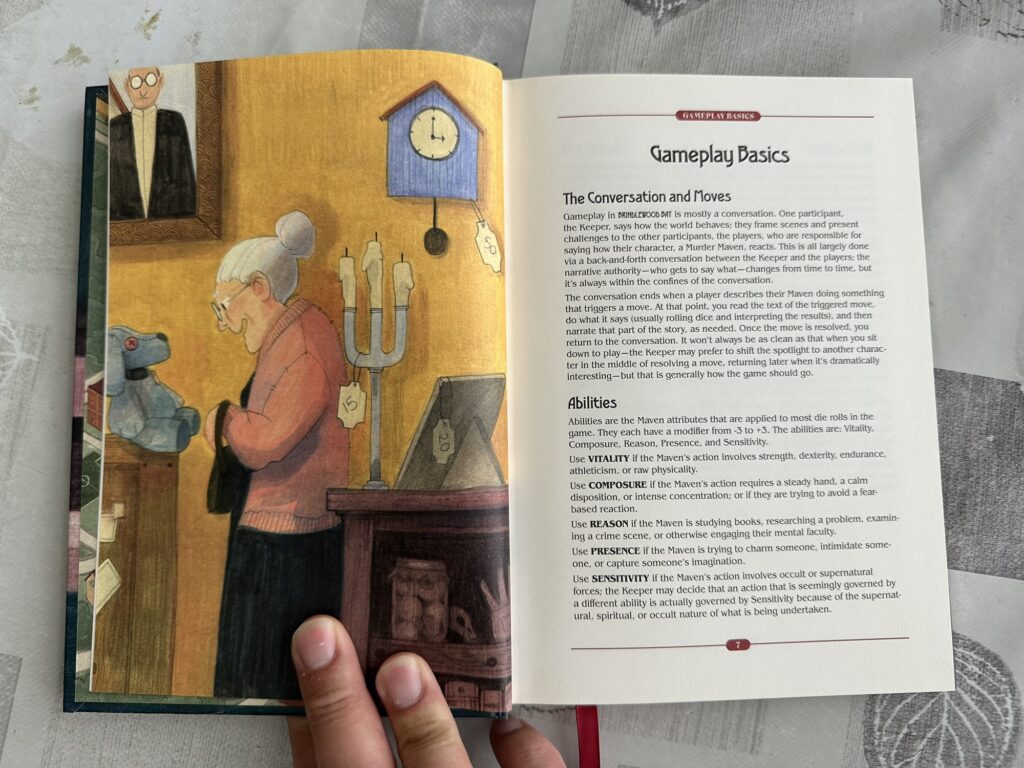
The Meddling Move is “when you search for a clue, conduct research, or otherwise gather information”. That’s the move players do all the time. Interrogating someone, searching a room, going through papers, eavesdropping, etc… these are all a Meddling Move: roll 2D6 plus an appropriate ability modifier for the situation. On a 7+ you get a clue, albeit maybe with a complication unless you got 10 or more.
This was another issue with my group. If you do something by night but it’s for finding a clue, then it’s a Meddling Move, right? So while shadowing a suspect by night should be a Night Move because it’s a scary thing to do, in practice it’s a Meddling Move because you want to get a clue. This is another problem I have with PbtA games: the move you choose is often based on what you want to achieve, and not how you achieve it (as it is with a skill-based system). Should I have asked for a Night Move first to shadow the suspect, and then a Meddling Move to get some clue, like overhearing a conversation or noticing something the suspect dropped? Maybe? But that’s two rolls, whereas a skill-based system would do this in one roll… Maybe I’m interpreting this all wrong? Yet another PbtA game problem: a lot more of the rules are up to interpretation. The gamemaster advice once again gives some hints, such as how the Day and Night Moves are often “passively triggered”, when a Maven is “facing something they fear”. So it does seem like I should ask for 2 different moves in this situation? Either way, that’s the third reason we didn’t use the Night Move very much in the end.
Here’s another tweak I would probably implement: just get rid of the Night Move, and rename the Day Move to Risky Move. Say it’s the move you use when a character faces a risky situation. And then, have a general rule stating that doing things by night or in spooky locations are riskier than doing things by day. All moves get riskier by night. There. Much simpler in my opinion.
Remembering Amanda Delacourt
The non-basic moves are generally where PbtA games get interesting. For instance, we loved the “Gold Crown Mysteries Move”, which is a good example of where PbtA-style abilities shine.
The “Gold Crown Mysteries” are the series of mystery books that the Murder Mavens love to read and re-read for their book club. All the player characters are fans of the series’ amateur sleuth protagonist Amanda Delacourt. You can use the “Gold Crown Mysteries Move” only once per mystery, but it lets you snap your fingers, say “oh ladies, this reminds me of that time Amanda was faced with a similar thorny problem, in book 12, ‘The Dog That Barked At Death’, and if I’m not mistaken, this is what she did…”. You describe a totally fictional book and situation from the Delacourt adventures, and then you either get to roll against 12+ (pretty much a guaranteed success) to get over the current obstacle, or you get temporary narrative control to introduce elements in the scene. This is fun! We get to build the mythology of the Gold Crown Mysteries books as we go! And that later feeds into some amusing role-playing!
Another fun one is the “Cut To Commercial!” move. Just before someone makes a particularly dramatic roll, the gamemaster can, well, cut to commercial! Just like it happened in all those TV shows that the game takes inspiration from! The player gets a prompt for a commercial, such as “Mike ‘The Gorilla’ Murphy, Attorney at Law!” or “Le Guillotine kitchen gadget!” (there’s a list in the rulebook). The player needs to narrate a cheesy 80’s TV commercial for it. In exchange, the roll automatically succeeds. That move is great fun… at least the first couple times. After that it started feeling cheap and stale so I recommend either using it once every few scenarios, or just a couple times in total, depending on the reception at your table. Your mileage may vary.
Some other moves fell pretty flat with my group, however. For instance, there’s a thing called “Putting on a Crown”, which the player characters can do when bad things happen to them. This allows bumping a roll up by one level. In exchange, you have to narrate a flashback or slice-of-life vignette that fleshes out your character’s background. It’s pretty straightforward but, first, I didn’t really understand why it was called “Putting on a Crown” (apart from some contrived reference to the Amanda Delacourt books), and, second, since we didn’t use the Night Move much, the complications weren’t too horrible or numerous anyway. Allowing to Put on a Crown felt like it made the game too easy, so we dropped it after a few adventures. Your mileage will vary. If we played again, I think we would keep the Crowns, at least until we had time to see if the other tweaks I’ve mentioned made the game a bit harder.
My Moves Are My Favourite TV Series
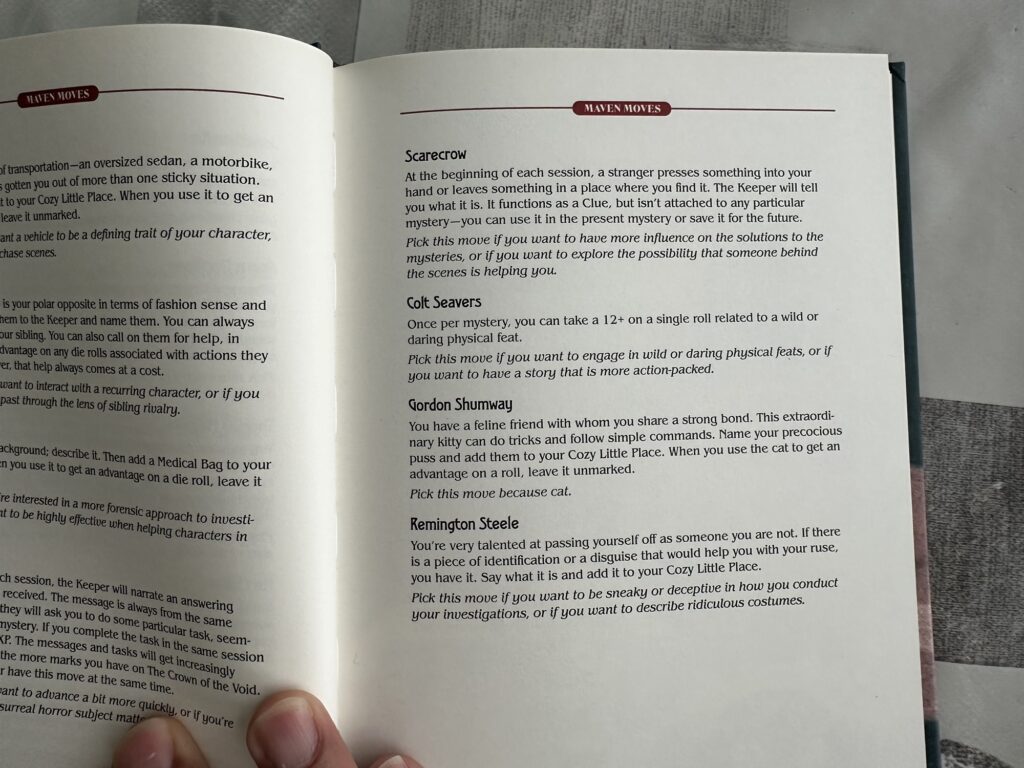
The “Maven Moves” are the special moves that are really the only true differentiator between characters. They’re all named after some famous TV series characters like Frank Columbo, Fox Mulder, Jonathan Hart, Angus MacGyver, and more. For a game with all female player characters, it’s weird that these moves are only named after the male characters: there are no Scully, Mrs. King, or Jennifer Hart moves for instance. I’ve read somewhere that the author was making some sort of feminist statement with this but… meh. I’m not sure it worked out. And it’s doubly ironic, given the premise of the show, when Remington Steele has a move, but not Laura Holt!
Anyway, these moves add some cool flavour and abilities. For instance, the Frank Columbo move lets you get an extra clue in scenes where you are investigating the high society. The Jonathan Hart move gives you +1 to Presence from being a former jet-setter and globetrotter. The Remington Steele move always gives you access to some disguise or piece of ID that helps you pass as someone else. The B. A. Baracus move lets you avoid physical harm once per mystery. You get the idea. It’s good stuff!
The Midwives of the Fragrant Void
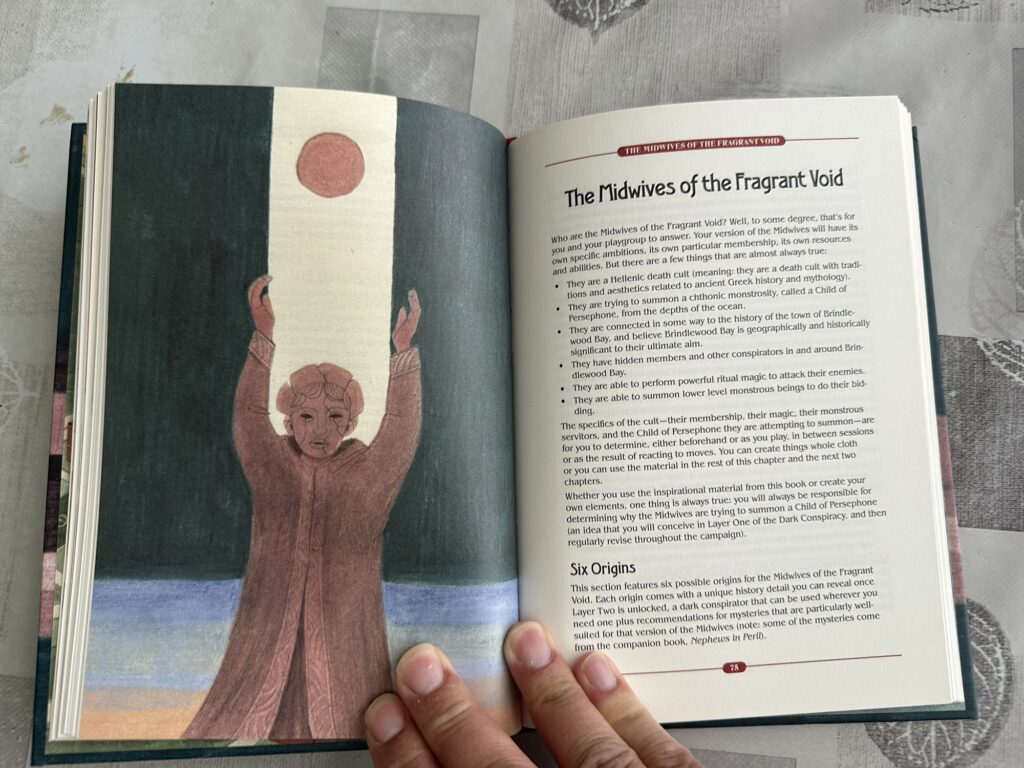
After a couple mysteries, I started following the rulebook’s instructions to introduce the “Midwives of the Fragrant Void”. This is an undefined faction that wants to bring forth some sort of cosmic horror into our world. The rulebook gives six different possible conspiracies, ranging from a cult of mad academics to a group of aging hippies, or some tech-bros in service of an AI god they don’t understand. The gamemaster gets to pick or invent who these bad guys are.
The instructions to slowly introduce the Fragrant Void into the campaign are pretty well done. Basically you start with some basic scenarios with no cosmic horror element, and then you start dropping a clue or two, and then you start getting mysteries that tie into what the Midwives are doing. It’s common sense, and easy to follow and implement. Again, the gamemaster advice in Brindlewood Bay is generally pretty solid and you shouldn’t skip on it.
The problem is that my players ended up not being interested! They just had fun playing old ladies solving crimes, and we didn’t feel like adding Cthulhu in the mix would actually improve things. So we kept it in the background and never brought it forth. Maybe it’s something for a season 2…
Theorizing on the Theorize
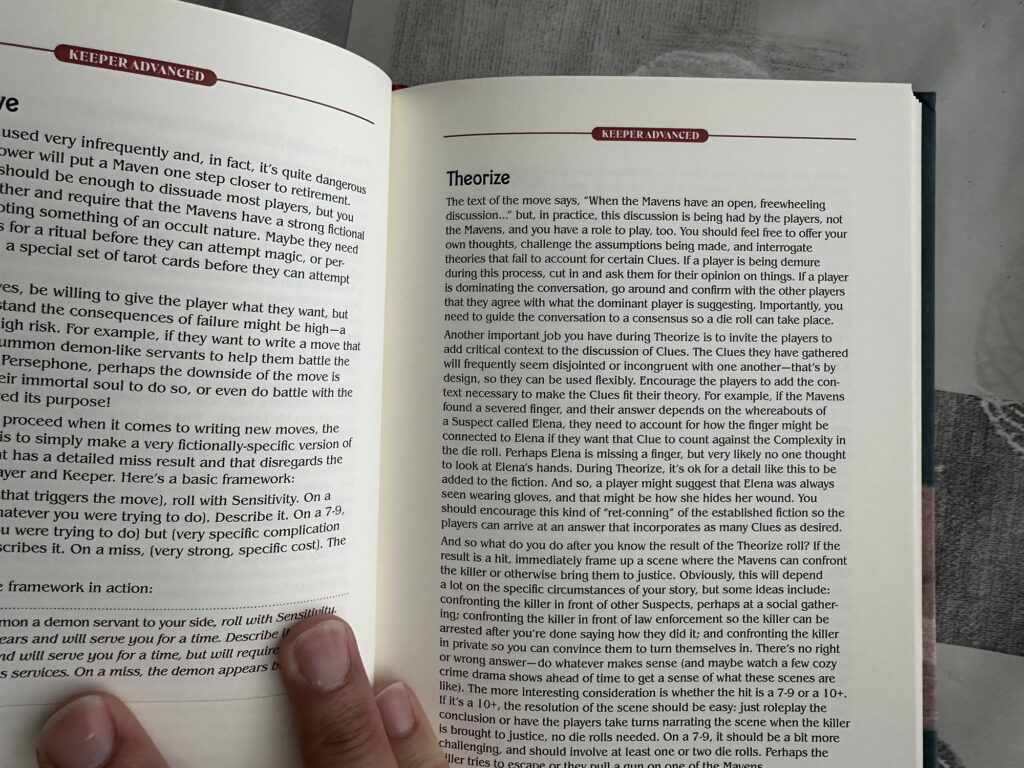
Okay so now let’s talk about that “new take on investigation games”, also known as the Theorize Move.
Here’s how it works. The players go about the investigation and find clues using the Meddling Move. They follow up on those clues, find more clues, get into trouble, do shenanigans, etc. The usual stuff. Eventually, they are ready to “solve the case”. This only happens when they have gathered at least as many clues as half the mystery’s Complexity (each scenario has a Complexity rating, generally between 6 and 8). Then, players may trigger the Theorize Move.
Narratively speaking, the Mavens discuss their investigation and come to a conclusion as to what’s really going on. Then, maybe they confront the main suspect directly, like Columbo does. Or maybe they gather all the NPCs for a big speech, like Hercule Poirot. It’s up to you. Either way, the players must make the usual 2D6 roll. But instead of adding an ability, they add the number of clues that they incorporated into their “solution”.
As always, 7+ is a partial success, meaning that the solution is mostly correct but not quite, or there’s some complication such as the culprit suddenly fleeing or taking someone hostage. On a 10+ the solution is correct and the culprit is taken down!
On a failure, well… that’s one of the very few times the gamemaster advice wasn’t very good in my opinion. Technically, the solution is supposed to be incorrect, and the gamemaster is supposed to “react”. The book provides example reactions such as the (wrongly) accused suspect being murdered by the true culprit, or the Mavens being attacked in some way. To me that makes no sense: why would the culprit mess things up when the Mavens are keeping the investigation away from them?
If I played Brindlewood Bay again and kept the Theorize Move, I would interpret the results a bit differently. The 10+ and 7+ results would broadly stay the same, but a failed roll would be about “escalation”. While a 7+ roll can lead to escalation if the culprit takes someone hostage or something, it should all be resolved in a roll or two, within the same scene. I would interpret a failed roll as enough escalation for a whole final act, such as a chase, a revelation that the culprit had an accomplice that must now be caught, or whatever. Basically, interpret 7+ as “yes, and…”, and failures as “yes, but…”.
The Disconnect
But I would not keep the Theorize Move. We did not like it at all.
After our short campaign, I asked the players about their opinions on the game, and they unanimously agreed on this. The word “disconnect” was mentioned quite a few times. One player said that it felt like “invalidating everything we did during the investigation”, to which everybody else nodded.
The root of the problem, I think, is that it doesn’t matter what clues you get. You can go around town rolling for the Meddling Move a dozen times in random locations with random NPCs, pick the 4 most promising clues of the lot, weave some half-assed solution from them, and “solve the case”. Don’t mind the other 8 clues, they’re just unrelated, it turns out. The system is incredibly easy to abuse.
Of course, nobody in their right mind would play Brindlewood Bay like this. If they do, they deserve to be kicked out of the table…. but that’s the problem: people will play the game “the correct way”. They will look for the clues where it makes sense to look for them, they will think about what they mean, use their reasoning to find the next clue, follow leads and theories, and so on… but Brindlewood Bay, as a system, does. not. care.
The gamemaster is supposed to give clues semi-randomly, either by inventing them or picking them from a list of clues included in each mystery. The gamemaster doesn’t “know” the solution to the case because there is no solution. So these clues don’t actually mean much. The players pour intellectual and emotional effort into the investigation, and in exchange for that they’re given random narrative junk. The game answers this effort on the players part with a big shrug. “You didn’t really have to do that”.
That’s where the disconnect comes from, I think. That’s why my players felt that the Theorize Move “invalidated” everything they did.
This was such a giant disappointment for me. Everybody was raving about Brindlewood Bay, so I was excited! And at first I thought we were doing it wrong, or that maybe it would grow on me… but no. We didn’t like it.
I think that if we play Brindlewood Bay again, I would run the mysteries in a more “classic” way. That is: I would prepare one or two “canonical solutions” to each case, and then hand out clues according to that. Clues that make sense. Clues that honour and respect the players’ time and efforts, and let them actually solve a case… which leads us to my next point.
Mystery Solving vs Mystery Creation
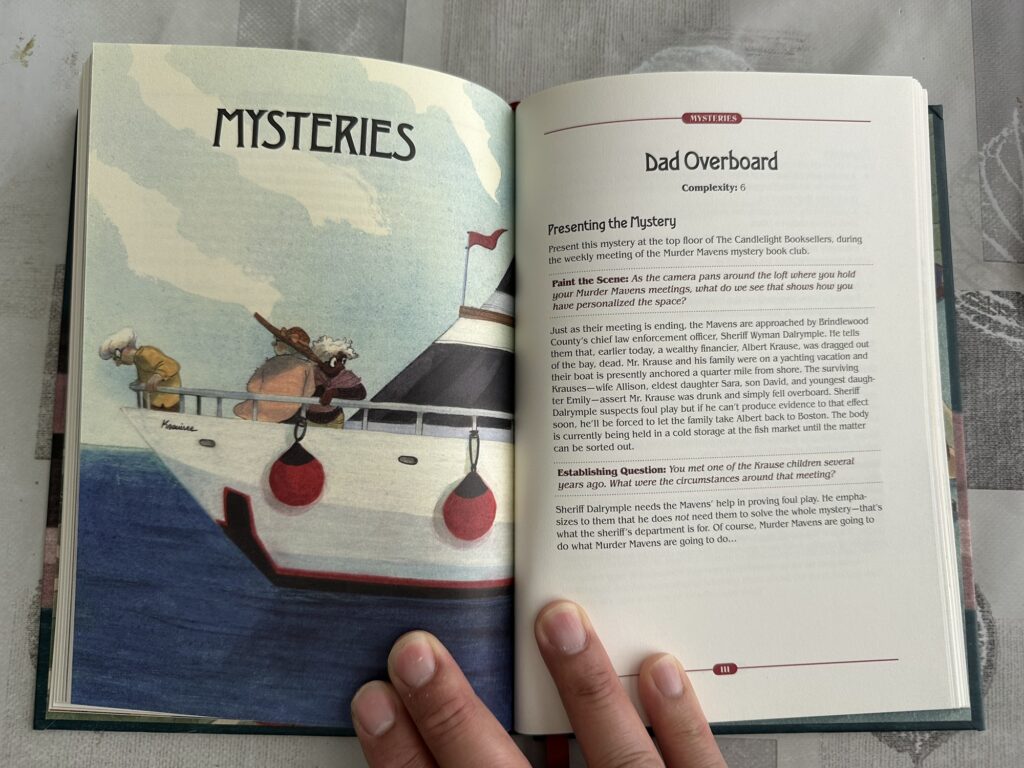
I think another big part of my disappointment was a mismatch in expectations. I thought (obviously mistakenly) that Brindlewood Bay was mystery-solving game. But it’s not. It’s a mystery-creation game.
To be fair, the game doesn’t quite describe itself as a mystery-solving game. At best it describes itself as an investigation game, or it says that it’s a game in which you play old ladies that solve mysteries… which, I guess, is technically correct. Although incredibly misleading. The players don’t solve any mystery. They create a mystery. Or, I guess, they create a mystery-solving story. That’s a big difference. It’s a fact that should be written on bold letters in any description of the game.
I think that if you want to get into Brindlewood Bay, you need to be acutely aware of this fact, and you need to make it plainly clear to your players during Session Zero. As a mystery-creation game, Brindlewood Bay is, I suppose, pretty good? It must be, given how many people love it!
You Don’t Have to Swing A Sword
Judging from a few interviews I’ve read or listened to with the author, Jason Cordova, it seems that the design goal of this game was to provide players with the experience of solving a mystery, but without having to actually solve a mystery. That’s a fine goal! You do you. We prefer to do the thing itself, but if it scratches someone’s itch, then that’s great, there’s no wrong way to have fun at the table.
But here’s the argument I’ve seen repeated online a few times: when you play through a D&D combat, you don’t actually have to swing a sword and jump around, so why should you have to actually solve a murder?
Let me take a bit of time here to address this (it’s my blog after all!)… I think it’s an incredibly flawed argument. Sure you don’t swing a sword in combat (you just roll for that), but you don’t go and perform autopsies either in an investigative game (you just roll for that), and you don’t have to decipher the gamemaster’s facial expressions to detect if an NPC is lying (you just roll for that), and you don’t go canvas a park trying to find a footprint or a bullet casing (you just roll for that).
What you do is choose what actions and rolls to make, and what to do with the results. In a combat, you don’t need to physically swing a sword, but you still need to decide whether to use the sword or the bow, use a spell or consume a potion, focus everybody’s attacks on one monster or spread out and flank the NPCs, and so many other decisions.
If anything, someone may come up and say that they want the experience of a dramatic fantasy combat, but without the tedious tactical aspects because, well, they’re not a tactician. But their character is. So why should they do all this themselves? I suppose we could design some moves for the player to use: Switch Weapon, Flank, Everyone On Me!, This Looks Like That Time King Grievus Beat The Odds, and so on. Just pick the moves that sound cool to you every round, it doesn’t really matter, and make a roll to see which ones succeed. After 10 minutes of play, tally up the successes, add 2D6, and see if you beat the encounter’s Danger Rating. On a success, you win! On a partial success, you win but lose 1D6 HP. On a failure, lose 2D6 HP and retreat. Yay! Do you feel like you’re a bad-ass warrior yet?
Okay, okay, I’m getting a bit heated here, but that argument really irritates me. But I’m good now. Writing three paragraphs about it was cathartic, and that’s why having a blog is great, even if nobody reads it. You should try.
Some Better Implementations
I did some research after our little campaign ended and realized that while Brindlewood Bay popularized this sort of collective mystery/solution building, a couple of older and more obscure games introduced these sort of mechanics. I was curious, so I dug into it.
One that often gets mentioned is InSpectres (also available here), which is a riff on Ghostbusters and other supernatural-hunting stories. As far as I can tell, the implementation of those mechanics is much more to my liking here!
To keep it short, an InSpectres game is organized as follows:
- You “get the call” about something supernatural causing trouble somewhere.
- You “investigate” the problem and identify what’s the cause.
- You “suit up” and do “fieldwork”, effectively going on location to deal with the vampires or ghosts or whatever.
- Some other stuff like cleaning up and experience.
The gamemaster does not know what the “problem” actually is. In step 2, the players make some rolls and theorize about it, and maybe they decide that the clues point at it being a werewolf or a giant underground worm! Who knows! But once they’ve “figured it out” (that is, once they’ve made it up), then they suit up and go deal with it.
Mind you, that’s something every Call of Cthulhu Keeper has probably done once or twice in their career, even in the 80’s or 90’s. It’s rare but not unheard of that you prepare a scenario that pits the PCs against some Chthonians or whatever, but as the players chat about the first clues, one of them goes “well it could also be ghouls but I hope not because those fuckers are really scary”, and boom!, here you go striking out half of your notes and replacing it all by “GHOUULS” written in big letters across your notebook.
And by the way this is yet another thing I don’t like with PbtA games: they tend to formalize into strict rules what used to be happy organic accidents and gamemaster advice. Talk about losing the magic…
Anyway, InSpectres sounds fun! And it sounds fun because it’s a game about busting some ghosts, and you still get to do that. The “narrative control” mechanic does not get in the way of the core activity: the players define what the monsters are, but they still get to, you know, go and bust them (although it arguably robs them of the story twist of being wrong, and then faced with something for which they are not equipped… maybe there’s a side note for that in InSpectres though, I have only skimmed it… and if not I’ll add some house rule!)
Contrast this with Brindlewood Bay where the “narrative control” mechanic effectively invalidates (to use my players’ words) the core activity of being old ladies solving mysteries.

Outro
In the end, Brindlewood Bay is a game my group would probably like a lot if we tweaked it as mentioned so far in this lengthy article. To recap: allow for more variation in the Mavens’ ability scores, remove the Night Move, and run it as a more “classic” mystery game with no Theorize Move. Maybe keep ignoring the cosmic horror stuff, too. The rest is great! The premise is great, most of the Maven Moves are fun, and the scenarios offer a great starting point even if I need to work a bit to make a proper “solution”. My players still mention this game occasionally as a possible “interlude one-shot” between other games, so this may very well happen!
I’m also very interested in running Rosewood Abbey at some point, very probably with similar tweaks. This is a game inspired by The Name of Rose, Cadfael, and other stories of medieval monks investigating murders. I’m sure Kalum, the game’s author, would be horrified at the idea of playing it without the Theorize Move, so let’s make sure nobody tells him, OK?
In fact I’ve heard people say that playing a Brindlewood Bay game without the Theorize Move entirely defeats the purpose of the game… which I agree with, since my point is indeed to totally change the purpose of the game! I want a mystery-solving game!
Anyway, Brindlewood Bay is worth checking out depending on what you’re looking for, and depending on the house rules and tweaks you’re ready to implement. It’s available on the Gauntlet website and many other places. Jason Cordova has also created a couple other games using the same system, each with their own cool premise: The Between, for Victorian-era monster hunting (but I’ve got Vaesen for that, thank you very much), and Public Access, a game of “nostalgic analog horror” that seems inspired by stuff like the V/H/S film series and the creepypasta internet culture.
In the meantime, I think I’ll try and convince my players to play some InSpectres as our next interlude! Or maybe go back to the original, Ghostbusters, whose legendary designers pioneered a couple of key mechanics and concepts back in 1986! You wouldn’t have Blades in the Dark without Ghostbusters…
That’s it for now! That article was way longer and harder to write than I thought, but I hope it’s useful to someone out there. Have fun!